

Sapphire FUE Hair Transplant: What the Blade Actually Does and What Only the Surgeon Can
Introduction: The Question Behind the Search
If you have arrived at the term “sapphire FUE,” you have already moved past the introductory phase of hair restoration research. You understand what follicular unit extraction is. You are no longer asking whether a transplant works. You are now evaluating a specific instrument-based refinement and weighing whether it justifies your attention and your investment. That is a sign of sophisticated due diligence, and it deserves a sophisticated answer.
Here is the central tension. Over the past several years, “sapphire FUE” has migrated from specialist forums into mainstream patient awareness, propelled largely by international clinic marketing. Reddit’s r/HairTransplants community alone counts more than 330,000 members, and the phrase now circulates freely among prospective patients. The result is a landscape where people arrive at consultations armed with precise terminology but incomplete clinical context.
This article states its thesis plainly and up front: sapphire blades represent a genuine, evidence-backed refinement in one specific phase of the FUE procedure. But blade material accounts for roughly 10 to 15 percent of outcome variance. The surgeon accounts for the rest.
What follows will do three things most content on this subject does not. It will locate precisely where sapphire blades apply. It will quantify their advantages using peer-reviewed evidence, neither overstated nor dismissed. And it will make the case that no instrument can substitute for the judgment, artistry, and experience of the surgeon holding it. The surgical team at Hair Doctor NYC brings 18 to 25-plus years of specialized experience to that argument, which is the one variable a sapphire blade alone cannot replicate.
First, a Precision Point Most Clinics Skip: Where Sapphire Blades Actually Apply
Follicular unit extraction is a two-phase procedure, and understanding the distinction between those phases is the single most important clinical fact most competitor content omits.
Phase 1 is extraction. The surgeon uses a punch tool to remove follicular units from the donor area, typically the back and sides of the scalp. Phase 2 is recipient site creation. The surgeon uses a blade to make micro-channels in the balding or thinning area, and each harvested graft is placed into one of those channels.
Sapphire blades apply exclusively to Phase 2. The extraction phase is identical in both standard FUE and sapphire FUE. The punch tool used to harvest grafts does not change. Any content that implies “sapphire FUE” transforms the entire procedure is conflating two distinct steps, and that is a fundamental accuracy gap worth catching early.
Recipient site creation is where artistry lives. The surgeon creates hundreds or thousands of precisely angled micro-incisions, and the angle, depth, and direction of each channel directly determines whether the final result looks natural or artificial. This is the phase sapphire blades were designed to refine.
The core difference is geometric. Traditional steel blades create wider, U-shaped, chisel-tipped cuts. Sapphire blades create V-shaped, pointed-tip micro-incisions that cause less lateral tissue displacement and more closely match the natural cross-section of a hair follicle.
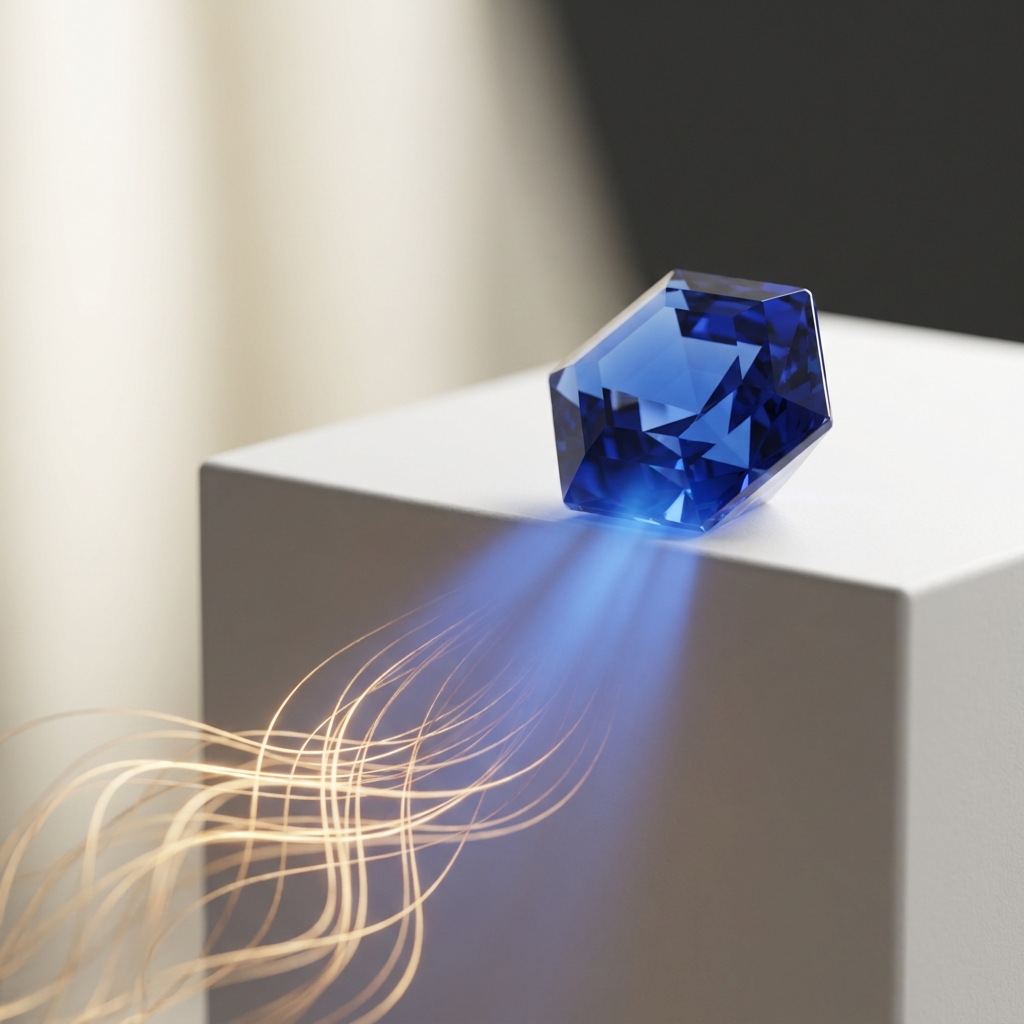
The material itself is medical-grade synthetic corundum (Al₂O₃), the same crystalline compound as natural sapphire but lab-engineered for surgical use rather than mined as a gemstone. It rates 9 on the Mohs hardness scale, compared with surgical steel at roughly 5.5 to 6.5.
One regulatory clarification almost entirely absent from competitor content: the FDA does not classify sapphire and steel surgical blades differently for hair transplant purposes. “Sapphire FUE” is a technique descriptor, not an FDA-approved designation. Understanding that distinction protects a patient from marketing that implies otherwise.
What the Evidence Actually Shows: The Genuine Advantages of Sapphire Blades
There is real peer-reviewed evidence supporting sapphire blade advantages, and it deserves accurate presentation.
It also deserves an honest limitation stated up front: randomized controlled trial data specifically isolating blade material as the sole independent variable remains limited as of 2026. Most studies involve confounding variables, including surgeon skill, clinic setting, and patient characteristics, which makes it difficult to attribute outcomes to blade material alone. That transparency is not a weakness of the case for sapphire. It is what makes the case credible.
Precision at the Incision Level
Sapphire blades achieve cutting precision of approximately 0.25mm, versus 0.8mm for traditional steel blades, according to Zhang et al. (2021). That difference enables sub-millimeter control over incision depth, angle, and direction.
This matters most in the hairline zone, where even minor angular deviations produce an unnatural appearance that is difficult to correct. Sapphire blades allow surgeons to create channels at precise angles, typically 40 to 45 degrees, matching the patient’s natural hair growth direction. The V-shaped incision geometry also better matches the natural cross-section of a follicle, reducing mechanical stress on the graft during placement.
Tissue Trauma and Healing
A 2021 peer-reviewed study on recipient site creation micro-blades found that 30-degree sapphire blades caused the least tissue injury of all blade types tested, while rectangular steel blades caused the most. Histopathological analysis confirmed the finding, and patients in the sapphire group healed up to 25 percent faster, a clinically meaningful difference for anyone who cannot afford extended recovery.
Sapphire also possesses anti-bacterial and anti-static surface properties, theorized to reduce post-operative infection risk and minimize tissue vibration during incision, though this remains an area of ongoing study.
Follicular Survival Rates
A large-scale prospective observational study of 1,000 patients conducted from January 2024 through March 2025 found the sapphire group achieved a 94.7 percent graft survival rate versus 88.9 percent for the steel group. In accredited clinical settings with skilled surgeons, sapphire FUE graft survival ranges from 90 to 95 percent, compared with 88 to 92 percent for standard steel-blade FUE: a genuine but incremental improvement.
One protocol note rarely discussed elsewhere: sapphire blades are used once per procedure or replaced frequently within a procedure due to micro-chipping risk. This adds to the overall procedure complexity but eliminates the cross-contamination concerns associated with re-sterilized steel instruments, a genuine infection-control advantage.
The Central Thesis: Blade Material Is Approximately 10 to 15 Percent of the Outcome
Here is the argument stated directly. The evidence supports sapphire blades as a real refinement, but a refinement that accounts for roughly 10 to 15 percent of outcome variance. Surgeon skill, artistic judgment, hairline design, and graft handling account for the rest.
The counterintuitive reality: sapphire blades require more surgical skill to use effectively, not less. They are more fragile than steel, more expensive, and carry specific risks, including failure to achieve appropriate slit depth and damage to existing follicles from incorrect angles, that steel blades do not present in the same way.
The logical implication follows cleanly. A skilled surgeon with steel blades will outperform an unskilled surgeon with sapphire blades. The blade is a multiplier of surgeon skill; it amplifies what is already there. It cannot manufacture precision the surgeon does not possess.
For lower-density sessions, under approximately 1,500 grafts at moderate density, a skilled surgeon with fresh steel blades produces outcomes not meaningfully distinguishable from sapphire FUE. That honest calibration is missing from most content on the subject.
The stakes become vivid in the industry data. According to the ISHRS 2025 Practice Census, repair cases due to black-market or unqualified-technician hair transplants rose to 10 percent of all cases in 2024, up from 6 percent in 2021: a 67 percent increase. Fully 59.4 percent of ISHRS member surgeons reported unqualified-technician clinics operating in their cities. None of those repair cases are the result of blade selection. They are the result of who is holding the blade.
The survival gap tells the same story. Experienced surgeons achieve graft survival rates of 95 to 97 percent. In technician-run or high-volume chain settings, survival can fall as low as 75 percent, a gap no blade material can close.
When Sapphire FUE Is Most Clinically Relevant: A Four-Variable Framework
Sapphire FUE is not universally indicated. Understanding when it offers the greatest marginal benefit helps a patient ask sharper questions during consultation. There are four scenarios where its advantages are most clinically meaningful.
High-Density Packing
When the surgical plan calls for exceeding 50 to 60 grafts per square centimeter, the precision of sapphire incisions becomes more consequential. Tighter packing leaves less margin for incision width error, and the V-shaped geometry reduces lateral tissue displacement that could compromise adjacent grafts. The 2024 to 2025 prospective study found two-day full-head operations with sapphire blades yielded density of 43.2 grafts per cm² with high patient satisfaction, supporting sapphire’s role in high-density planning. Patients researching this topic may also find it useful to review hair transplant density calculations to understand how graft counts translate to coverage.
Fine or Thin Hair Texture
Narrower sapphire incisions better match the smaller follicle diameter of fine hair, reducing mechanical stress during placement and minimizing the risk of a graft sitting loosely in an oversized channel. This is especially relevant for patients in earlier stages of hair loss whose remaining hair is fine, a common presentation in men aged 25 to 40.
Hairline Zone Reconstruction
The hairline is the most scrutinized zone of any result. Minor angular deviations here create an unnatural appearance that is difficult to correct. Sapphire’s sub-millimeter angular precision is most valuable in this zone, but only when the surgeon designing the hairline possesses the artistic judgment to determine the correct angles, density gradients, and follicular unit distribution in the first place. The blade executes the design. It does not create it.
Sensitive or Reactive Scalp Skin
For patients with sensitive scalp skin, a history of slow healing, or conditions that raise post-operative inflammation risk, the 25 percent faster healing documented with sapphire blades and the reduced tissue injury profile represent a meaningful advantage. The anti-bacterial surface properties may offer additional benefit in this population, though that remains under investigation.
What Sapphire Blades Cannot Do: The Irreplaceable Variables
Even in the four scenarios where sapphire FUE is most indicated, the blade’s contribution is bounded by what the surgeon brings.
Artistic hairline design. A natural hairline is not a straight line. It is an irregular, asymmetric zone with varying follicular unit sizes, density gradients, and directional shifts, individually designed for each patient’s facial structure, age, and long-term hair loss trajectory. No blade determines this. The surgeon does.
Graft handling and survival. The interval between extraction and implantation is a critical survival window. How grafts are stored, handled, placed, and how quickly, directly affects survival rates. This is entirely a function of surgical team skill and protocol.
Donor area judgment. Determining how many grafts can be safely extracted without depleting the donor reserve, and preserving that reserve for potential future procedures, requires longitudinal clinical judgment developed over decades. Understanding why the donor area is so important is essential context for any patient evaluating a transplant plan.
Long-term planning. A patient at 30 with early-stage loss has a different 20-year trajectory than a patient at 50. The surgeon must design today’s result to remain natural as hair loss progresses. That cannot be instrumented.
This is precisely where the surgical team at Hair Doctor NYC provides the variable blade selection cannot replicate. Dr. Roy B. Stoller brings 25-plus years in facial plastic surgery and more than 6,000 successful procedures. Dr. Christopher Pawlinga has spent 18 years dedicated exclusively to hair transplantation. Dr. Louis Mariotti contributes a specialized focus on surgical detail and facial harmony. That depth of experience is the substance behind every incision, regardless of the blade.
The Honest Counterpoint: What Sapphire Marketing Often Obscures
Sapphire FUE emerged as a premium differentiator in an intensely competitive international market. Turkey alone performs an estimated 60 to 70 percent of global hair transplant volume, with Istanbul home to more than 500 clinics competing for international patients. In that environment, equipment marketing fills the space surgeon credentials cannot easily occupy.
The consequence is an inversion of the correct priority order. Patients arrive at consultations having researched “sapphire FUE” exhaustively while having spent little time evaluating the credentials of the surgeon who will actually perform the procedure.
There is also a fragility disclosure the marketing omits. Sapphire blades must be replaced frequently within a procedure due to micro-chipping. A micro-chipped blade creates irregular incisions, the exact opposite of the precision being advertised. Managing that risk is itself a surgical skill.
The technology is already advancing. CVD lab-grown diamond blades entered clinical FUE practice in 2026, with independent testing showing 15 times greater edge durability than sapphire and twice the initial cutting sharpness within the first 1,000 incisions. Sapphire itself may soon be superseded, which only reinforces the point: the instrument is always secondary to the surgeon using it.
The right question to ask any clinic is therefore not “do you use sapphire blades?” It is: who performs the procedure, what are their specific credentials in hair restoration, how many procedures have they performed, and will they be present for the entire operation? Reviewing FUE hair restoration advantages and disadvantages provides useful grounding before any consultation.
The Hair Doctor NYC Approach: Sapphire Blades as One Tool Among Many
Hair Doctor NYC does not market equipment. It offers the clinical fluency to explain why its surgeons’ experience is the irreplaceable variable.
Sapphire blades are employed when the clinical case warrants them, specifically in high-density sessions, hairline zone reconstruction, fine hair cases, and sensitive scalp presentations, rather than as a universal marketing claim. The surgical philosophy is consistent: the instrument serves the surgeon’s judgment, not the reverse. Hairline design, donor area planning, and long-term trajectory assessment precede any instrument selection.
The practice operates from a state-of-the-art clinical environment on Madison Avenue in Midtown Manhattan, not a volume-driven chain model. Each procedure is approached with individualized planning. The team’s double board certifications in facial plastic surgery inform hairline design in ways that extend well beyond hair restoration training alone, drawing on a deep understanding of facial aesthetics and harmony. Dr. Stoller’s 6,000-plus successful procedures represent a track record built on results, not equipment claims.
Conclusion: The Blade Is the Instrument. The Surgeon Is the Procedure.
Sapphire blades represent a genuine, evidence-backed refinement in recipient site creation. They deliver measurably lower follicular damage rates, faster healing, and sub-millimeter incision precision in the cases where those advantages are most clinically relevant.
That refinement accounts for roughly 10 to 15 percent of outcome variance. The surgeon’s skill, artistic judgment, hairline design, donor area management, and long-term planning account for the rest.
For anyone evaluating a hair transplant practice, the correct sequence is clear. Evaluate the surgeon first: credentials, specialization, volume of procedures, board certifications. Then ask how their instrument selection serves their clinical approach.
The most sophisticated patients are not the ones who ask about sapphire blades. They are the ones who understand why the surgeon holding the blade matters far more than the blade itself.
Schedule a Consultation with Hair Doctor NYC
Prospective patients are invited to bring their questions, including questions about sapphire FUE, to a consultation with the surgical team at Hair Doctor NYC on Madison Avenue in Midtown Manhattan.
This is a clinical conversation, not a sales appointment. With 18 to 25-plus years of specialized experience, the team can assess whether sapphire FUE is indicated for a specific case, design a hairline appropriate to an individual’s facial structure and long-term hair loss trajectory, and provide honest guidance on what to expect. The commitment is to individualized planning over equipment-first marketing.
To schedule a consultation, contact Hair Doctor NYC or visit hairdoctornyc.com.