

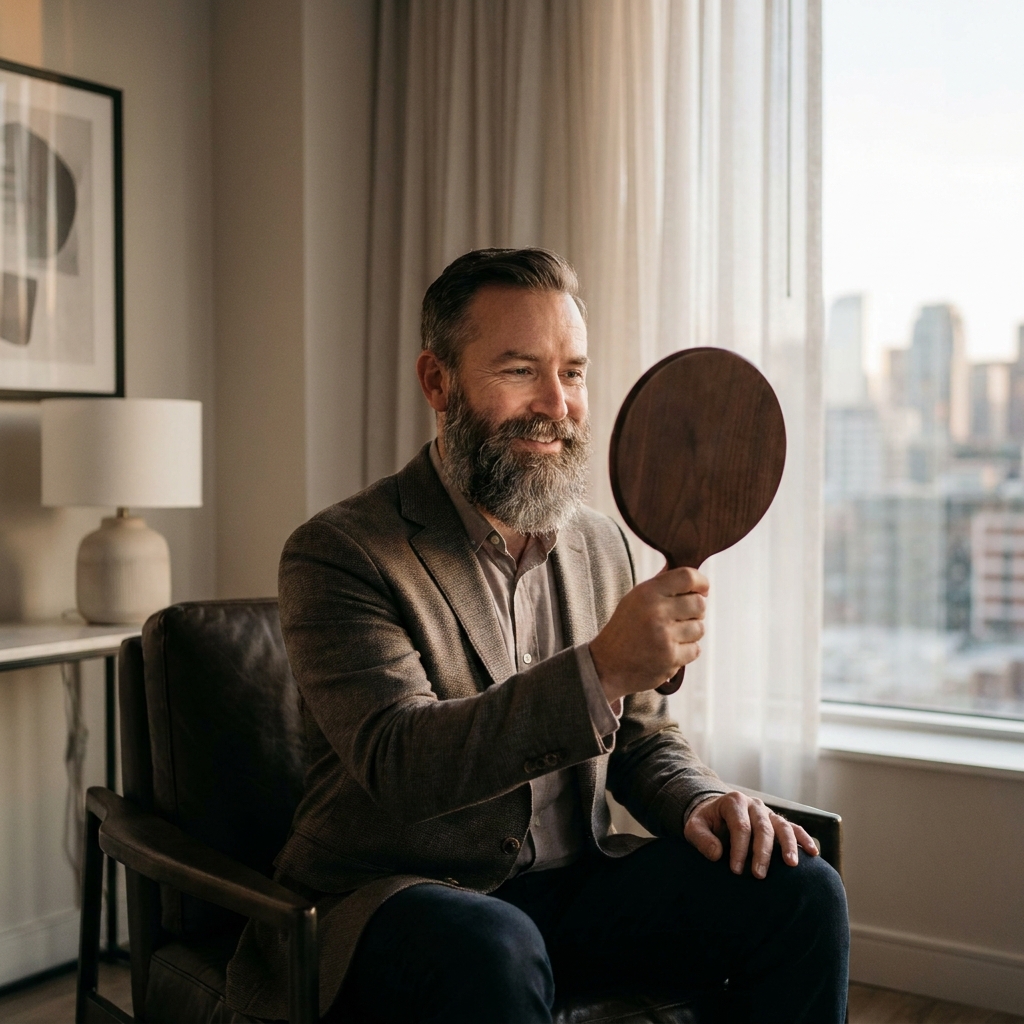
Beard Transplant Before and After: The Density Illusion Explained
Introduction: Why Before-and-After Photos Can Deceive Even Sophisticated Buyers
Most beard transplant “before and after” content treats photographs as self-evident proof. A sparse jawline on the left, a full beard on the right, and the viewer is invited to conclude that more density equals a better outcome. For an elective facial procedure, that assumption is incomplete and often misleading.
The central fact most galleries never explain is this: native beard density typically runs 30 to 50 follicular units per square centimeter (FU/cm²), yet skilled surgeons deliberately target only 25 to 35 FU/cm². They do so because that range is the threshold at which the eye perceives a beard as full. This is the density illusion, and understanding it changes how a discerning patient reads every photo in a surgeon’s portfolio.
This article presents three technical lenses for evaluating results: density calibration, angle and direction fidelity, and single-hair versus multi-hair border placement. It also explains the 9 to 18 month maturation timeline that determines whether an “after” photo means anything at all.
For men accustomed to scrutinizing high-stakes decisions, this is essential due diligence. A beard transplant is an irreversible procedure. Correcting mistakes consumes scarce donor hair and roughly a year of waiting. A surgeon’s portfolio deserves the same rigor a sophisticated investor would apply to any significant commitment.
The Density Illusion: Why More Grafts Isn’t Automatically a Better Result
Clinical data shows that only 40 to 50 percent of native density is needed for a beard to read as “full.” Facial hair is coarser and darker than most scalp hair, and the skin contrast and growth pattern of the beard create visual coverage at lower counts than the scalp requires.
This has direct implications for photo evaluation. A lower graft count placed with precision can visually outperform a denser transplant executed poorly. A patient looking only at fullness may favor the wrong result.
There is also a long-term tradeoff. Beard grafts are typically harvested from the occipital scalp, the same finite donor reserve that may be needed for future scalp restoration. Chasing maximal facial density over-harvests that supply, creating lasting risk with no proportional visual benefit. Once donor follicles are used, they cannot be regenerated.
Density, in other words, is a starting metric, not a verdict. The sections that follow explain what deserves closer attention.
Three Technical Lenses for Evaluating Any Beard Transplant Photo
Passively admiring images rarely reveals much. A disciplined, repeatable method of scrutiny does. The following three lenses can be applied to any portfolio, from any clinic, to separate genuine craftsmanship from flattering presentation.
Lens One: Density Calibration
The first question is not “how dense is it?” but “how is the density distributed?”
- Look for natural gradation. Native beards are not uniformly saturated. Density typically concentrates in the chin, mustache, and lower jaw, then tapers toward the upper cheeks and neckline. A skilled surgeon replicates this variation.
- Treat edge-to-edge uniformity as a red flag. A beard that appears equally dense from cheek line to neck, with no softening, suggests a templated approach rather than an anatomically designed one.
- Question unusual density claims. Photos or marketing that cite graft densities well above the 25 to 35 FU/cm² clinical target should prompt skepticism, either about the accuracy of the claim or the judgment behind the execution.
Lens Two: Angle and Direction Fidelity
Angle is where good transplants and poor ones diverge most clearly. The Brazilian Journal of Plastic Surgery specifies a target slope of approximately 20 degrees for beard grafts. It also notes that existing hairs of at least 1 centimeter in length are crucial for correctly reading and replicating natural direction during implantation.
Incorrect angle placement is the single most frequent cause of unnatural-looking beard transplants. This one variable determines whether transplanted hair lies flat against the skin like natural growth or stands upright with a brush-like, “doll hair” appearance. In a properly performed follicular unit transplant, the results mimic the way hair grows in nature, which is precisely what correct angle placement is meant to achieve.
The mustache zone is the most visually demanding test case, and it is something readers can actually check in photos:
- Hairs above the center of the lip should angle downward and laterally.
- Hairs at the outer edges of the mustache angle more horizontally.
When evaluating a photo set, readers should look for directional consistency across multiple facial zones (jawline, cheek, chin, and mustache) rather than judging overall fullness alone. Because direction changes acutely from one area of the face to another, a technically “successful” transplant with excellent graft survival can still look wrong if the hairs are misdirected.
Lens Three: Single-Hair vs. Multi-Hair Graft Placement at Borders
Follicular units naturally contain one, two, three, or more hairs. The clinical principle is straightforward:
- Single-hair grafts belong along beard borders, creating soft, natural transitions into bare skin.
- Multi-hair grafts build interior density where fullness is expected.
Follicular Unit Extraction (FUE), the dominant technique for beard work and the method used in more than 65 percent of beard procedures, enables this selectivity. Because each follicular unit is extracted individually, the surgeon can choose precisely which graft type goes into each recipient site. Inferior execution cannot replicate this level of control.
For photo evaluation, this means readers should zoom into the perimeter: the cheek line, the neckline, and the edges of the mustache. Hard, mapped-looking edges indicate multi-hair grafts misplaced at the border. That is a definitive tell of poor execution, regardless of how dense the beard looks overall.
Timestamping Results: The Real 9-18 Month Maturation Curve
A photo is only meaningful when its timing is known. Clinical sources converge on a consistent timeline:
| Phase | Approximate Timing |
|---|---|
| Initial healing | 7 to 14 days |
| Shock-loss shedding | Weeks 3 to 4, extending through months 1 to 2 |
| First regrowth | 3 to 4 months |
| Visible density | 6 to 9 months |
| Full maturation | 9 to 18 months |
Cleveland Clinic guidance supports this benchmark, noting that people typically see results from hair transplantation between six and twelve months after surgery, not weeks.
Graft survival provides additional context. With experienced surgeons using advanced FUE techniques, survival rates range from 80 to 95 percent. Peer-reviewed data published in PMC found that beard recipient areas showed the highest early survival rate (95 percent) compared with scalp (89 percent). Donor source matters as well: occipital scalp grafts achieve 90 to 95 percent survival, while body or chest hair grafts drop to roughly 75 percent due to higher transection rates and shorter growth phases.
The “Ugly Phase” Is Proof of Authenticity, Not a Flaw
In the weeks after surgery, patients experience scabbing, redness, and shock loss, during which transplanted hairs shed before the follicles re-enter their growth cycle. For a period, the beard may look sparser than it did before the procedure.
Many marketing galleries omit this stage entirely. That omission is itself a signal worth questioning. A credible before-and-after sequence should acknowledge the temporary regression rather than jump straight from surgery day to a flattering final image.
Transparency about the unattractive middle stages is a marker of a clinic confident enough in its outcomes to show the full process. Patients should view honest documentation of this phase as a reason for trust, not concern.
Why Too-Early “After” Photos Are a Red Flag
Any “after” photo taken before nine months cannot represent a mature, final result. Density is still building, and hair direction is still resolving as new growth thickens and settles.
Readers should check every photo for a timestamp, caption, or stated post-operative interval. The absence of this information should raise suspicion.
The incentive problem is real. Early photos, particularly those taken with short stubble, can mask poor angle work that only becomes apparent once hair grows long enough to reveal whether it lies flat or stands upright. A gallery built on early images may be hiding precisely the error that matters most.
Red Flags That Signal Staged or Misleading Marketing
A practical checklist for reviewing any beard transplant portfolio:
- Uniform density across the entire beard, with no natural gradient between zones.
- Hard or mapped perimeter borders at the cheek line, neckline, or mustache edges.
- No donor-area photographs, leaving the harvesting site undocumented.
- Inconsistent lighting or camera angles between “before” and “after” shots.
- Missing post-operative timeframes on “after” images.
- Styled or concealing presentation, such as heavy grooming products or strategic shadows that obscure borders.
The absence of donor-area imagery deserves special attention. It can conceal evidence of over-harvesting, visible thinning, or excessive scarring, all of which affect the patient’s future options for scalp restoration.
Prospective patients should request multiple angles and lighting conditions for each case. A single flattering shot is easy to stage; a complete, consistently lit photo set is far harder to fake.
Why Angle Correction Is the Costliest Mistake to Reverse
Of all possible errors, misdirected grafts are among the most consequential, for two reasons.
First, the timeline. Correcting unnatural hair direction requires waiting a minimum of 10 to 12 months after the original transplant for full healing before corrective work can begin. That is a year spent living with a result the patient is unhappy with, followed by another maturation cycle after the correction.
Second, the donor supply. The corrective procedure consumes additional donor hair, a finite resource that cannot be regenerated. Every graft spent fixing an error is a graft unavailable for future needs.
The strategic conclusion is clear. Surgeon skill on the first attempt matters far more than speed or convenience. For a high-consideration buyer, selecting a beard transplant surgeon is an exercise in risk management, not bargain-hunting.
This is exactly why the photo-evaluation lenses matter. A patient who can identify angle and border errors in a portfolio is protecting himself from a mistake that takes more than a year to correct.
Verifying Surgeon Skill: The Credentials That Actually Matter
Credential confusion is widespread in hair restoration. Any licensed physician can legally perform a hair transplant, regardless of training background. As the International Society of Hair Restoration Surgery (ISHRS) notes, there is currently no American Board of Medical Specialties (ABMS) certification specific to hair restoration, nor an accredited residency or fellowship dedicated to it.
The credential hierarchy looks like this:
- ABMS board certification confirms competence in a general specialty, such as facial plastic surgery or dermatology, but is not hair-restoration-specific.
- ISHRS membership signals professional engagement, not competency. The American Hair Loss Association states plainly that ISHRS membership “does not indicate competence in the field and should not be considered a qualifying credential,” a point echoed in ISHRS’s own guidance on choosing a surgeon.
- ABHRS Diplomate status, conferred by the American Board of Hair Restoration Surgery (founded in 1996), is the specialty-specific gold standard. It is held by fewer than 23 percent of ISHRS members worldwide.
Another critical consideration: the ABHRS and ISHRS classify extraction incisions and recipient site creation as non-delegable acts. These steps must be performed by the licensed physician of record, not by technicians. Prospective patients should ask any clinic directly who performs them.
Facial plastic surgery training is especially relevant to beard work. A technician may achieve adequate graft survival, but a surgeon trained in facial anatomy and aesthetics designs results that read as natural growth. That means accounting for facial symmetry, density gradients across zones, and the acute directional shifts from chin to cheek to lip.
Applying the Framework: What to Ask and Request at Your Consultation
Patients who arrive at a consultation prepared will learn far more. A practical checklist:
Documentation to request
- Full photo sets for each case, with multiple angles and consistent lighting
- Stated post-operative timeframes on every “after” image
- Donor-area images showing the harvest site after healing
Technique questions to ask
- How does the surgeon calibrate graft angle across the jawline, cheek, chin, and mustache?
- How are single-hair grafts selected and placed along beard borders?
- What density target does the surgeon recommend for this patient’s face and donor supply, and why?
Process and experience questions
- Who performs the extraction incisions and creates recipient sites: the physician or support staff?
- How much of the surgeon’s experience involves facial hair specifically, as opposed to primarily scalp work?
That last question matters. The angle and direction demands of beard and mustache zones differ substantially from scalp restoration, and experience in one does not automatically transfer to the other.
Why Hair Doctor NYC Is Built for First-Attempt Precision
Hair Doctor NYC, operating as Stoller Medical Group from its Madison Avenue clinic in Midtown Manhattan, has assembled a team that aligns closely with the verification criteria outlined above.
The practice is led by Dr. Roy B. Stoller, a double board-certified facial plastic surgeon with more than 25 years of experience and over 6,000 successful hair transplant procedures. That volume represents exactly the kind of repeated calibration this article describes: density targeting, angle fidelity near the 20-degree benchmark, and selective single-hair placement at borders.
He is joined by Dr. Louis Mariotti, a double board-certified facial plastic surgeon focused on surgical detail and facial harmony, and Dr. Christopher Pawlinga, who has spent 18 years dedicated exclusively to hair transplantation. Michael Ferranti, P.A., a licensed Scalp Micropigmentation specialist with more than 25 years in aesthetic dermatology and plastic surgery, rounds out the team’s non-surgical capabilities.
This combination of facial plastic surgery training and dedicated hair restoration specialization is a rare pairing, and it is precisely what beard and mustache work demands. The practice performs beard transplants, mustache restoration, sideburn enhancement, jawline transplants, and gender-affirming facial hair procedures using advanced FUE techniques, the method that enables graft-by-graft selectivity at the borders.
Hair Doctor NYC’s emphasis on natural, undetectable results, highly personalized treatment planning, and discretion reflects the standards a discerning patient should expect when making an irreversible decision governed by a finite donor supply.
Conclusion: Evaluate the Craft, Not Just the Density
The density illusion reframes how beard transplant results should be judged. Density is a starting metric, not the deciding factor. Angle fidelity and border graft precision determine whether a result reads as natural or as transplanted.
Readers now have a practical toolkit:
- Lens One: Is density naturally graduated, or uniformly saturated?
- Lens Two: Do hairs follow correct direction in every zone, especially the mustache?
- Lens Three: Are borders soft and single-hair, or hard and mapped?
- Timestamping: Is the “after” photo at least nine months post-procedure, and is the full process documented?
The stakes justify this rigor. With a correction timeline of 10 to 12 months before revision work can even begin, and donor hair that cannot be replaced, getting it right the first time is the only efficient path. An informed patient applying this framework is far better positioned to select a surgeon capable of executing correctly from the outset.
Schedule a Consultation with Hair Doctor NYC
Prospective patients are invited to bring this evaluation framework to a private consultation at Hair Doctor NYC’s Madison Avenue clinic. During the visit, they can review the team’s own photo documentation against these exact standards: density gradation, directional consistency, border refinement, and clearly stated post-operative timelines.
The consultation is also an opportunity to put the credential and technique questions in this article directly to board-certified surgeons, including who performs each surgical step and how angle and border grafts are planned for the individual’s facial anatomy.
For men who want to de-risk an elective, irreversible decision with a team experienced in both facial aesthetics and high-volume hair restoration, the next step is straightforward. Request a private consultation with Hair Doctor NYC through hairdoctornyc.com to begin a personalized facial hair restoration plan built for first-attempt precision.