

Clinic Hair Transplant Vetting: The Physician-Accountability Checklist
Introduction: Why “Choosing a Clinic” Is Really About Choosing a Surgeon
A hair transplant is permanent, visible, and, if poorly executed, largely irreversible. Donor follicles are a finite resource. A hairline placed at the wrong angle or density follows a patient into every meeting, photograph, and social setting for decades. For a discerning patient accustomed to scrutinizing major decisions, this is not a choice where diligence can be cut short.
Yet most guidance on choosing a hair transplant clinic stops at surface-level advice: check the medical license, look for professional society membership, read reviews. These steps confirm that a clinic exists and has a credentialed name attached to it. They do not confirm who actually performs the extraction and implantation of grafts on the day of surgery.
That distinction matters: the International Society of Hair Restoration Surgery (ISHRS) has formally warned about a “bait-and-switch” model, in which a clinic advertises a credentialed physician on its website while an unlicensed technician performs the actual surgery.
This article replaces marketing language such as “expertise,” “artistry,” and “world-class results” with five concrete proof points a patient can verify during consultation:
- ABHRS Diplomate status
- Named-surgeon documentation
- Transection-rate disclosure
- Graft ischemia time
- Reverse-image-verified before/after photos
The scale of the industry makes this framework necessary. According to the ISHRS Practice Census, more than 703,000 hair restoration surgeries were performed globally in 2021, a 250% increase from roughly 279,000 in 2010. Industry estimates now place annual procedures above 735,000. In many markets, that volume has outpaced oversight.
The Core Problem: Why Anyone With a Medical License Can Legally Operate on Your Scalp
The regulatory gap at the center of this issue is not widely understood. There is no ABMS-recognized board certification, accredited residency, or fellowship dedicated specifically to hair restoration surgery.
The implication is significant: a licensed physician from any specialty can legally perform a hair transplant, regardless of actual training or experience in the procedure. A physician whose background lies entirely outside surgical aesthetics faces no legal barrier to opening a hair restoration practice.
This gap enables what the industry calls the “hair mill” or franchise model. High patient volume is the business objective. The named physician provides legal cover and a credential for the website, while technicians perform the technically demanding steps of extraction and implantation.
The consequences are measurable:
- More than 80% of complaints regarding hair transplant complications stem from unlicensed technicians, not licensed physicians, according to an ISHRS study.
- 59% of ISHRS members reported “black market” hair transplant clinics operating in their own cities in the society’s most recent Practice Census (reporting 2024 data), up from 51% in 2021.
This is a growing problem, not a shrinking one. The five checkpoints below are designed to filter it out.
Checkpoint One: ABHRS Diplomate Status, the Only Validated Credential in the Field
The American Board of Hair Restoration Surgery (ABHRS) exists to fill the gap left by the absence of ABMS recognition. Its examination is the only psychometrically and statistically validated exam dedicated specifically to hair restoration surgery.
Scarcity is the point. Only approximately 270 hair restoration surgeons worldwide hold ABHRS Diplomate status. For a patient narrowing a shortlist, that number functions as a meaningful filter.
The pathway is demanding. Candidates must demonstrate either:
- Three years of documented private-practice experience in hair restoration surgery, or
- Completion of a one-year approved fellowship that includes 70 hair restoration cases as an assistant surgeon.
Diplomates cannot test straight out of training. They must demonstrate a safe track record in practice before sitting for the exam.
The terminology nuance most patients miss. Under the ABHRS’s own advertising policy, Diplomates must identify themselves as “ABHRS Diplomate,” not “board certified.” In common usage, “board certified” implies ABMS recognition, which the ABHRS does not hold. If a clinic describes a physician as “board certified in hair restoration,” that phrasing is itself a red flag: either the clinic misunderstands the credential landscape or it is deliberately blurring it.
This is distinct from legitimate board certification in an adjacent ABMS-recognized specialty, such as facial plastic surgery, which reflects verified surgical training but remains a separate credential.
Ongoing accountability. Maintaining Diplomate status requires 100 hours of continuing education every three years, with at least half related to hair restoration. A patient should ask whether a physician’s status is current, not simply whether it was earned at some point.
Checkpoint Two: Named-Surgeon Documentation, Confirming Who Actually Holds the Punch
The ISHRS identifies a core diagnostic: legitimate clinics provide substantial, specific information about the physician performing surgery, including training, case history, and direct involvement in procedures. Clinics relying on unlicensed personnel typically list a doctor in name only, with vague or absent detail about what that doctor actually does.
During consultation, a patient should ask directly:
- “Will you personally perform the extraction and implantation, from start to finish?”
- “Who else will be in the room, and what specifically will each person do?”
- “Which steps, if any, are delegated to technicians?”
ISHRS member physicians sign an oath to do no harm and to personally perform their patients’ surgeries. A patient should ask whether the consulting physician has made an equivalent commitment and should request that the named surgeon’s role be specified in writing within the surgical consent documentation.
A biography page is not evidence. Patients should request documentation of the specific surgeon’s role, such as case logs or a breakdown of the surgical team and responsibilities.
The volume tell. ISHRS members averaged 15 hair restoration surgeries per month in 2024, a figure the society’s leadership has framed as reflecting the hands-on nature of physician-performed surgery. A clinic claiming dramatically higher throughput per physician warrants direct questions about how much of the work is delegated.
Checkpoint Three: Transection-Rate Disclosure, the Number That Separates Skill From Guesswork
Transection rate is the percentage of grafts damaged or destroyed during extraction. It directly determines how many viable follicles remain available for transplant, and therefore how much density a patient can ultimately achieve from a finite donor supply.
The spread between average and elite performance is wide:
| Provider Profile | Typical FUE Transection Rate |
|---|---|
| Worldwide clinic averages | 20–30% |
| Elite, experienced surgeons | Under roughly 3–5% |
| Robotic-assisted (e.g., ARTAS) | 0.4–32.1% range; 4–6% average |
The robotic data is instructive: automation does not eliminate the skill variable, since outcomes still depend heavily on operator judgment and the patient’s hair characteristics.
A patient should ask the consulting physician for their personal, documented transection rate, not a generic clinic statistic or an industry figure. Refusal, deflection, or vague reassurance is informative in itself.
This metric is rarely volunteered in marketing material, which is precisely why asking for it works as a legitimacy filter. A surgeon who tracks outcomes can answer. A clinic built on volume often cannot.
Checkpoint Four: Graft Ischemia Time, the Clock That Determines Survival
Graft ischemia time (also called out-of-body time) is the duration grafts spend outside the body between extraction and reimplantation. Follicles are living tissue, and minimizing this interval is critical to viability.
Survival data illustrates how much execution matters:
- A meta-analysis of 42 studies covering 8,847 patients found an average FUE graft survival rate of 91.3% with modern technique.
- In scarred or compromised tissue, published FUE survival rates can drop to a mean of around 80.67% (range 70–90%).
Long ischemia times typically correlate with high-volume, understaffed operations where grafts sit for extended periods awaiting implantation. This is an operational symptom of the hair mill model.
A patient should ask:
- “How are grafts stored and handled during the procedure?”
- “What is the typical total surgical time relative to the number of grafts placed?”
- “How many patients are scheduled for surgery on the same day?”
FUE now represents 85.4% of male procedures globally and achieves graft survival of 90–95%, with up to 98% reported at top-tier, accredited clinics. The gap between the ceiling and the floor of outcomes is largely explained by execution discipline, including ischemia management.
Checkpoint Five: Reverse-Image-Verified Before/Afters, Confirming the Photos Are Real and Relevant
Most patients review before/after galleries for “natural-looking results” without confirming the images belong to the clinic at all. A more rigorous approach includes the following steps:
- Run a reverse image search. Tools such as Google Images or TinEye can reveal whether the same photos appear on other clinics’ marketing pages or stock-photo sites, a strong indicator of borrowed or fabricated results.
- Require donor-area documentation. A credible result shows the extraction zone, including density and scarring pattern. Low-skill extraction leaves patchy, over-harvested donor regions that recipient-only hairline shots conveniently hide.
- Request dated progression photos. A documented timeline across the months of healing, not just day-of and final images, confirms a recovery consistent with realistic graft-survival biology.
- Ask for evidence of the named surgeon at work. A short video or procedural photo of the specific surgeon actively performing extraction or implantation carries far more weight than a portrait on a team page.
Beyond the Checklist: Reading the Regulatory Environment
Oversight varies sharply by country, and sometimes by region within the same country. Patients comparing providers internationally should understand what local regulation does and does not guarantee.
The UK as an emerging benchmark. In England, hair transplant clinics are legally required to register with the Care Quality Commission (CQC), and patients can verify registration status directly on the CQC website. The British Association of Hair Restoration Surgery has also called for a requirement that only licensed medical doctors perform hair transplant procedures, following a rise in disfigurement cases linked to black market clinics.
The 2025 regulatory shift. England confirmed a three-tier (green/amber/red) cosmetic licensing framework in August 2025. Hair restoration surgery is classified among the highest-risk procedures, restricted to regulated healthcare professionals in CQC-registered premises. Proposed standards go further, specifying that only GMC-registered doctors should perform the surgical steps of hair transplantation, including making FUE incisions to harvest donor hair.
Inspection ratings are real differentiators. In 2025, one Manchester hair transplant clinic was rated “requires improvement” after an unannounced inspection found breaches in governance, risk management, medicines optimisation, and infection control. The same year, another Manchester-area provider was upgraded from “good” to “outstanding”. Both outcomes are publicly checkable.
The translation for US patients. The United States has no identical CQC-style system for hair restoration, but the principle holds. Patients should ask whether a clinic’s state medical board licensing, facility accreditation, and inspection history are available for independent review, and then verify them directly rather than relying on self-reported claims.
What Surgical Accountability Looks Like in Practice
Across all five checkpoints, a consistent pattern emerges: legitimacy is demonstrated through verifiable, specific detail, not broad claims of expertise or artistry.
A physician-led practice tends to present named surgeons with documented, specialty-specific case histories. Examples include a surgeon with more than 6,000 personally performed hair transplant procedures, or one who has spent 18 years exclusively dedicated to hair transplantation. These are specific, checkable claims rather than references to an anonymous “surgical team.”
Team composition alone does not settle the question. A multi-surgeon practice staffed by double board-certified facial plastic surgeons is not automatically safer than a skilled solo practitioner. The determining factor is always whether each named physician personally performs extraction and implantation on their own cases, with documentation to support it.
A serious consultation should feel like a technical dialogue covering transection rates, ischemia handling, and named-surgeon confirmation. If it feels like a sales presentation built on reassurance language, that is a signal worth heeding.
The cost of getting this wrong is not abstract:
- One London surgeon-led clinic reported a 43% increase in hair transplant repair cases in 2025, averaging 1.8 repair requests per week, largely from patients returning after poorly executed procedures.
- Fatal outcomes have been documented as recently as 2025, including two deaths in Uttar Pradesh, India, linked to an untreated post-procedure infection. The practitioners responsible were later found to be a dentist couple posing as hair transplant surgeons.
This is a health and safety decision, not merely an aesthetic one.
Conclusion: Treat the Consultation as Due Diligence, Not a Sales Meeting
The right question is never whether a clinic is “reputable” in the abstract. It is whether a patient can verify, with evidence, who will perform the surgery and how skillfully that person does it.
The five-point checklist works as a decision framework in any consultation, anywhere in the world:
- ABHRS Diplomate status, current and correctly described
- Named-surgeon documentation, confirmed in writing
- Transection-rate disclosure, personal rather than generic
- Graft ischemia time, with a clear handling protocol
- Reverse-image-verified before/afters, including donor areas and dated progression
For a discerning patient, a practice’s willingness to answer these questions directly and specifically is the most reliable signal of surgical legitimacy, more reliable than facility aesthetics or marketing polish. A permanent, visible outcome deserves the same rigor applied to any major personal or financial decision.
Schedule a Consultation Built on Transparency
Prospective patients are encouraged to bring this checklist into a consultation at Hair Doctor NYC, where named physicians, including Dr. Roy B. Stoller and Dr. Christopher Pawlinga, are directly involved in surgical planning and execution. Dr. Stoller is a double board-certified facial plastic surgeon with more than 25 years of experience and over 6,000 hair transplant procedures performed. Dr. Pawlinga has dedicated 18 years exclusively to hair transplantation.
During a private consultation at the practice’s Madison Avenue clinic in Midtown Manhattan, patients are welcome to ask about surgeon-specific experience, extraction technique, graft handling, and documented outcomes. FUE, FUT, scalp micropigmentation, and facial hair restoration can all be discussed in the context of each patient’s goals and donor characteristics.
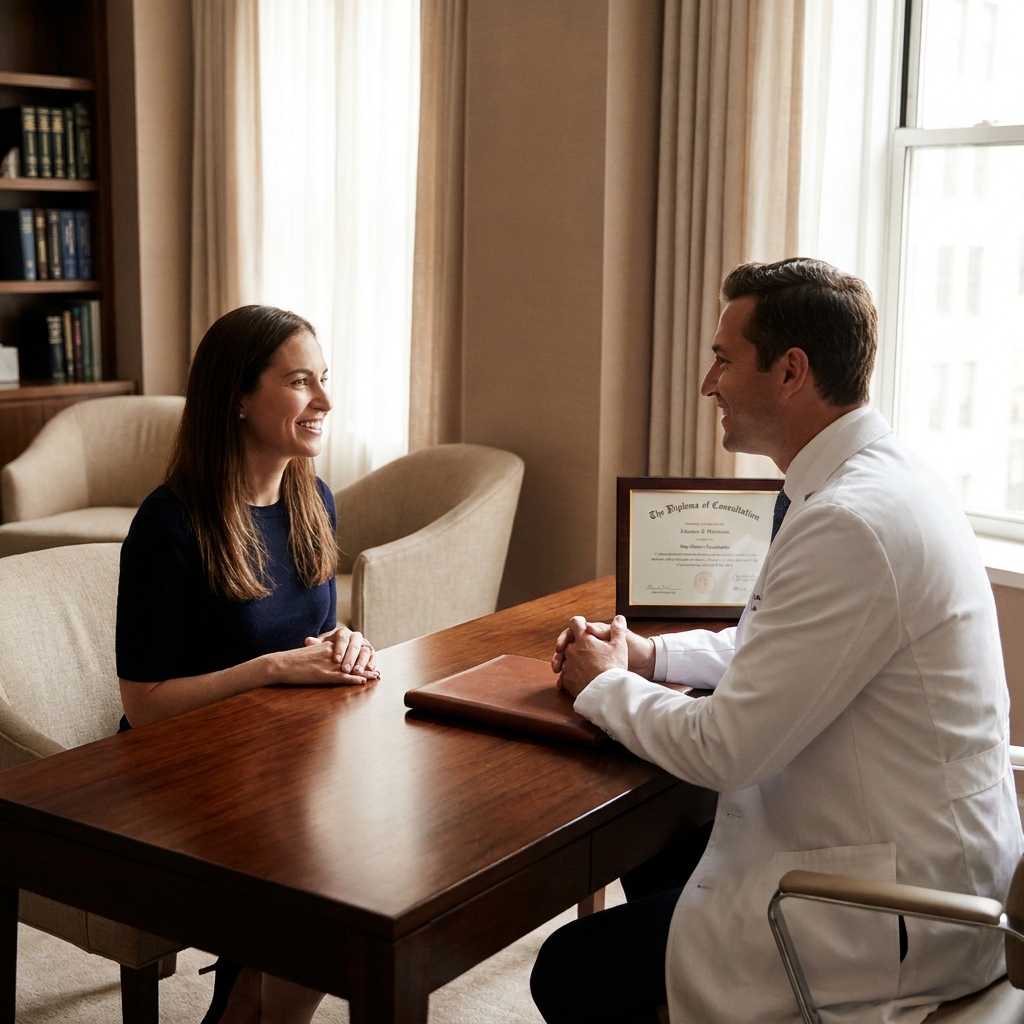
The consultation is the appropriate setting to apply every checkpoint in this article. Patients who arrive prepared with specific questions will leave with specific answers.
To discuss individual goals and surgical planning, prospective patients can request a private consultation with Hair Doctor NYC.