

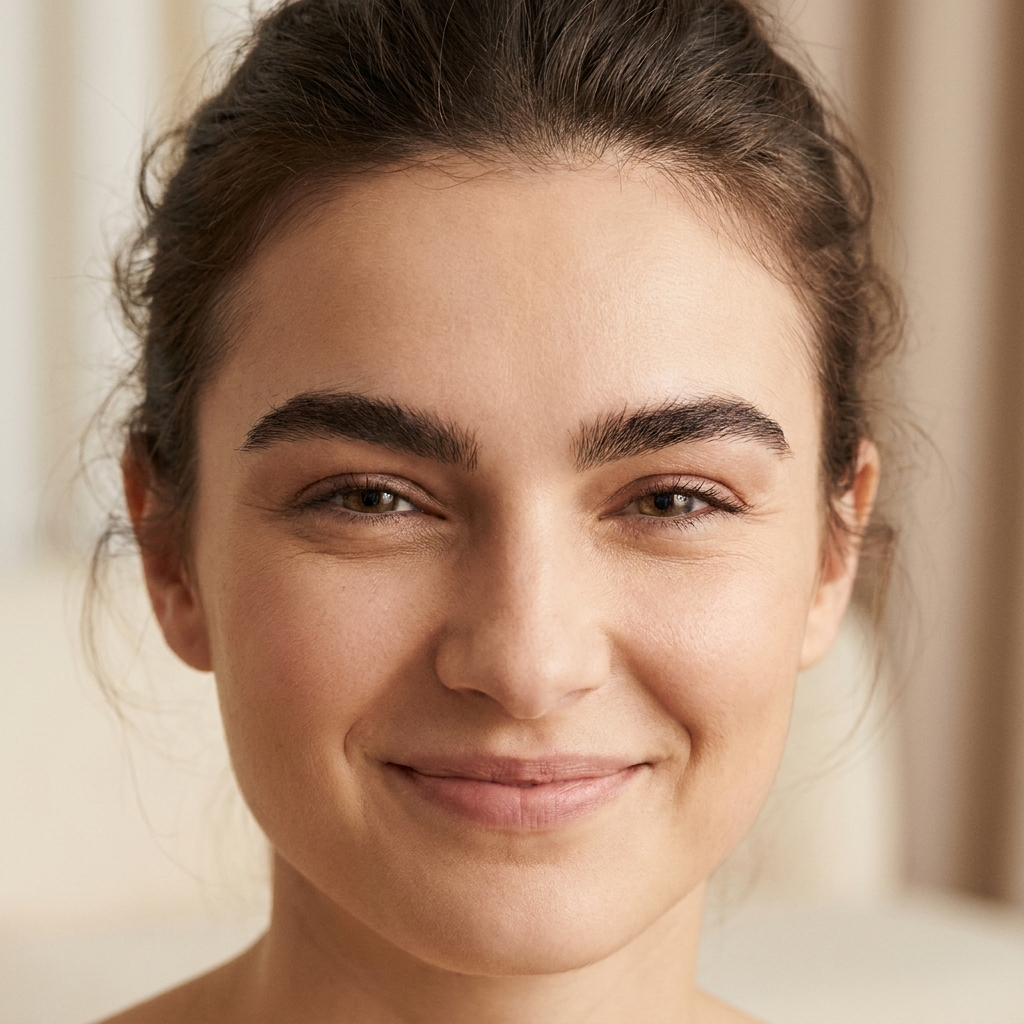
FUE Eyebrow Hair Transplant: The Facial-Harmony Surgeon Standard
Introduction: Why Eyebrow FUE Deserves Its Own Standard
Eyebrow hair transplantation is one of the most frequently miscategorized procedures in aesthetic medicine. Many clinics market and perform it as a scaled-down version of scalp FUE, using the same harvesting tools and placement habits, simply applied to a smaller area. That framing understates what the procedure demands.
A successful FUE eyebrow hair transplant depends far less on graft count than on three factors: micro-precision in graft preparation, directional artistry in placement, and sound judgment about facial structure. The eyebrow is not a miniature hairline. It frames the eyes, shapes expression, and anchors the proportions of the upper face. Small errors in angle or shape are immediately visible in conversation, in photographs, and in the mirror.
Demand is also rising. According to the International Society of Hair Restoration Surgery (ISHRS) 2025 Practice Census, eyebrows are now the most common non-scalp recipient site for women, at 12.2% of female non-scalp procedures (up from 11% in 2021). Eyebrows also account for roughly 4% of non-scalp procedures in men. More patients are seeking the procedure, and the consequences of getting it wrong are increasingly visible.
This article explains why eyebrow FUE is a distinct surgical discipline, and why double board-certified facial plastic surgeons, rather than scalp-trained technicians, represent the appropriate standard of care. The surgical team at Hair Doctor NYC serves as the frame of reference for what facial-harmony-trained expertise looks like in practice.
The Core Technical Divide: Scalp FUE vs. Eyebrow FUE
Eyebrow FUE and scalp FUE share an extraction method in name only. Follicles are harvested individually from a donor area in both cases, but recipient-site execution differs at nearly every step. Three technical pillars define that difference: angle, graft dissection, and directional mapping.
The Angle Problem: 1 to 15 Degrees vs. 30 to 45+ Degrees
Natural eyebrow hairs exit the skin at an acute angle of roughly 1 to 15 degrees, lying almost flat against the brow. Scalp hairs typically emerge at 30 to 45 degrees, and in some regions of the scalp they approach 90 degrees.
That single divergence is the most common root cause of “spiky” or upright transplanted brows. When grafts are inserted too steeply, the hairs project outward from the face instead of lying smoothly along the brow line. The result reads as artificial even to untrained observers.
The problem is often one of habit. Surgeons and technicians whose experience is concentrated in scalp work develop muscle memory for scalp-appropriate angles. Applied to the brow, that habit produces an unnatural, doll-like appearance. Wrong-angle insertion is consistently cited across patient complaint literature as a leading cause of unsatisfactory eyebrow results, and it is almost entirely a technique failure rather than a biological one.
Single-Hair Dissection Under Stereomicroscope
Scalp donor tissue naturally grows in follicular units of one to four hairs. On the scalp, multi-hair units are an asset because they build density efficiently. On the brow, they are a liability. Natural eyebrow hairs emerge individually, so eyebrow grafts must be strictly single-hair units.
Achieving this requires dissecting multi-hair grafts under a stereomicroscope, separating each follicle without transecting or dehydrating it. The work is painstaking enough that the eyebrow procedure is better described as an ultra-refined form of micrografting than as a conventional transplant.
Volume tells the rest of the story. A typical eyebrow case uses only 150 to 600 grafts in total, compared with the thousands used in many scalp procedures. With so few grafts, each one carries disproportionate weight. A single misdirected or multi-hair graft can disrupt the line of an otherwise well-designed brow. In eyebrow work, surgical skill is measured in precision per graft, not volume.
Three-Zone Directional Mapping: Medial, Body, and Tail
Natural eyebrows follow a complex directional pattern that shifts across three distinct zones:
- Medial head (near the nose): hairs point upward and slightly outward.
- Body: hairs run horizontally and outward toward the temple, with upper and lower rows converging.
- Tail: hairs angle in a modified direction again, contributing to a crisscross or fishbone pattern where rows meet.
Nothing on the scalp is equivalent to this zone-by-zone shift. A practitioner whose experience is built on scalp cases has simply never needed to develop this skill set.
Uniform-direction placement, with every hair angled the same way from head to tail, is a telltale sign of templated, non-individualized work. Correct mapping requires graft-by-graft planning based on the patient’s remaining native hairs, skin characteristics, and facial structure. It cannot be reproduced with a stencil or a repeatable pattern.
The Biology Behind the Difficulty: Growth Cycles and Survival Rates
Eyebrow hair and scalp hair operate on very different biological clocks. Natural eyebrow hair has an anagen (growth) phase of roughly four months, which is why brows stay short without trimming. Scalp hair grows for three to seven years before cycling.
Because grafts are typically harvested from scalp donor tissue, transplanted eyebrow hairs retain their scalp growth cycle. They will continue growing well beyond natural brow length, and patients should expect to trim them every one to two weeks for life. Surgeons can moderate this by choosing donor areas with finer, slower-growing characteristics, but it cannot be eliminated.
Graft survival adds another layer of complexity. Reported survival rates for eyebrow transplantation commonly range from 75% to 95%. A standardized operating procedure published in the peer-reviewed literature reported an average survival rate of 85% (range 70% to 90%), a meaningful improvement over the 75% historically reported, with the gain attributed directly to technical refinement.
The implication is significant. Eyebrow outcomes are more technique-sensitive than scalp outcomes. Harvesting, handling, hydration, dissection, and placement all influence survival, and with a few hundred grafts in play, there is little margin for inexperience.
Why “Templated Brows” Happen, and Why They’re Preventable
Across patient complaint content, the same failure modes appear repeatedly:
- Hairs standing upright due to scalp-angle insertion.
- Coarse or mismatched hair caliber from poorly selected donor sites, producing brows that look wiry or heavy.
- Generic shapes applied regardless of the patient’s bone structure, eye position, or natural brow history.
These are not cases of biological graft rejection. They are failures of technique and judgment, which means they are avoidable with the right surgical training.
The “one-shape-fits-all” approach is especially problematic for male patients. A strong, natural male brow is typically flatter, fuller, and positioned closer to the orbital rim than a female brow. A brow designed from a generic template can feminize the face, look overly groomed, or appear disconnected from the patient’s features. In every case, the brow looks transplanted rather than grown.
Preventing these outcomes requires a surgeon who treats brow design as facial architecture rather than as a hairline exercise in miniature.
Facial-Bone-Structure Judgment: The Missing Discipline in Hair-Only Training
The eyebrow is a structural element of the entire face. Its shape and position interact with the brow bone, the orbital rim, the upper eyelid, and the spacing of the eyes. A brow that sits slightly too high can create a look of permanent surprise. One that arches too sharply can read as severe. One that begins too far from the midline can make the eyes appear wide-set.
Facial plastic surgeons work with proportional frameworks that guide brow placement, including:
- Medial brow positioning aligned above the inner canthus (the inner corner of the eye).
- Arch apex positioning at or near a vertical line above the lateral limbus (the outer edge of the iris).
- Tail termination relative to the nasal ala and lateral canthus, along with brow height in relation to the orbital rim.
These principles are core to facial plastic surgery training and are refined daily in brow lifts, forehead procedures, and eyelid surgery. Scalp hair restoration training, by contrast, centers on hairline density, coverage patterns, and donor management. It addresses the frame of the face, not its three-dimensional proportions.
This is the deeper, less frequently discussed reason facial plastic surgeons bring a structural advantage to eyebrow FUE. They are not only placing hair; they are positioning a feature within a face they understand anatomically and aesthetically.
The Hair Doctor NYC Standard: Facial Plastic Surgery Training Applied to Eyebrow FUE
Hair Doctor NYC, operating as Stoller Medical Group, is led by double board-certified facial plastic surgeons whose core training is facial aesthetics and proportion, not hair biology alone.
Dr. Roy B. Stoller, a globally recognized leader in facial plastic surgery and hair restoration, brings more than 25 years of facial plastic surgery experience and a record of over 6,000 successful hair transplant procedures. That combination of surgical volume and facial-aesthetic depth is uncommon, and it is the pairing eyebrow work requires.
Dr. Louis Mariotti, also a double board-certified facial plastic surgeon, focuses on surgical detail and facial harmony. Those disciplines bear directly on the decisions that define a successful brow: where it begins, where it peaks, how it tapers, and how it relates to the eyes and brow bone.
The team also includes Dr. Christopher Pawlinga, who has dedicated 18 years exclusively to hair transplantation. His specialized focus on graft handling and transplant technique complements the facial plastic surgery expertise of his colleagues.
Together, the team provides what eyebrow FUE demands: angle-accurate insertion, zone-correct directional mapping, and proportion-aware design. The practice’s state-of-the-art clinic on Madison Avenue in Midtown Manhattan reflects the same priorities found in the operating room: premium care, attention to detail, and discretion for patients who expect results no one will notice as surgical.
Who Is a Candidate for Eyebrow FUE
Eyebrow FUE serves a diverse patient population. Common candidate profiles include:
- Over-plucking or over-grooming damage, where years of tweezing, waxing, or threading have permanently depleted follicles.
- Genetic thinning, including naturally sparse or patchy brows.
- Trauma or burn scarring, including scars that interrupt the brow line.
- Chemotherapy-related loss that has not fully recovered.
- Resolved trichotillomania, provided the hair-pulling behavior is stable and well managed.
A growing segment of patients are correcting earlier cosmetic missteps, such as brows over-tweezed decades ago that never returned, while others are addressing medically driven loss. Among men, patients often seek fuller, more defined brows that restore balance to the face, or correction of gaps caused by scars or injury.
Careful screening is essential. Several conditions are contraindications or significant risk factors requiring specialist evaluation:
- Active alopecia areata, which can attack transplanted follicles.
- Alopecia totalis or universalis, where unstable autoimmune activity undermines results.
- Active trichotillomania, given the risk of behavior targeting new grafts.
- Frontal fibrosing alopecia (FFA) and lichen planopilaris, scarring conditions that frequently involve the eyebrows and may compromise graft survival.
Eyebrow loss can also be secondary to systemic causes such as thyroid dysfunction, so an accurate diagnosis must precede any surgical plan. A facial-plastic-surgeon-led consultation integrates medical screening and aesthetic planning in a single evaluation, so candidacy is assessed as a whole rather than as a checklist exercise.
What to Expect From a Facial-Harmony-Driven Eyebrow FUE Process
Consultation. The process begins with a facial proportion assessment and evaluation of bone structure, brow position, eye spacing, and any remaining native brow hair. The brow shape is designed individually for the patient’s face, not selected from a standard template. For male patients, this typically means preserving a strong, natural, minimally arched line.
Donor-site selection. Matching hair caliber and texture is critical. The surgeon identifies donor areas, often in the lower occipital region or nape, where hairs are finer and more closely resemble natural eyebrow hair. This choice directly affects how natural the result looks and feels.
Procedure day. Grafts are harvested via FUE, then dissected into single-hair units under stereomicroscope. Placement proceeds zone by zone: upward-oriented hairs at the medial head, horizontal and outward hairs through the body, and appropriately angled hairs through the tail, all at the near-flat angle that natural brow hair requires.
Recovery and maintenance. Most patients resume normal routines within days. Transplanted hairs commonly shed in the first weeks before regrowth begins. Because these hairs retain their scalp growth cycle, ongoing trimming every one to two weeks is a permanent part of maintenance.
Evaluating results. Final outcomes should be judged over a full growth cycle, typically many months, rather than immediately after surgery. Grafts settle into their final direction and density over time, and the brow continues to mature as hairs grow in.
How to Vet a Surgeon for Eyebrow FUE
Prospective patients can apply a straightforward checklist:
- Confirm board certification in facial plastic surgery. General cosmetic credentials or hair-only training do not provide the same foundation in facial proportion.
- Ask about eyebrow-specific technique. Overall FUE case volume is not enough. Patients should ask directly about single-hair dissection and three-zone directional placement.
- Review eyebrow before-and-after results. Scalp results reveal little about brow capability. Eyebrow photos should be evaluated for flat hair angles, natural directionality, and shapes individualized across different face types, including male faces.
- Ask how facial proportion is assessed. A surgeon’s answer to this question is a reliable litmus test. Specific references to brow bone, orbital rim, canthal positions, and eye spacing indicate facial-harmony training. Vague references to “standard shapes” indicate templated planning.
Conclusion: Treating Eyebrow FUE as the Specialty It Is
Eyebrow FUE is a distinct surgical discipline. Its acute insertion angles, single-hair dissection requirements, three-zone directionality, and dependence on facial proportion separate it clearly from scalp FUE.
Most dissatisfaction with eyebrow transplant results traces back to gaps in technique and judgment, not biology. Those gaps are addressable, and the most effective way to address them is to choose a surgeon whose training is grounded in the architecture of the face.
Hair Doctor NYC’s double board-certified facial plastic surgeons apply that standard, designing brows with the same rigor brought to any other facial feature. As ISHRS data shows demand for eyebrow restoration continuing to rise, matching that demand with appropriately specialized surgical care has never been more important.
Schedule a Facial-Harmony Eyebrow Consultation
Patients considering eyebrow restoration are invited to schedule a private consultation with the facial plastic surgery team at Hair Doctor NYC’s Madison Avenue clinic in Midtown Manhattan.
Each consultation includes an individualized facial-proportion assessment, medical screening, and a brow design developed for the patient’s own bone structure, never a one-size-fits-all template. The practice’s discreet, highly personalized approach is built for discerning patients who expect natural, undetectable results.
Contact Hair Doctor NYC today to book a consultation and take the next step toward a surgically precise, facially harmonious brow.