

Non-Surgical Hair Restoration: The Physician-Led Standard for 2026
Introduction: Redefining What “Non-Surgical” Means in 2026
Hair loss is one of the most common medical concerns in modern dermatology. Androgenetic alopecia affects 85% of men and 40% of women, and the American Academy of Dermatology estimates that approximately 80 million Americans live with the condition: 50 million men and 30 million women. For accomplished professionals who expect precision in every other area of their lives, the question is rarely whether to address hair loss. The question is how.
For years, non-surgical hair restoration was treated as a consolation prize, the option offered to patients who “couldn’t” have a transplant. That framing no longer reflects clinical reality. In 2026, non-surgical hair restoration is a deliberate, physician-led, first-line decision, chosen because it matches a patient’s diagnosis rather than because surgery was ruled out.
This article uses a mechanism-based framework to explain that shift. Instead of ranking treatments on a simple efficacy scorecard, it separates therapies into two categories: biological regrowth and appearance simulation. That distinction shapes every sound treatment plan.
At Hair Doctor NYC, surgical and non-surgical specialists practice under one roof on Madison Avenue. The non-surgical pathway is anchored by Michael Ferranti, P.A., whose 25+ years in aesthetic dermatology and plastic surgery give it the same clinical seriousness as the practice’s surgical work.
The Outdated Myth of “Non-Surgical as Plan B”
Describing non-surgical treatment as a lesser option is clinically inaccurate. A transplant relocates existing follicles; it does not create new ones. For a significant share of patients, surgery is simply not the correct tool.
Recognized disqualifiers for surgical candidacy include:
- Insufficient donor hair: Some patients do not have enough healthy follicles available for transplantation.
- Diffuse unpatterned alopecia (DUPA): When hair loss affects the entire scalp evenly, there is no stable donor zone to harvest from.
- Certain medical conditions: Systemic or dermatologic conditions can make surgery inadvisable.
Women are disproportionately affected: hormonal differences can produce an unstable donor area, so fewer women than men qualify as transplant candidates. For these patients, a non-surgical pathway is not a compromise. It is the clinically correct choice.
This leads to the central thesis of a physician-led approach: the right question is not “Is non-surgical as good as surgery?” It is “Which mechanism matches this patient’s diagnosis and goals?“
The Real Clinical Framework: Two Mechanisms, Not One Category
A menu-style clinic presents a list of treatments and invites patients to choose. A credentialed medical practice starts with diagnosis and recognizes that every non-surgical option operates through one of two mechanisms. Understanding which mechanism applies is what separates a coherent treatment plan from a collection of products.
Biological Regrowth: Treatments That Require Viable Follicles
Minoxidil, finasteride, platelet-rich plasma (PRP), and low-level laser therapy (LLLT) all work by preserving or stimulating active follicular biology. They can slow loss, thicken miniaturized hairs, and in some cases reactivate follicles that are underperforming.
The limitation is equally important: these treatments require living, viable follicles. They cannot manufacture new growth where follicles are dormant beyond recovery or entirely absent. A patient with advanced, long-standing baldness will not regrow a full scalp on medication alone, regardless of how consistently it is used.
Appearance Simulation: Treatment That Works Independent of Follicle Viability
Scalp micropigmentation (SMP) is the sole modality in this category. It replicates the visual appearance of close-cropped hair follicles regardless of the scalp’s biological status.
Some sources describe this as a weakness, since SMP does not grow hair. In clinical terms, it is SMP’s unique strength. Because it does not depend on follicle viability, donor supply, or disease activity, SMP delivers results at any Norwood stage, including complete baldness, precisely where regrowth treatments cannot.
Biological Regrowth Modalities: What the Evidence Actually Shows
Not all regrowth therapies stand on the same evidentiary ground. The sections below move tier by tier, from FDA-approved drugs to FDA-cleared devices to therapies with strong but still developing literature.
Minoxidil and Finasteride: The Only FDA-Approved Pathway
Only two drugs carry FDA approval for androgenetic alopecia: oral finasteride (for men) and topical minoxidil (for men and women). Finasteride works by inhibiting the conversion of testosterone to DHT, the hormone that drives follicular miniaturization. Minoxidil prolongs the growth phase and improves follicle caliber.
This distinction matters. Patients evaluating hair loss treatments encounter a wide range of claims, and a physician-led practice starts with the evidentiary baseline: these two medications have decades of clinical trial data behind them. They serve as the pharmacological backbone of most combination protocols, with other therapies layered on top.
Low-Level Laser Therapy: FDA-Cleared, Not FDA-Approved
LLLT is FDA-cleared as a device, not approved as a drug. Most patient-facing content blurs this nuance, but clearance and approval are different regulatory pathways with different evidentiary requirements.
That said, the data is meaningful. Meta-analysis findings show significant hair density increases compared with sham treatment (standardized mean difference of 1.27) across controlled trials. In women with androgenetic alopecia, clinical data indicates LLLT can produce up to a 51% increase in hair density.
Within a supervised protocol, LLLT functions best as a maintenance-tier therapy: a consistent, low-burden way to support results achieved through medication and PRP, rather than a standalone solution.
Platelet-Rich Plasma: Moderate-to-Strong and Improving Evidence
The 2026 literature consensus rates PRP’s clinical evidence as moderate-to-strong. Studies show statistically significant improvements in hair density and thickness compared with placebo, particularly for androgenetic alopecia. Reported outcomes include:
- 30% to 40% increased hair density after three to six months
- A mean increase of 45.9 hairs/cm² after three initial treatment cycles
PRP plays a dual role. It works as a standalone regrowth therapy for patients with viable follicles, and it serves as a pre-surgical optimization tool that prepares the scalp for transplantation.
Scalp Micropigmentation: Elevated to Surgical-Grade Clinical Rigor
SMP is frequently marketed as a cosmetic add-on. A physician-led practice holds it to the same evidentiary and procedural standard as surgical hair restoration: careful diagnosis, measurable outcomes, and credentialed delivery.
What SMP Is and How It Works
SMP deposits medical-grade pigment into the upper dermis to replicate the visual density of shaved follicles. Done well, it creates the impression of a full, closely cropped hairline or adds perceived density beneath thinning hair.
Because SMP is independent of follicular biology, it is effectively candidacy-agnostic. It works for diffuse thinners, advanced Norwood stages, and donor-depleted patients alike, groups that are often poorly served by surgery.
The 2025 Peer-Reviewed Evidence Base
A 2025 technical analysis and case series published in the Journal of Cosmetic Dermatology found SMP to be an effective, safe cosmetic improvement for localized alopecia, with sustained outcomes and strong patient satisfaction. Key metrics included:
- Immediate post-treatment Visual Density Score (VDS): averaged 8.7, with androgenetic cases scoring 9.1
- 6-month follow-up VDS: 7.7, a modest decline
- Mean Patient Satisfaction Score: 2.7 out of 3
- 85.7% of androgenetic cases reported being “very satisfied”
- Zero adverse events across the cohort
These are structured outcome measures comparable to those used in surgical literature. That is the basis for treating SMP as a medical procedure rather than a tattoo service.
SMP Outcomes Vary by Diagnosis: The Scarring Alopecia Data
A prospective study in the Journal of Cutaneous and Aesthetic Surgery examining SMP in scarring alopecia adds important nuance. At six months, 50% of participants showed a favorable esthetic response overall. Results varied sharply by diagnosis:
- Frontal fibrosing alopecia: 100% satisfaction
- Traction alopecia: 80% satisfaction
- Morphea: 80% of patients failed to retain at least half of the pigment
- Lichen planopilaris: 66.6% failed to retain at least half of the pigment
The lesson is clear: outcomes depend on accurate diagnosis. SMP belongs within a physician-supervised diagnostic framework, not offered as a one-size-fits-all cosmetic service.
Why Practitioner Credentialing Changes the Outcome
At Hair Doctor NYC, SMP is led by Michael Ferranti, P.A. For more than 25 years, he has practiced as a Physician Assistant in aesthetic dermatology and plastic surgery, and he is a licensed Scalp Micropigmentation specialist dedicated to non-surgical hair restoration.
SMP delivered by a credentialed medical professional within a surgical practice differs materially from studio-based or unlicensed providers in three areas:
- Pigment selection: matching undertone and shade to skin type so dots read as follicles, not ink, and resist discoloration over time.
- Layering technique: controlling depth and density to avoid blurring, spreading, or an artificial “helmet” effect.
- Complication management: recognizing underlying scalp conditions, scar tissue behavior, and when a patient should not proceed.
The Regulatory Reality: Approved, Cleared, and Unregulated
Patients deserve a clear view of the regulatory landscape before choosing a treatment. Three tiers exist: FDA-approved drugs, FDA-cleared devices, and unregulated or off-label products. A practice that explains these tiers openly is signaling that it leads with evidence, not marketing.
FDA-Approved vs. FDA-Cleared: A Distinction Patients Deserve to Know
Minoxidil and finasteride are FDA-approved drugs. LLLT is an FDA-cleared device. These statuses are not interchangeable, and marketing language that calls a laser cap “FDA-approved” misrepresents its evidentiary standing. A physician-led practice discloses this distinction upfront so patients can weigh each therapy accurately.
Exosome Therapy: Separating Hype From Evidence
Exosomes are among the most heavily promoted hair treatments of 2026. The facts are straightforward:
- No exosome-based products have received FDA approval for dermatologic use, and long-term safety data remains limited.
- Under federal law, exosome products marketed to treat disease or affect the structure or function of the body are regulated as drugs or biologics requiring premarket authorization. The FDA has stated that there are currently no approved exosome products.
- Clinics administering exosome treatments outside an authorized clinical trial may be operating outside federal law.
This stands in contrast to the decades of randomized controlled trial data behind minoxidil and finasteride, as well as the growing evidence base for PRP and LLLT. Proven science, not trend-chasing, is the foundation of a responsible treatment plan.
How a Physician-Led Team Sequences These Therapies
Clinical sophistication is not choosing one modality. It is orchestrating several in the right order, based on diagnosis.
Diagnosis First: Norwood and Ludwig Staging Drive the Plan
The Norwood scale (men) and Ludwig scale (women) classify the pattern and extent of loss. Staging determines which mechanism applies: regrowth where follicles remain viable, simulation where they do not, or both in combination.
In a physician-led model, diagnosis precedes treatment selection. This is the reverse of clinics that lead with a product or a procedure and then fit the patient to it.
Combination Protocols as the 2026 Clinical Standard
For early-stage patients, the 2026 standard is a layered protocol:
- Oral minoxidil plus finasteride as the pharmacological backbone
- PRP every four to six months to stimulate follicular activity
- LLLT for maintenance between sessions
This combination can stabilize early-stage loss and delay, or potentially avoid, the need for surgery altogether.
Non-Surgical Treatment as Pre-Surgical Optimization
For patients planning a transplant, using PRP and medications three to six months before surgery improves the scalp environment and enhances graft survival rates. This kind of coordination is a hallmark of an integrated practice, where non-surgical and surgical teams work from a shared plan instead of operating as separate silos.
When SMP Is the Definitive Solution, Not a Bridge Therapy
For certain patients, SMP is the endpoint rather than a stopgap:
- Advanced Norwood stages, where too few viable follicles remain for regrowth therapy to matter
- Diffuse unpatterned hair loss, where surgery lacks a stable donor zone
- Donor-depleted scalps, including patients who have already had transplants
Women with unstable donor areas are frequently better served by SMP than by pursuing surgical candidacy they do not have. SMP results commonly last three to five years before touch-ups, making it a durable, maintainable component of a long-term plan.
Why Credentials Are the Real Differentiator in a Growing Market
Rapid growth in any medical category is a double-edged signal. Legitimacy and risk rise together.
Market Growth Is Attracting Undercredentialed Providers
The global SMP services market is estimated at $3.10 billion in 2026 and projected to reach $4.91 billion by 2033, with North America leading adoption at a 36% share. Technology is advancing in parallel across the industry, with AI-driven scalp mapping, pigment color-matching algorithms, and robotic SMP systems reshaping delivery precision for providers that adopt them.
Growth at this pace attracts new providers, and their quality varies widely. Without proportional credentialing oversight, practitioner vetting matters more than ever.
The Integrated Model: Surgical and Non-Surgical Expertise Under One Roof
Most clinics offer surgical procedures or SMP, but rarely both with a dedicated, credentialed SMP specialist on the team. Hair Doctor NYC is structured differently:
- Dr. Roy B. Stoller: double board-certified, 25+ years in facial plastic surgery, more than 6,000 successful hair transplant procedures
- Dr. Louis Mariotti: double board-certified facial plastic surgeon focused on surgical detail and facial harmony
- Dr. Christopher Pawlinga: 18 years dedicated exclusively to hair transplantation
- Michael Ferranti, P.A.: licensed SMP specialist leading non-surgical care
This structure allows diagnosis, staging, and treatment sequencing to happen under one clinical roof rather than being fragmented across unconnected providers.
Visualizing Outcomes During the Consultation Process
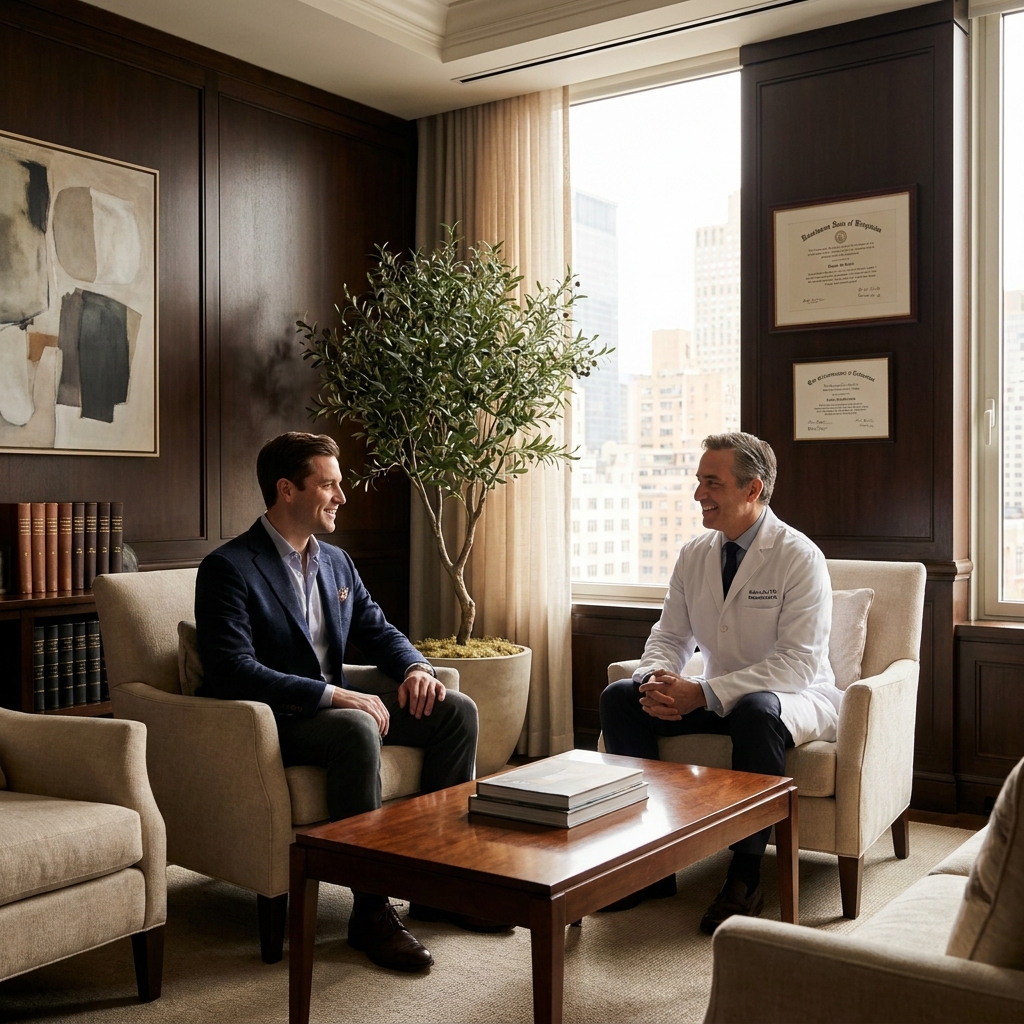
Hair Doctor NYC’s consultation process gives patients the opportunity to discuss realistic SMP outcomes with Michael Ferranti, P.A. before committing to treatment. This personalized review reduces anxiety and aligns expectations before any procedure begins, consistent with the practice’s deliberate, evidence-based approach.
Who Is the Ideal Candidate for Non-Surgical Hair Restoration?
The profiles below serve as a diagnosis-based self-assessment guide. A formal evaluation remains essential, but most patients will recognize themselves in one or more categories.
Early-Stage Thinners Seeking to Preserve What They Have
Men at early Norwood stages and women at early Ludwig stages have the highest likelihood of success with biological regrowth. The physician-guided pathway is the combination protocol: minoxidil and finasteride, PRP, and LLLT, with the goal of stabilizing loss and protecting existing density.
Diffuse Thinners and Women With Unstable Donor Areas
Diffuse unpatterned hair loss and hormonally driven donor instability make these patients poor surgical candidates. They are, however, excellent candidates for SMP and PRP. This closes the loop on the central argument: for these patients, non-surgical care is the correct clinical answer, not a fallback.
Patients Seeking Pre- or Post-Surgical Enhancement
Some patients use PRP to prepare the scalp before transplantation. Others use SMP after surgery to camouflage donor scars or increase perceived density between transplanted grafts. In both cases, the non-surgical and surgical plans reinforce each other.
Advanced Norwood Stages Choosing SMP as a Definitive Outcome
For men with extensive hair loss or depleted donor supply, SMP alone can deliver a complete, natural-looking cosmetic result. It does so without the biological limitations that restrict regrowth therapies or surgery.
Conclusion: Non-Surgical Hair Restoration as a Rigorous Medical Discipline
Non-surgical hair restoration in 2026 is not a consolation prize. It is a mechanism-driven, evidence-based medical pathway. The correct lens for evaluating any treatment plan is simple: does the patient need biological regrowth, appearance simulation, or a deliberate combination of both?
Outcomes depend on accurate diagnosis, regulatory transparency, and practitioner credentialing, not on marketing claims. Hair Doctor NYC’s physician-led, integrated team of board-certified surgeons and a credentialed SMP specialist reflects the standard this approach requires.
Schedule a Physician-Led Hair Restoration Consultation
Men and women considering non-surgical hair restoration are invited to book a consultation at Hair Doctor NYC’s Madison Avenue practice in Midtown Manhattan. Each consultation provides an individualized diagnosis and a treatment sequencing plan built around the patient’s staging and goals.
Patients gain access to the full care team within a single consultation pathway, including Michael Ferranti, P.A. for SMP evaluation and the surgical team for candidacy assessment. The consultation offers a low-pressure way to discuss realistic outcomes before deciding on a path forward, so every decision is made with clarity and confidence.