

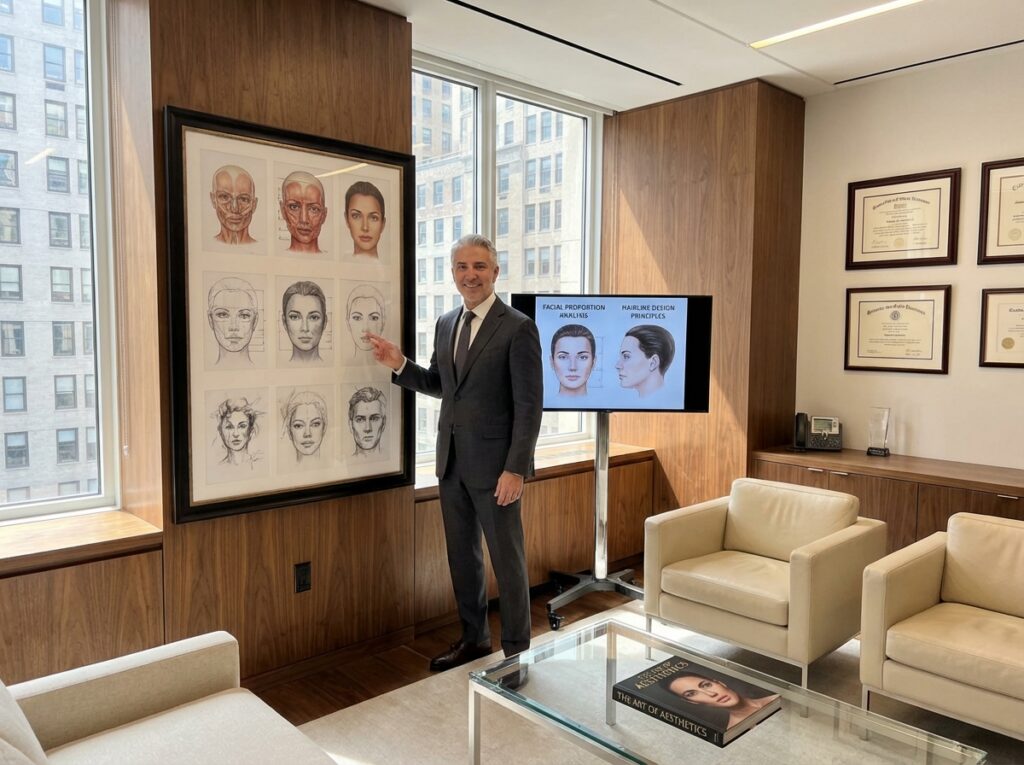
Facial Plastic Surgeon Hair Transplant: Why Face Training Creates Better Hairlines
The hair transplant industry operates with a surprising lack of regulation. Any licensed physician can legally perform hair transplant procedures without specific training, accreditation, or demonstrated competency in hair restoration. While marketing campaigns spotlight advanced technology—robotic systems, precision extraction tools, and minimally invasive techniques—the surgeon’s training ultimately determines whether a patient leaves with a natural, harmonious hairline or an artificial-looking result.
Facial plastic surgery fellowship training provides transferable skills that directly impact hairline design quality. These specialists bring a comprehensive understanding of facial proportions, refined aesthetic judgment, and mastery of facial anatomy that extends beyond the scalp. With over 628,000 hair transplant procedures performed globally and a market growing at 8.78% annually, understanding these distinctions has never been more critical for prospective patients.
The Unregulated Reality of Hair Transplant Surgery
Unlike many surgical specialties with clearly defined training pathways, hair restoration exists in a regulatory gray zone. The American Hair Loss Association confirms that because the field lacks formal regulation, anyone with a medical degree can call themselves a hair transplant surgeon—regardless of actual training or experience.
This regulatory gap has given rise to “turn-key” clinics where unlicensed technicians may perform significant portions of procedures under minimal physician supervision. The surgical and aesthetic skill levels across providers vary dramatically. While success rates for graft survival exceed 90-97% at reputable clinics, aesthetic satisfaction depends on design quality, not just whether follicles take root.
A technically successful procedure with poor hairline design leaves patients with results that look unnatural for decades. This reality underscores why specialized training matters—particularly training focused on facial aesthetics and harmony.
What Facial Plastic Surgery Training Actually Includes
Facial plastic surgeons follow a rigorous training pathway. After completing medical school, they undertake residency training in otolaryngology-head and neck surgery. This is followed by a dedicated 12-month fellowship in facial plastic surgery, focusing exclusively on facial aesthetics, proportions, harmony, reconstruction, and cosmetic procedures.
This pathway leads to double board certification: surgeons can earn certification from both the American Board of Otolaryngology and the American Board of Facial Plastic and Reconstructive Surgery (ABFPRS). The ABFPRS has maintained rigorous standards since 1986, measuring candidate qualifications against demanding benchmarks.
The American Academy of Facial Plastic and Reconstructive Surgery has offered 65 or more fellowship positions annually since 1969, training over 1,200 specialists. This training is specifically dedicated to the face—unlike general plastic surgery or dermatology pathways that cover the entire body. For hair restoration, this facial focus translates directly to superior aesthetic outcomes.
Three Critical Skills Facial Plastic Surgeons Bring to Hair Restoration
Facial plastic surgery training develops specific competencies that distinguish these specialists from providers who focus solely on technical graft extraction and placement. Three skills prove particularly valuable for hair transplant patients seeking natural, harmonious results.
Understanding Facial Proportions and the Golden Ratio
Facial plastic surgeons routinely apply mathematical principles to aesthetic design. The golden ratio (phi), rule of thirds, and facial proportion guidelines inform every procedure they perform—including hairline design.
Research published in PMC demonstrates that perception of physical beauty correlates with how closely facial features reflect phi in their proportions. This principle can be directly applied to anterior hairline design, creating results that appear naturally attractive rather than artificially placed.
The rule of facial thirds provides concrete guidance: the face divides into three equal vertical sections—hairline to brow, brow to nose base, and nose base to chin. Proper hairline placement must respect these proportions to achieve facial balance. A hairline positioned too low or too high disrupts this harmony, regardless of how many grafts survive.
Johns Hopkins Facial Cosmetic Surgery emphasizes this holistic approach, considering the balance and harmony among each area of the scalp and face rather than treating hair restoration in isolation.
Aesthetic Judgment for Age-Appropriate Hairlines
Hairlines must look natural now and continue looking natural as patients age over subsequent decades. Facial plastic surgeons understand how hairline placement affects perceived youthfulness—and how to avoid creating unnaturally low “teenage” hairlines on mature faces.
Temple recession angles must complement bone structure and age. Overly aggressive temple points that eliminate all recession appear artificial on patients over 30. Similarly, forehead height affects facial proportions, which is why one-size-fits-all hairline templates consistently fail.
UCLA Health’s Facial Plastic Surgery division describes hair transplantation as “more than a surgery, it is an art.” Their physicians “paint a new, individually crafted hairline that appears natural”—language that reflects the aesthetic judgment facial plastic surgeons bring to every case.
Mastery of Facial Anatomy Beyond the Scalp
Facial plastic surgeons possess comprehensive anatomical knowledge extending beyond scalp tissue. They understand forehead shape, brow position, temple angles, facial musculature, and vascular supply as interconnected systems.
This knowledge prevents complications and optimizes aesthetic outcomes. Understanding how hairline placement interacts with brow position and forehead contour creates natural facial flow. Providers who focus narrowly on scalp anatomy without considering broader facial context miss these critical relationships.
Facial plastic surgery training includes facial reconstruction, providing deep understanding of tissue handling and healing that benefits surgical precision during hair transplant procedures.
How Facial Training Translates to Real Patient Outcomes
Consider three scenarios illustrating how facial harmony expertise affects real results:
Scenario One: A patient presents with a high forehead and prominent brow ridge. A facial plastic surgeon adjusts hairline height and shape to balance facial thirds rather than applying a standard template. The result respects the patient’s unique bone structure while restoring proportion.
Scenario Two: A patient seeks temple restoration. Understanding temple anatomy and facial angles, the surgeon creates a natural recession pattern that complements bone structure rather than filling in temples completely—which would appear unnatural.
Scenario Three: An older patient wants hairline lowering. Age-appropriate design prevents an unnatural appearance while restoring youthful proportions. The surgeon avoids the common mistake of recreating the patient’s hairline from their twenties, which would look incongruous with mature facial features.
First-time procedures require an average of 2,176-2,347 grafts, with results visible at 3-4 months and full impact appreciated at 9-12 months. This permanent work demands expert design from the outset—revision procedures are more complex and costly than getting it right initially.
Board Certifications That Matter for Hair Transplant Patients
Understanding certification differences helps patients evaluate surgeon qualifications effectively.
The ABFPRS (American Board of Facial Plastic and Reconstructive Surgery) requires completion of facial plastic surgery fellowship training and tests candidates against rigorous standards. This certification indicates comprehensive facial aesthetic expertise.
The ABHRS (American Board of Hair Restoration Surgery) focuses specifically on hair restoration competency. While valuable, this certification doesn’t require facial plastic surgery training background.
Double board certification—holding both facial plastic surgery and hair restoration credentials—indicates both facial aesthetic expertise and hair restoration specialization. Major academic medical centers including Johns Hopkins and UCLA Health position hair transplants within their facial plastic surgery divisions, recognizing the importance of this combined expertise.
Patients should ask prospective surgeons about their specific training pathway, fellowship completion, and board certifications to understand what expertise they bring to hairline design.
Why Technology Alone Doesn’t Guarantee Natural Results
The hair transplant industry heavily markets technology—robotic FUE systems, NeoGraft devices, and advanced extraction tools dominate advertising. FUE (Follicular Unit Extraction) holds 58-60% market share due to minimal scarring and faster recovery compared to FUT strip methods.
However, technology handles graft extraction and placement mechanics. The surgeon determines hairline design, angle, density distribution, and the overall aesthetic plan. Advanced extraction tools cannot compensate for poor design judgment.
Consider an analogy: an advanced camera doesn’t make someone a great photographer. Artistic eye and training create compelling images. Similarly, sophisticated surgical technology doesn’t replace the aesthetic foundation that facial plastic surgery training provides.
The hair transplant market, valued at $6.98 billion in 2026 and projected to reach $10.64 billion by 2031, includes providers with vastly different levels of aesthetic training. Technology access is relatively equal; aesthetic expertise is not.
The Hair Doctor NYC Approach: Where Facial Expertise Meets Hair Restoration
Hair Doctor NYC exemplifies the integration of facial plastic surgery expertise with specialized hair restoration. Dr. Roy B. Stoller brings double board certification in facial plastic surgery alongside 25+ years of experience and over 6,000 successful hair transplant procedures. Dr. Louis Mariotti, also double board-certified in facial plastic surgery, focuses on surgical detail and facial harmony.
The team includes Dr. Christopher Pawlinga, who has dedicated 18 years exclusively to hair transplantation, combining deep procedural specialization with the practice’s facial expertise approach. This team-based model ensures patients benefit from both facial aesthetic training and concentrated hair restoration experience.
The practice applies facial proportion principles, golden ratio concepts, and age-appropriate design to each patient’s unique facial structure. Comprehensive services—FUE, FUT, scalp micropigmentation, and facial hair restoration—are all informed by facial plastic surgery perspective, treating hair restoration as integral to overall facial aesthetics rather than an isolated procedure.
Questions to Ask When Choosing a Hair Transplant Surgeon
Prospective patients should evaluate aesthetic training, not just technical credentials:
- What is the surgeon’s medical specialty training background and board certifications?
- Did the surgeon complete a facial plastic surgery fellowship, and if so, where?
- How does the surgeon approach hairline design—what facial proportion principles are applied?
- Can the surgeon show before/after examples demonstrating age-appropriate, natural hairlines on patients with similar facial structures?
- How does the surgeon determine hairline placement specific to individual facial anatomy versus using standard templates?
- What percentage of the procedure will the surgeon personally perform versus technicians or assistants?
- How many hair transplant procedures has the surgeon personally performed, and what is the patient satisfaction rate?
These questions help distinguish surgeons with genuine aesthetic training from those offering technical competency alone.
Conclusion
Facial plastic surgery training provides specific, transferable skills that directly impact hairline design quality. Understanding facial proportions, exercising aesthetic judgment for age-appropriate design, and mastering facial anatomy beyond the scalp distinguish these specialists from other providers.
While any licensed physician can legally perform hair transplants, specialized facial training produces measurably different aesthetic outcomes. Hair restoration is permanent—the design will accompany patients for decades. With graft survival rates exceeding 90-97%, survival is expected; aesthetic design informed by facial expertise is what distinguishes outstanding results.
Patients who prioritize facial plastic surgery credentials when evaluating providers position themselves for natural, harmonious outcomes that enhance rather than distract from their overall appearance.
Schedule a Consultation with Hair Doctor NYC
Hair Doctor NYC’s team of double board-certified facial plastic surgeons offers comprehensive evaluation of facial structure, proportions, and aesthetic goals. With 25+ years of facial plastic surgery expertise combined with specialized hair restoration experience, the practice delivers personalized hairline design at their state-of-the-art Madison Avenue facility.
Contact Hair Doctor NYC to discuss how facial plastic surgery expertise creates hairlines designed specifically for individual facial harmony. Initial consultations address questions about training, approach, and how facial proportion principles apply to each unique case.