

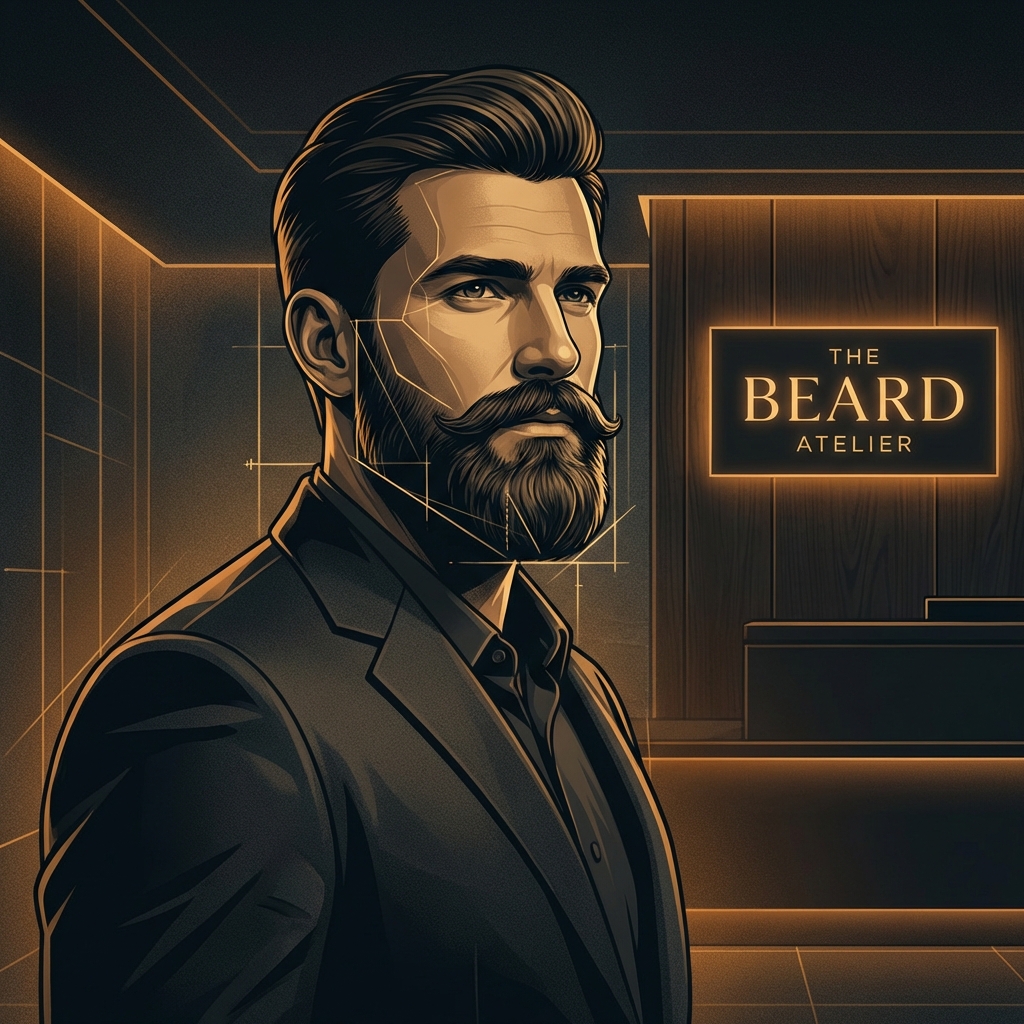
Beard Density Hair Transplant: The 5-Zone Graft Architecture Guide
Introduction: Why Beard Density Is a Design Problem, Not a Volume Problem
Most men seeking a beard density hair transplant focus on raw graft numbers—a natural instinct when investing in facial hair restoration. However, density without architectural precision produces an artificial, pluggy result that undermines the entire purpose of the procedure. The face is not a uniform canvas waiting to be filled with follicles. It is five distinct surgical zones, each with its own growth biology, angulation requirements, and aesthetic logic.
A full beard restoration typically requires 1,500–5,000 scalp grafts, with results that are permanent and fully natural-looking after 9–12 months. Yet the difference between a beard that looks grown and one that looks placed lies entirely in how those grafts are distributed across the facial architecture.
At Hair Doctor NYC, a team of double board-certified facial plastic surgeons approaches beard restoration as a spatial design challenge rather than a volume exercise. This guide walks through each of the five zones—mustache, goatee/chin, cheeks, sideburns, and neck—with the specific graft logic, angulation specifications, and design principles that separate natural outcomes from detectable ones.
The 5-Zone Framework: How Facial Plastic Surgeons Map the Beard
Treating the beard as a single region is a fundamental surgical error. Each zone has a distinct hair growth direction, density expectation, and aesthetic function that must be addressed independently while maintaining visual harmony across the entire face.
The five zones function as a surgical framework:
- Mustache – The most visible region, requiring precision above all else
- Goatee/Chin – The structural anchor that gives the beard visual weight
- Cheeks – The largest canvas with the most complex angulation requirements
- Sideburns – The transition zone bridging scalp hair and facial hair
- Neck – The frame that supports jaw definition without drawing independent attention
This zone-by-zone approach is rooted in facial plastic surgery expertise—the same discipline that governs rhinoplasty, facelift, and facial harmony assessment. Graft count per zone is only one variable; angulation, graft composition (single-hair versus multi-hair), and border design are equally critical to achieving natural results.
The midoccipital scalp is the preferred donor area because it provides grafts that best match beard hair caliber and texture, ensuring transplanted follicles integrate seamlessly with existing facial hair.
Zone 1: The Mustache — Precision in the Most Visible Region
Mustache restoration requires 300–500 grafts, depending on existing density and desired fullness. As the most scrutinized area of the beard during conversation, the mustache demands exceptional precision.
Angulation specification: Mustache hairs must grow downward and slightly outward from the philtrum. Any deviation creates an unnatural, stiff appearance that immediately signals artificial placement.
Border design is critical here. The upper border of the mustache (vermilion border) demands exclusively single-hair grafts to create a soft, graduated edge that blends with the skin. Multi-hair grafts (2–3 hair units) are reserved for the body of the mustache where density and shadow are needed.
A common error involves placing multi-hair grafts too close to the vermilion border, creating a blunt, artificial line—the hallmark of a poorly planned mustache transplant. The aesthetic goal is a mustache that frames the upper lip naturally, with density that reads as grown rather than placed.
Zone 2: The Goatee and Chin — Anchoring the Beard’s Structural Core
The goatee/chin zone requires 300–500 grafts, with higher counts needed for patients with near-total absence of growth.
Angulation specification: Chin beard hair grows forward and slightly downward. This forward projection gives the chin beard its three-dimensional, sculpted appearance that defines masculine facial structure.
The chin serves as the structural anchor of the beard. Density here creates the visual weight that makes the entire beard look intentional. Single-hair grafts define the outer perimeter of the goatee while multi-hair grafts build the central density.
A key design decision involves whether to connect the goatee to the mustache (full goatee) or keep them separate—a patient-specific aesthetic choice that must be planned pre-operatively. The chin zone is where over-dense packing errors are most common; too many multi-hair grafts in too small an area creates a tufted, unnatural look.
Zone 3: The Cheeks — The Largest Canvas and the Hardest to Get Right
Cheek coverage requires 500–800 grafts per side for patients with sparse or absent cheek growth—the highest per-zone count in most full beard transplants.
Angulation specification: Cheek hair fans outward from a central axis, following the natural growth vectors of the face. The angle shifts gradually from the cheekbone downward toward the jaw.
The cheeks are the most forgiving zone for density variation but the least forgiving for angulation errors. Misaligned grafts on the cheek are immediately visible at conversational distance. Both the upper cheek border (below the zygomatic arch) and the lower cheek-to-jaw transition require single-hair grafts to create a soft, natural fade.
Matching cheek density to the patient’s natural hair caliber and skin tone is essential. Darker skin with coarser hair requires different density planning than lighter skin with finer hair. A biological advantage supports this zone: beard hair has double the cuticle layers of scalp hair, making transplanted grafts more resilient and better suited to the cheek’s wider surface area.
Zone 4: The Sideburns — Bridging the Scalp and the Beard
Sideburns serve a unique architectural function as the transition zone between scalp hair and facial hair, requiring grafts that can mimic both textures.
Angulation specification: Sideburn hair grows downward along the face with a slight inward curve toward the jaw. The angle must be consistent with the patient’s existing scalp hairline direction.
The upper sideburn border must align precisely with the temporal hairline. Misalignment here creates a disconnected, patchy appearance that undermines the entire beard design. Single-hair grafts are essential at both the anterior (face-side) and superior (scalp-side) borders, with multi-hair grafts filling the central body.
Sideburn restoration is frequently requested as a standalone procedure by patients who have lost density due to traction alopecia, scarring, or genetic factors.
Zone 5: The Neck Beard — The Most Commonly Misdesigned Zone
Angulation specification: Neck beard hair grows downward and slightly inward—a direction that differs meaningfully from chin and cheek hair and must be respected to avoid a wiry, unnatural texture.
The most common design error in this zone involves over-extending the lower neck border downward, creating an unkempt, unnatural appearance. The lower border must look natural with the patient’s head in a neutral position.
The neck beard functions as a frame rather than a focal point—it should support chin and jaw definition without drawing independent attention. Single-hair grafts at the lower border are non-negotiable; a sharp or blunt lower neck border is one of the clearest signs of an inexperienced surgeon.
Single-Hair vs. Multi-Hair Grafts: The Logic That Separates Natural from Artificial
Approximately 70% of beard hair grafts are naturally single-haired follicular units, unlike scalp hair, which contains more two- and three-hair units. This biological reality affects how grafts are selected and placed.
The core rule: single-hair grafts belong at all beard borders (perimeter edges, zone transitions, upper and lower limits); multi-hair grafts build density in the interior body of each zone.
Nature never produces a sharp, dense line of multi-hair follicles at the edge of a beard. The border is always a gradual fade from sparse single hairs to denser growth. Violating this principle produces blunt, sharp borders that look drawn-on rather than grown—the most common complaint in poorly executed beard transplants.
The surgeon’s ability to correctly classify, sort, and place grafts by hair count requires both surgical precision and aesthetic judgment. Understanding facial borders and soft tissue transitions is foundational to both facial plastic surgery and beard design.
Technique Selection for Beard Density Work: FUE, DHI, and Sapphire FUE Compared
FUE (Follicular Unit Extraction) is the dominant technique for beard transplants, accounting for over 65% of all procedures. It is preferred for minimal scarring, faster recovery, and the absence of a linear scar at the donor site.
DHI (Direct Hair Implantation) using the Choi Implanter Pen offers millimeter-perfect control over depth, angle, and direction—making it particularly well-suited for beard density work where natural growth angles are critical.
Sapphire FUE uses ultra-sharp sapphire blades to create finer incisions, enabling denser implantation and faster healing. This technique has become standard at leading clinics in 2025–2026.
Technique selection should be driven by zone-specific requirements. DHI’s angle control is especially valuable in the mustache and sideburn zones, while Sapphire FUE’s dense packing capability is advantageous in the cheek zone. Experienced surgeons using advanced FUE techniques achieve 85–95% graft survival for beard transplants, with peer-reviewed data demonstrating that beard hair achieves a 95% survival rate at one year—the highest of all donor sources.
Adjunct Therapies That Improve Beard Density Outcomes
PRP (Platelet-Rich Plasma) therapy is the most evidence-backed adjunct. A 2025 meta-analysis pooling 43 trials with 1,877 patients found PRP significantly improves density, with an average gain of +25.61 hairs per cm². One study found 99% graft survival with PRP versus 71% without at four months post-procedure.
Exosome therapy is an emerging adjunct showing gains of +35 hairs per cm² or +69% density improvement in early trials. While promising, this therapy remains in early clinical validation.
AI-guided pre-operative planning has become standard at elite clinics in 2025–2026, encompassing scalp analysis, graft density mapping, and predictive modeling of hair loss patterns that improve surgical precision.
Hair Doctor NYC’s team evaluates adjunct therapy candidacy as part of the pre-operative planning process, integrating these advanced approaches into comprehensive density strategies.
What to Expect: Timeline, Recovery, and the Path to Full Density
- Immediate post-procedure: Minor swelling, redness, and scabbing at implantation sites; most patients return to normal daily activities within days
- Weeks 2–4: Transplanted hairs shed (shock loss phase)—this is expected and does not indicate graft failure
- Months 3–4: New growth begins to emerge, with early density becoming visible
- Months 9–12: Full density and natural texture achieved for most patients
Results are permanent. Transplanted follicles retain the genetic characteristics of the donor area and continue to grow for life.
Common Design Errors That Patients Should Know Before Choosing a Surgeon
- Blunt, sharp borders caused by placing multi-hair grafts at zone edges
- Over-extended neck beard creating an unkempt appearance
- Poor cheek-to-jaw transition breaking visual continuity
- Incorrect angulation producing grafts that grow in the wrong direction
- Uniform graft placement ignoring natural density gradients
- Ignoring future hair loss patterns without a long-term donor reserve strategy
Patients should evaluate surgeons on their zone-specific design philosophy, not solely on total graft count numbers.
Why Facial Plastic Surgery Expertise Matters for Beard Density Transplants
Beard restoration is fundamentally a facial aesthetics challenge requiring the same understanding of facial proportions, soft tissue behavior, and border design that governs rhinoplasty and facelift procedures.
Hair Doctor NYC’s team includes double board-certified facial plastic surgeons—Dr. Roy B. Stoller, with 25+ years of experience and over 6,000 successful procedures, and Dr. Louis Mariotti—whose training in facial harmony directly informs beard design decisions. Dr. Christopher Pawlinga brings 18 years of exclusive hair transplant specialization, providing technical depth in graft handling and implantation precision.
This combination of facial plastic surgery expertise and dedicated hair restoration specialization is rare—and directly relevant to the zone-by-zone architectural approach that produces natural-looking results.
Conclusion: Beard Density Is Built Zone by Zone, Not Graft by Graft
A successful beard density hair transplant is not a volume problem solved by maximizing graft counts. It is a spatial design challenge requiring zone-by-zone surgical planning across the mustache, goatee/chin, cheeks, sideburns, and neck.
The single-hair versus multi-hair principle remains the technical detail that most separates natural-looking results from artificial ones. As the beard transplant market continues its growth trajectory—reaching USD 294.65 million in 2026—advances in DHI, Sapphire FUE, PRP, and AI-guided planning are making procedures more precise and predictable than ever.
Yet surgical design expertise remains the irreplaceable foundation.
Schedule a Consultation with Hair Doctor NYC
A personalized beard density consultation with Hair Doctor NYC’s team of double board-certified facial plastic surgeons includes zone-by-zone design assessment, graft density planning, technique recommendation, and a realistic timeline for results.
Hair Doctor NYC brings together facial plastic surgery expertise and dedicated hair restoration specialization—a combination uniquely suited to the architectural precision beard density work demands.
Contact Hair Doctor NYC at hairdoctornyc.com to schedule a consultation at their Midtown Manhattan, Madison Avenue clinic.
Excellence Meets Elegance—beard restoration begins with a design, not just a graft count.