

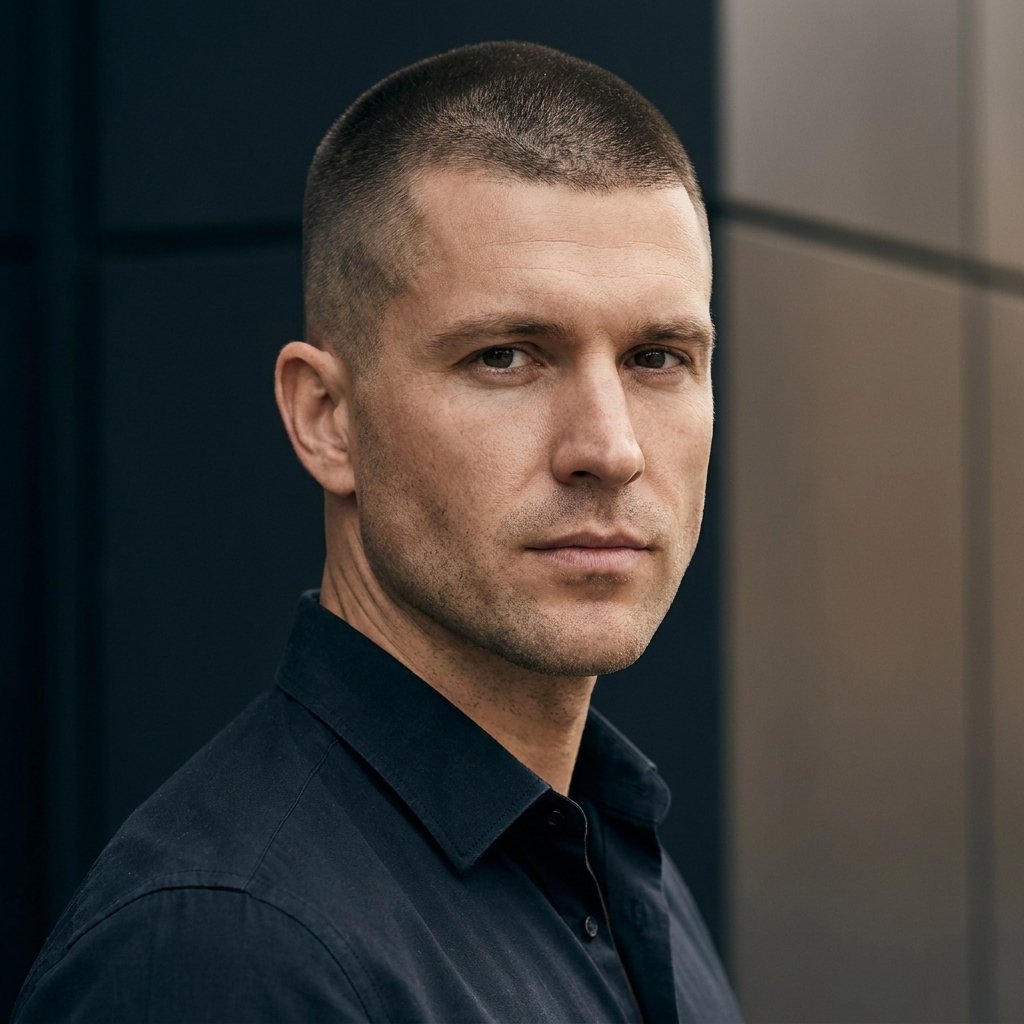
Men’s Scalp Micropigmentation: The Precision Aesthetic Guide
Introduction: The Man Who Chooses Precision
Consider the Manhattan executive who walks into a Madison Avenue clinic not because he is losing a battle, but because he has made a decision. He has evaluated his options with the same rigor he applies to a portfolio allocation or a boardroom negotiation. He wants a clean, sharp, defined look that reads as intentional in every room he enters. He is not there to hide something. He is there to design something.
This is the central truth of men’s scalp micropigmentation in 2026: it is not a consolation prize. It is a precision aesthetic instrument chosen by men who understand that a sharp, controlled presentation is both a competitive and a personal asset.
The reality of male hair loss is well documented. By age 35, roughly 40 to 65 percent of men experience noticeable hair loss, and up to 80 percent will develop androgenetic alopecia by age 70. But the men leading in their fields do not treat this as a crisis. They treat it as a variable to be managed with intelligence and taste.
Think of SMP the way one thinks of bespoke tailoring or considered architectural design. Every element is intentional. Every line is customized. Every result is engineered to perform across every setting. For the discerning man who has already researched the procedure and is now evaluating providers, this guide covers the aesthetic logic of SMP, the design process, its lifestyle compatibility, the critical importance of provider selection, and why a medically credentialed practice represents the standard worth pursuing.
What Men’s Scalp Micropigmentation Actually Is (And What It Is Not)
Scalp micropigmentation is a non-surgical procedure that uses medical-grade pigments to deposit micro-impressions into the scalp dermis, replicating the visual appearance of hair follicles at the skin level. The result is the look of a closely shaved head of dense hair.
This is not cosmetic tattooing dressed up with a new name. The International Society of Hair Restoration Surgery formally classifies SMP as “medical-grade micro-tattooing” and calls it “an indispensable part of the comprehensive hair surgeon’s practice.” The Cleveland Clinic describes it as “an effective, noninvasive way to make your hair look thicker,” providing mainstream medical validation that this is a legitimate restoration discipline.
The “consolation prize” narrative deserves to be dismantled directly. SMP is not what a man chooses when he cannot get a transplant. It is what a man chooses when he wants a specific aesthetic outcome: the sharp, defined, clean-shaved look that performs in every environment.
SMP differs from cosmetic tattooing on nearly every technical dimension, including pigment chemistry, needle depth, dot-pattern technique, artistic discipline, and critically, risk profile when performed in a medical setting rather than a beauty salon.
What SMP does not do is regrow hair. It is designed for men who have embraced, or are choosing, the short or shaved aesthetic. That is not a limitation. For the right man, it is precisely the point.
The Aesthetic Logic: Why High-Achieving Men Are Choosing SMP First
The strategic case for SMP begins with the recognition that appearance is not vanity for men in high-visibility roles. It is professional infrastructure.
A landmark multinational European study of 1,536 men found that over 70 percent considered hair an important feature of their image, and 62 percent said hair loss affects self-esteem, as cited in the Shapiro Medical guide. The stakes, in other words, are real and widely acknowledged.
Then there is the beauty premium. Peer-reviewed research has documented a 10 to 15 percent difference in career earnings linked to appearance, and a 2026 PsyPost study found that self-perceived attractiveness boosts men’s confidence and willingness to contribute professionally. In client-facing, high-stakes Manhattan roles, a sharp and confident presentation translates directly into performance.
The clinical evidence reinforces the psychological case. A 2021 study in the Journal of Plastic, Reconstructive and Aesthetic Surgery found that SMP significantly improved self-esteem and quality of life, with participants reporting greater confidence, attractiveness, and social acceptance.
The men choosing SMP have moved past hair anxiety and into deliberate aesthetic design. It is the same mindset that drives investment in bespoke suits, premium grooming, and considered interior spaces. The audience is also getting younger: up to 30 percent of men experience visible hair loss before age 30. For these men, SMP offers a lifestyle-compatible, non-surgical solution that aligns with how a modern professional approaches personal brand.
The SMP Design Process: Architecture for the Male Face
Hairline design is a core artistic discipline, not a technical checkbox. The quality of the design determines the quality of the result. A skilled SMP specialist must master and customize several design variables for each individual client.
Hairline Positioning: Height, Depth, and Facial Proportion
Hairline height is calibrated to facial structure, forehead proportion, and age. A hairline placed too low reads as artificial; placed too high, it loses the defining frame of the face.
Facial geometry drives the decision. Oval, square, rectangular, and round face shapes each call for different hairline architectures. Age-appropriate design matters just as much. A man in his 20s with progressing loss is best served by a conservative, slightly receded hairline that will not create a mismatch as his loss continues. A man in his 40s with a stabilized Norwood V to VI pattern has room for a more defined placement.
This is a collaborative process. The practitioner brings clinical and artistic expertise. The client brings his lifestyle, professional context, and aesthetic preferences.
Edge Definition: Sharp Edge-Up vs. Soft Graded Fade
There are two primary edge-definition styles. The sharp “edge-up” is crisp, defined, and barbershop-clean. The soft “graded fade” offers a natural transition and a less geometric appearance.
Edge style should match lifestyle and professional context. A sharp edge-up reads as intentional and groomed in boardroom and social settings. A soft fade can appear more natural for men who prefer a look that is not obviously designed. Edge definition also interacts with Norwood stage and scalp texture, factors a skilled specialist accounts for from the outset.
In 2026, AI-assisted scalp mapping and digital hairline simulation are available at leading clinics, allowing a man to visualize his design before a single needle touches the scalp.
Density Mapping and the Layered Pigment Approach
SMP is built session by session. The procedure typically requires two to four sessions, spaced 10 to 14 days apart, building from roughly 40 dots per square centimeter in session one to full density by session three. Understanding how many SMP sessions are needed is an important part of planning the process.
Density is varied deliberately across zones: denser at the hairline, lighter toward the crown. This creates a three-dimensional, natural-looking result rather than a flat, uniform appearance. Pigment depth precision is critical. Too shallow, and the pigment fades rapidly; too deep, and it blurs and migrates.
The layered approach is clinically validated. A 2025 study by Liu et al. in the Journal of Cosmetic Dermatology found that a standardized three-session protocol achieved Visual Density Scores of 8.7 out of 10 immediately post-treatment, holding at 7.7 out of 10 at six-month follow-up.
Pigment Science: Why Modern SMP Looks Nothing Like Its Early Iterations
The most common objection to SMP is a memory of its early reputation: pigments that shifted blue or green over time. That concern belongs to an earlier era. In 2026, modern SMP pigments are clinically tested and formulated specifically to resist color shift. The chemistry has fundamentally changed.
Pigment tone is matched to natural hair color, skin tone, and the desired level of contrast. This is a critical artistic decision that separates skilled practitioners from technicians. Pigment selection is also influenced by skin type and UV exposure patterns, which is precisely why a medically supervised consultation is essential.
SMP and the Manhattan Male Lifestyle: Performance in Every Setting
SMP is uniquely suited to the active, high-visibility Manhattan professional because it demands nothing of his time once healed.
It is zero-maintenance precision. No daily styling. No product. No morning routine adjustment. For a man who optimizes his time, that is a meaningful advantage.
It is gym and fitness compatible. SMP is sweat-proof and swim-proof. It performs in the gym, the pool, and the sauna without degradation, unlike hairpieces or topical concealers.
It delivers boardroom performance. A sharp, consistent hairline reads as intentional and groomed in every professional context, with no bad hair days and no thinning visible under conference room lighting.
It travels well. SMP looks the same on day one and day thirty, in New York and in any time zone. It is a consistent aesthetic asset. It is also barber-compatible: a closely cropped or shaved head is maintained with regular barber visits and no special protocols.
On lifestyle terms, the contrast with hair transplants is stark. Transplants require 6 to 12 months to assess results, involve recovery periods, and leave scarring. SMP delivers a visible result within weeks with minimal downtime.
Understanding the SMP Timeline: From Consultation to Settled Result
Knowing exactly what to expect is part of a confident decision. The process begins before treatment, with a consultation that includes scalp assessment, Norwood staging, collaborative hairline design, pigment matching, and a medical history review.
The Treatment Sessions: What Happens and How It Feels
The procedure spans two to four sessions, each lasting two to five hours depending on coverage area, spaced 10 to 14 days apart to allow healing between layers.
Most men describe the sensation as mild discomfort, comparable to a light tattoo. Topical numbing is typically applied. Immediately after each session, the scalp appears slightly reddened, with pigment that looks darker and more intense than the final healed result. This is normal. The fresh result and the healed result look different, and understanding this in advance prevents unnecessary concern.
The Healing Phases: Fresh, Healed, and Settled
Fresh (days 1 to 5): Pigment appears dark and the scalp may be slightly sensitive, with minimal activity restrictions.
Healed (days 7 to 14): Pigment lightens and softens as the skin heals over the deposits. This is precisely why multiple sessions are necessary to build density.
Settled (six weeks to three months post-final session): The true, long-term result emerges. Pigment integrates with the skin tone, and the hairline reads as natural and defined.
The six-month benchmark from the Liu et al. 2025 study confirmed high satisfaction scores of 7.7 out of 10 at six months, validating that well-executed SMP holds its quality over time. Results typically last four to six years, and some sources cite up to five to eight years, before a color-boost touch-up is recommended. Longevity is directly influenced by practitioner skill, pigment depth, UV exposure, and aftercare.
The Provider Decision: Why Medical Credentialing Is Non-Negotiable
Of every choice a man makes in the SMP process, the selection of a provider is the most consequential. The clinical data is unambiguous.
A 2025 retrospective study by Park et al. in the International Journal of Dermatology examined 120 patients requiring corrective SMP procedures. Of those patients, 89.2 percent had originally been treated at non-medical beauty salons. The study directly linked provider setting to adverse outcome risk, including severe mental stress and feelings of inferiority.
What goes wrong with unqualified providers is predictable: incorrect pigment depth causing blur, migration, or rapid fading; wrong pigment chemistry causing color shift; poor hairline design producing asymmetry or unnatural placement; and inadequate infection control. The ISHRS classification of SMP as medical-grade micro-tattooing is not semantic. It reflects the clinical skill, anatomical knowledge, and sterile technique required to perform SMP safely and effectively.
There is a categorical difference between a licensed SMP specialist operating within a medically supervised practice and a studio technician with a weekend certification. The provider decision calls for the same discernment a man applies to every other high-stakes decision. Credentials matter. Track record matters. The setting matters. Understanding why hair loss doctor training and experience really matters is essential context for any man evaluating providers.
What to Look for in a Manhattan SMP Provider
- Medical supervision: SMP performed within a licensed medical practice, with physician oversight, is fundamentally different from a standalone studio.
- Practitioner licensure and specialty training: Look for a licensed SMP specialist with documented experience in aesthetic dermatology and plastic surgery, not a general tattoo artist who added SMP to a service menu.
- Portfolio depth and diversity: Review before-and-after results across multiple Norwood stages, skin tones, and hairline styles, not just best-case examples.
- Consultation quality: A skilled provider assesses scalp health, discusses Norwood progression, and designs a hairline collaboratively rather than offering a one-size-fits-all approach.
- Pigment and equipment standards: Medical-grade pigments and sterile, single-use equipment are baseline requirements.
- Facility standards: A state-of-the-art clinical environment signals the level of care and investment behind every procedure.
Michael Ferranti at Hair Doctor NYC: The Medically Credentialed SMP Standard in Manhattan
At Hair Doctor NYC, scalp micropigmentation is led by Michael Ferranti, PA, a licensed SMP specialist with more than 25 years of experience in aesthetic dermatology and plastic surgery. That background is uniquely qualifying. Two and a half decades in aesthetic dermatology and plastic surgery means Ferranti understands facial anatomy, skin physiology, and aesthetic proportion at a clinical level a studio technician cannot replicate.
The context matters as much as the practitioner. Hair Doctor NYC operates under the leadership of Dr. Roy B. Stoller, a double board-certified facial plastic surgeon with more than 25 years of experience and over 6,000 successful hair transplant procedures. This creates a medically rigorous environment for SMP that is rare in the New York market.
The team depth reinforces the standard. Hair Doctor NYC includes multiple double board-certified facial plastic surgeons, including Dr. Stoller and Dr. Louis Mariotti, alongside Dr. Christopher Pawlinga, who has dedicated 18 years exclusively to hair transplantation. Ferranti’s SMP work is embedded in a practice that understands hair, scalp, and facial aesthetics at the highest clinical level.
The clinic’s Madison Avenue location in Midtown Manhattan reflects both the caliber of clientele and the standard of care. For candidates who may also be transplant candidates, having surgical and non-surgical expertise under one roof means the treatment recommendation is always in the patient’s best interest, not driven by what a single-service provider is able to offer.
There is also a distinct advantage for scar camouflage. Hair Doctor NYC’s surgical expertise makes it uniquely positioned to serve men seeking SMP to conceal donor-area scars from prior FUE or FUT procedures, a growing need as ISHRS data shows repair procedures climbing to 6.9 percent of all hair transplants in 2024.
SMP vs. Hair Transplant: A Framework for the Deliberate Decision-Maker
The right question is not “which is better.” It is “which is right for a specific aesthetic goal and lifestyle.”
Start with the aesthetic goal. If a man’s desired outcome is a full head of growing hair, a transplant may be the appropriate path. If his desired outcome is the sharp, clean, shaved aesthetic, SMP is not a compromise; it is the direct route.
On timeline, SMP delivers a visible result within weeks, while a transplant requires 6 to 12 months to assess full results. On recovery, SMP involves days of minimal downtime, while a transplant involves a more significant recovery period. On scarring, FUE minimizes but does not eliminate scarring, whereas SMP leaves none and can camouflage existing transplant scars. On maintenance, SMP requires nothing daily beyond sun protection and periodic touch-ups every four to six years, while transplanted hair requires ongoing styling and potential additional procedures as loss progresses.
The two are not mutually exclusive. Many men use SMP to enhance transplant density, camouflage scars, or address areas where transplant coverage is insufficient. The ISHRS even predicts that future hair transplants will increasingly incorporate SMP to optimize outcomes. The goal is the right decision for a man’s specific situation, not the promotion of one procedure over another.
SMP Candidacy: Who Is the Ideal Candidate?
- Men at any Norwood stage (I to VII). The design approach varies significantly by stage, but candidacy spans the full range.
- Men who prefer the closely cropped or shaved aesthetic. SMP is designed to complement this look, not to simulate long hair.
- Men with alopecia areata, diffuse thinning, or scarring alopecia. The Liu et al. 2025 study validated SMP across diverse alopecia subtypes.
- Men with previous hair transplant scars. SMP is highly effective for scar revision and density enhancement.
- Men who are not surgical candidates due to insufficient donor hair, health considerations, or personal preference.
- Men who want a result without the recovery, surgical risk, or extended timeline of a transplant.
Age informs the design. Younger men in their 20s and 30s with progressing loss benefit from conservative hairline designs that age gracefully. Older men with stabilized loss enjoy more design flexibility. In every case, a thorough consultation assesses scalp health, skin tone, and any conditions that may affect pigment retention or healing.
Aftercare and Long-Term Maintenance: Protecting the Investment
Immediate post-session care is straightforward: avoid direct sun exposure, swimming, and heavy sweating for the first four to five days after each session, and keep the scalp clean and moisturized as directed.
Sun protection is the single most important long-term maintenance factor. UV exposure accelerates pigment fading, which makes daily SPF application to the scalp a non-negotiable habit for men who want to maximize longevity. Moisturization matters as well. A well-hydrated scalp maintains pigment vibrancy and skin quality, and it is a simple addition to any grooming routine.
Most men return for a color-boost touch-up every four to six years, and some go up to eight, depending on skin type, UV exposure, and pigment depth. That is a minimal time investment relative to the daily maintenance it eliminates. Over the long term, men should avoid harsh chemical scalp treatments, prolonged unprotected sun exposure, and aggressive exfoliation over the treated area.
At Hair Doctor NYC, medical oversight means aftercare guidance is clinically grounded rather than generic, and follow-up is built into the patient relationship.
Conclusion: The Precision Aesthetic Choice
Scalp micropigmentation is not a reaction to hair loss. It is a deliberate, design-forward aesthetic decision made by men who know exactly what they want and how they intend to present themselves.
The sharp, clean, confident look SMP delivers is not a compromise. It is a precision outcome that performs in every setting a high-achieving Manhattan man inhabits. The weight of the provider decision cannot be overstated. The difference between an exceptional result and a corrective procedure is almost entirely determined by who performs it and in what setting. The finding that 89.2 percent of revision patients originated at non-medical salons makes that unambiguous.
The same judgment a man applies to every other high-stakes decision applies here. Credentials, artistry, and the right environment matter. In 2026, men’s scalp micropigmentation is a clinically validated, globally growing aesthetic discipline. The men choosing it are not settling. They are leading.
Ready to Design Your Look? Schedule a Consultation at Hair Doctor NYC
For the man who has done his research and knows what he wants, the next step is a conversation with a specialist who can bring his vision to life.
A consultation at Hair Doctor NYC is a design session, not a sales appointment. Michael Ferranti and the team will assess the scalp, discuss aesthetic goals, and develop a hairline design tailored to facial structure, Norwood stage, and lifestyle. The clinic is located on Madison Avenue in Midtown Manhattan, a state-of-the-art environment that matches the standard of care a discerning patient expects.
Visit hairdoctornyc.com to schedule an SMP consultation. Consultations are personalized, confidential, and designed for men who value their time: no pressure, no generic protocols, only expert guidance tailored to each individual situation.