
Hair Restoration Specialists: Why the Whole Team Must Qualify
Introduction: The Credential Question Doesn’t End With the Founder’s Bio
The research pattern is familiar. A prospective patient searches for “hair restoration specialists,” narrows the field to a handful of practices, and lands on a lead surgeon’s biography: decades of experience, thousands of procedures, a list of board certifications. The bio is impressive, the consultation gets booked, and the patient quietly assumes that the same standard applies to whoever actually performs the surgery.
That assumption is rarely tested. Most credential-focused content in the hair restoration field, including much of the industry’s own coverage, explains the difference between the American Board of Hair Restoration Surgery (ABHRS) and the International Society of Hair Restoration Surgery (ISHRS) at the level of the individual physician. Then it stops. Multi-provider practices, where several surgeons, physician assistants, or associates may be involved in patient care, go largely unexamined.
This article makes two arguments. First, a credentialed founder’s reputation can create a halo effect that patients mistakenly extend to every associate, PA, or junior surgeon on staff. Second, the popular narrative that solo “one-surgeon-a-day” boutiques are inherently more rigorous confuses low scheduling capacity with credentialing superiority.
What follows is a framework for discerning patients who want to verify every named provider on a team, not just the one whose name is on the door.
The Credential Hierarchy, Briefly Revisited
The credential hierarchy has been covered at length elsewhere, so a concise summary is enough to build on.
The core problem is regulatory. Hair transplant surgery sits in a gray zone of American medicine: no federal or state law requires specialized training before a licensed physician performs the procedure. Most surgical specialties work differently. In those fields, board certification is effectively mandatory for hospital privileges and insurance participation. Hair restoration, performed almost entirely in private office settings, has no equivalent gatekeeper.
ABHRS Diplomate Status: The Only Validated Exam in the Field
According to the American Board of Hair Restoration Surgery, its exam is the only psychometrically and statistically validated examination dedicated specifically to hair restoration surgery. The credential is rare: approximately 270 hair restoration surgeons worldwide have completed the pathway to Diplomate status.
The pathway demands evidence, not just a license. Applicants must submit:
- Two reference letters from physicians with personal knowledge of the applicant’s surgical skills
- Documented case logs showing a minimum of 150 hair restoration cases in the preceding three years
ISHRS Membership Is Tiered, Not a Single Credential
Basic ISHRS membership and ABHRS Diplomate status are not equivalent. Fewer than 23% of ISHRS members hold the Diplomate credential.
ISHRS membership itself is also tiered. The Fellow designation (FISHRS), established in 2012 as the highest recognition the Society bestows, is earned through a competitive, point-based Scorecard of Eligibility. Fellows must earn 3 points every 3 years, with at least 3 points acquired through in-person World Congress attendance every 6 years. The designation cannot be purchased with dues.
For context, the ISHRS describes itself as a global non-profit medical association with roughly 1,200 members across 80 countries. That relatively small number underscores how selective genuine specialization in this field actually is.
Why Licensure Alone Isn’t Proof of Qualification
A medical license permits a physician to perform hair transplant surgery without any specialized training in the procedure. Credentialing bodies exist precisely to fill that gap.
This leads to the article’s real focus: the standard has to be verified for every provider who touches a patient, not just the physician whose name appears in the marketing.
The Halo Effect: When One Surgeon’s Reputation Covers an Entire Team
In consumer-trust terms, the halo effect works simply. A patient researches a founder’s decades of experience and procedure count, then unconsciously assumes every provider at that practice meets the same bar.
Practice marketing often reinforces this. The founder’s bio, case volume, and before-and-after gallery dominate the website. The provider who will perform a given patient’s most consequential surgical steps may never be named at all.
The risk is straightforward. If an associate, PA, or junior surgeon has not independently earned ABHRS Diplomate status or verified ISHRS standing, their qualifications cannot be inferred from a colleague’s credentials.
How the Halo Effect Forms in Multi-Surgeon Practices
The mechanics are subtle. Consistent branding, shared clinic photography, and practice-level testimonials all credit results to “the practice” rather than the individual surgeon who produced them. A glowing review describing an excellent hairline rarely specifies which hands created it.
A founder’s headline statistics, such as 25+ years of experience or thousands of procedures performed, are easy to find. They say nothing about who is actually scheduled for a particular patient’s surgery date.
Why the Halo Effect Matters Clinically and Legally
The stakes go beyond aesthetics. The NIH-published Hair Transplant Practice Guidelines state plainly that “the concept of nonphysicians removing human tissue and primarily performing HT surgery is improper and not acceptable” and “not consistent with the standard of care in the medical community.”
Enforcement is real. Florida, Virginia, California, Illinois, and New York have all taken formal disciplinary action against physicians who allowed unlicensed individuals to perform surgical steps. Illinois law explicitly requires that only a licensed physician perform procedures involving incisions in the skin, including FUE punch graft harvesting and recipient site creation.
There is also a financial and legal exposure that many patients never consider. When unlicensed technicians perform surgical steps, patients may have no malpractice recourse, because technicians are typically not covered by malpractice insurance. If something goes wrong, the patient may be left without legal protection.
The Non-Delegable Act Standard: What Every Provider Must Personally Meet
“Non-delegable acts” are the surgical steps a licensed physician must personally perform. In hair restoration, the two most critical are:
- Graft extraction (including FUE punch harvesting)
- Recipient-site incision creation (the incisions that determine angle, direction, density, and ultimately the naturalness of the result)
These steps cannot be handed off to unlicensed staff, however credentialed the supervising surgeon may be.
This standard is the real test of a qualified team. Each individual who handles a scalpel or punch tool has to meet it personally. It cannot be inherited from a credentialed colleague down the hall.
This is where the halo effect becomes dangerous. The fact that a founder meets the non-delegable-act standard does not automatically mean every associate performing procedures under the practice’s name meets it too.
Verifying Each Provider Independently
Verification is practical and quick:
- Search the named surgeon directly in the ABHRS Diplomate registry. Diplomate status is either listed or it is not.
- Cross-check the surgeon’s standing in the ISHRS member directory, noting whether the listing reflects basic membership or Fellow status.
Patients should also watch for a recurring red-flag pattern in consultations and marketing materials: vague references to a “surgical team” or “technicians” without named, individually credentialed providers. Collective language can be perfectly benign, but it can also hide who actually performs the surgery.
The simplest safeguard is to request, before booking, the name and credentials of the specific person who will perform the extraction and recipient-site creation.
Reframing the Solo-Surgeon Myth: Capacity Is Not a Credential
In New York, a prevailing narrative holds that “one-surgeon-a-day” boutique practices are inherently more rigorous because they are exclusive. The scarcity is presented as a mark of quality.
That framing deserves scrutiny. Limited daily capacity reflects a scheduling bottleneck created by having only one credentialed surgeon on staff. It is not, by itself, evidence of superior vetting, screening, or surgical standard.
The argument has a logical gap. A solo practice has exactly one credentialed surgeon, whether that scarcity is marketed as exclusivity or not. It does not inherently outperform a practice with several independently credentialed surgeons, each personally meeting the same non-delegable-act standard.
A properly vetted multi-surgeon model delivers identical rigor per provider while removing an artificial constraint on patient access.
Procedural Volume as a Proxy for Collective Expertise
According to ISHRS data, member surgeons performed an average of 15 hair restoration surgeries per month in 2024. That figure is a useful benchmark for what an active specialist’s caseload looks like.
A multi-surgeon team can combine strengths that no single surgeon can replicate alone. Decades-long specialization, such as 18+ years focused exclusively on hair transplantation, can sit alongside high-volume individual track records in the thousands of procedures. Each surgeon’s experience stands on its own, and together they create a depth of judgment that one practitioner alone cannot offer.
Session-level benchmarks from the ISHRS 2025 Practice Census add context for what specialist-level execution looks like, regardless of practice size:
- Two-thirds (67.3%) of members report achieving the desired result in a single procedure, with an average of 1.5 procedures and a median of 1.
- More than half (58.4%) perform 1,000 to 1,999 grafts per session for first procedures.
Rising Patient Demand Makes Access a Real Factor
Demand for qualified surgical hair restoration is accelerating. The ISHRS 2025 Practice Census found that the average number of patients per member rose 20% since 2021.
Patients are also starting younger. In 2024, 95% of first-time surgery patients began treatment between ages 20 and 35. This demographic is often managing demanding careers and public-facing roles, and many cannot easily absorb the long wait times inherent to single-surgeon, limited-slot practices.
Long waiting lists at solo practices are a genuine tradeoff that patients should weigh consciously. They are not an automatic signal of quality.
What Separates a Vetted Multi-Surgeon Team From a Credential-by-Association Practice
The following framework can be applied to any practice under evaluation. It is a tool for discerning patients, not a sales pitch.
Transparency is the dividing line. A legitimately vetted team discloses and names every provider’s individual credentials. A credential-by-association practice leans on one headline bio.
Individual Verification Checklist
- Confirm ABHRS Diplomate status for the specific surgeon, by name, in the official registry.
- Confirm ISHRS membership tier (member or Fellow/FISHRS) in the official directory.
- Ask for documented case volume consistent with the ABHRS logging standard of 150 cases over three years.
- Check for consistent, specific board-certification language (for example, “double board-certified facial plastic surgeon”) rather than generic claims of expertise.
Practice-Level Transparency Checklist
- Does every surgeon on staff have a named, credential-specific bio, or does the marketing center exclusively on one founder?
- Does the practice disclose who personally performs extraction and recipient-site creation for a given patient?
- Does the practice proactively address the unlicensed-technician risk, in line with the ISHRS “Fight the FIGHT” (Fraudulent, Illicit & Global Hair Transplants) awareness effort, rather than staying silent on it?
The Black-Market Contrast: Why Full-Team Vetting Is the Real Safety Line
The stakes extend well beyond the solo-versus-multi-surgeon debate.
According to ISHRS census data, repair procedures rose to 6.9% of all transplants in 2024, up from 5.4% in 2021, largely because of black-market procedures. Meanwhile, 59% of ISHRS members report black-market clinics operating in their cities, up from 51% in 2021. The problem is growing regardless of practice size or structure.
Laser medicine offers a parallel precedent. Researchers reviewing legal cases related to procedures such as laser hair and scar removal found that 75 of 175 cases involved a non-physician operating the device. The proportion of lawsuits naming a nurse, medical assistant, technician, or “intern” as the operator more than doubled between 2008 and 2011.
For patients, the meaningful dividing line is not solo boutique versus multi-surgeon practice. It is credentialed, disclosed providers versus undisclosed delegation, and undisclosed delegation can happen at a practice of any size.
How a Properly Vetted Multi-Surgeon Team Should Be Structured
Team-wide qualification has a recognizable shape. It includes multiple independently board-certified surgeons, each with credentials that can be verified individually rather than borrowed from a senior colleague’s reputation.
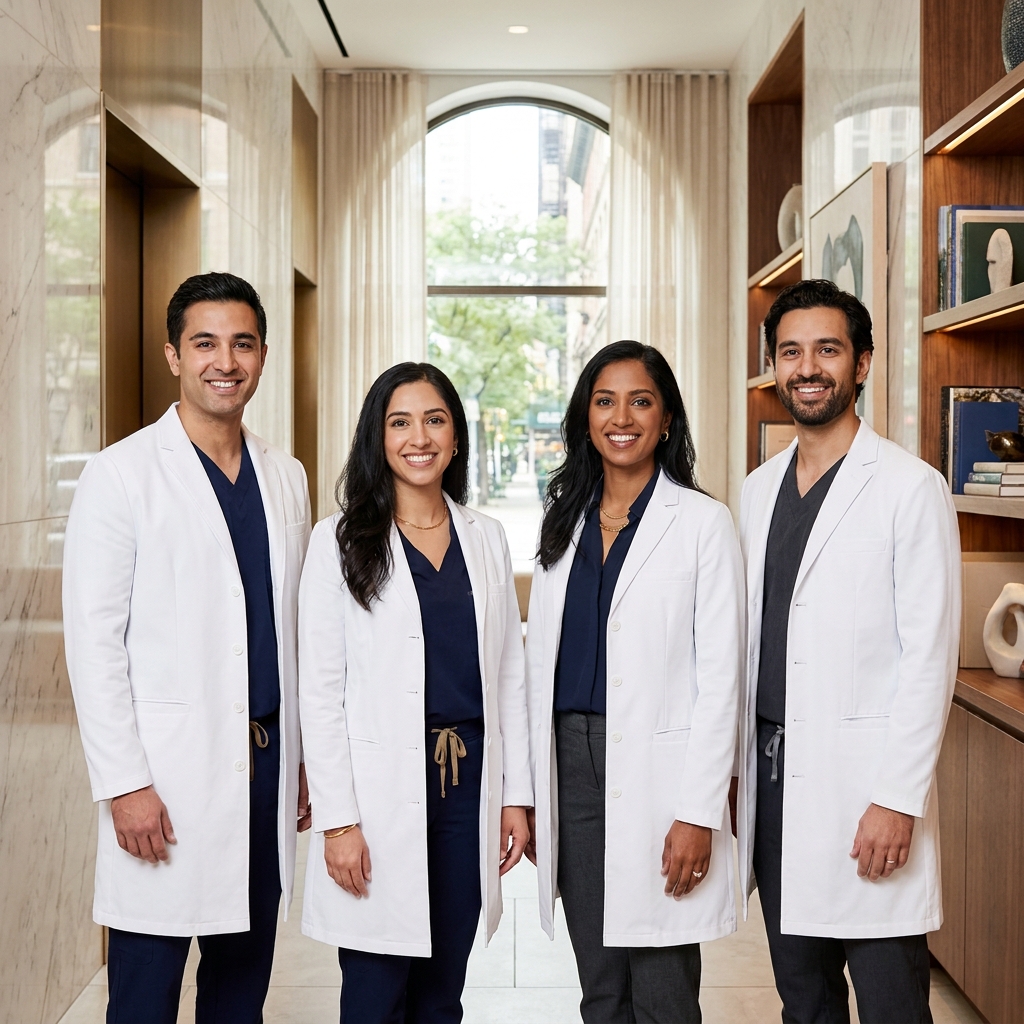
Complementary specializations add real value. Hair Doctor NYC illustrates the model. Its team pairs Dr. Roy B. Stoller, a double board-certified surgeon with 25+ years in facial plastic surgery and more than 6,000 hair transplant procedures, with Dr. Louis Mariotti, a double board-certified facial plastic surgeon focused on surgical detail and facial harmony. They work alongside Dr. Christopher Pawlinga, who has spent 18 years dedicated exclusively to hair transplantation. For non-surgical care, Michael Ferranti, P.A., a licensed scalp micropigmentation specialist with 25+ years in aesthetic dermatology and plastic surgery, handles SMP, a distinct, non-surgical discipline.
The principle that matters is presentation. Each provider’s qualifications should be stated and verifiable on their own terms, not folded into a founder’s aggregate statistics.
A team built this way can offer patients meaningfully greater scheduling access without lowering the bar any single provider must meet for non-delegable acts.
Questions to Ask Before Choosing a Multi-Surgeon Practice
Prospective patients can bring these questions to any consultation:
- “Who, specifically, will perform my extraction and recipient-site creation, and can I see that person’s name and credentials in advance?”
- “Can you point me to this surgeon’s listing in the ABHRS registry or ISHRS directory?”
- “What is this specific surgeon’s documented case volume and years of focused experience, independent of other providers at the practice?”
- “Will one surgeon handle my entire procedure, or will multiple providers be involved, and what are each of their individual qualifications?”
- “How does the practice address the risk of unlicensed personnel performing surgical steps?”
A qualified practice should welcome every one of these questions and answer them clearly.
Conclusion: Qualify the Whole Team, Not Just the Name on the Door
The credential hierarchy that matters (ABHRS Diplomate status, verified ISHRS standing, and documented experience with non-delegable acts) has to be met by every provider who will touch a patient’s scalp. It cannot be assumed from a founder’s reputation.
The solo-practice reframe follows from that principle. Limited capacity is a scheduling constraint, not proof of elevated rigor, and it should not be mistaken for a credentialing advantage.
A transparent, independently verifiable multi-surgeon team can deliver the same non-delegable-act standard as any solo boutique while offering far greater patient access.
The practical takeaway is simple: verify, don’t assume. Discerning patients should check each named provider directly against the ABHRS registry and ISHRS directory before committing to a consultation.
Verify the Full Hair Doctor NYC Team Before Your Consultation
Hair Doctor NYC invites prospective patients to review the individually stated credentials of every provider on its team, including its double board-certified facial plastic surgeons and a surgeon with 18 years exclusively dedicated to hair transplantation. Patients are not asked to rely on a single headline bio.
In keeping with the framework outlined above, patients are encouraged to check named providers independently against the ABHRS registry and ISHRS directory as part of their due diligence.
Those ready to take the next step can schedule a consultation at the practice’s Madison Avenue location in Midtown Manhattan to discuss candidacy for FUE, FUT, scalp micropigmentation, or facial hair restoration, with a team whose every provider’s qualifications are built to withstand independent verification.