

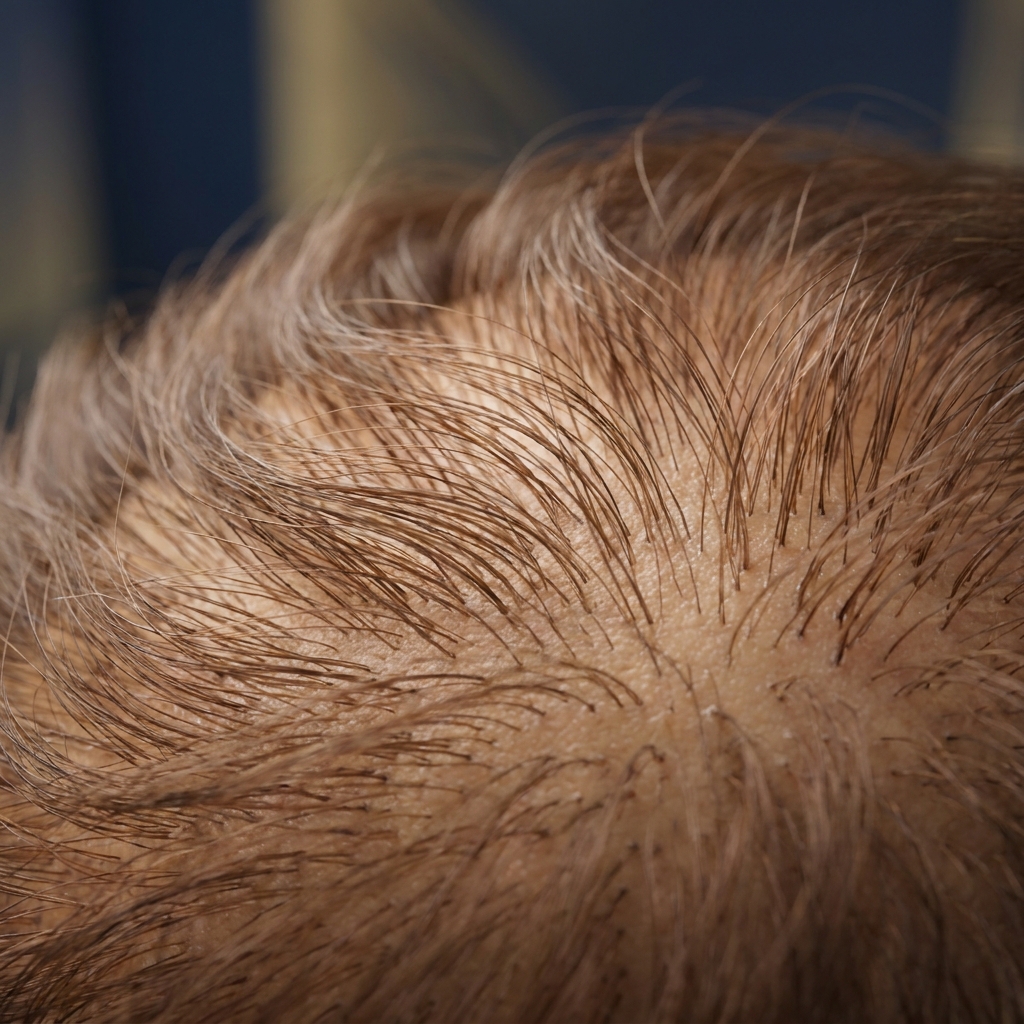
Hair Plugs Transplant: The Graft-Size Science Behind the Fear
Introduction: Why the Word “Plugs” Still Haunts a Modern Procedure
Most people who type “hair plugs transplant” into a search bar are not looking for a procedure from the 1950s. They are using legacy terminology to answer a more pressing question: will modern hair restoration look fake? The word “plugs” has outlived the technique it describes by decades, and it still carries the image of rows of doll-like tufts on an otherwise bare scalp.
This article addresses that fear in two parts. The first explains the graft-size physics that made old plugs look unnatural, and why those physics no longer apply. The second covers a risk that is rarely discussed: a well-executed modern transplant can still develop a “pluggy” appearance 10 to 15 years later if the surrounding native hair was not accounted for in the original design.
That second point changes the question. Avoiding outdated technique is easy in 2026. The harder task is finding a surgeon whose plan accounts for a patient’s future hairline as well as the one he has now. For men treating hair restoration as a long-term investment in their appearance, that distinction matters more than any comparison table.
1952: The Origin Story of the Modern Hair Transplant and the Original Sin of Graft Size
Modern hair transplantation began in New York City in 1952, when Dr. Norman Orentreich performed the first successful procedures using 4mm punch grafts, roughly the width of a pencil eraser.
Orentreich’s central insight was correct, and it remains the foundation of every transplant performed today. He identified donor dominance: hair taken from the back and sides of the scalp keeps its genetic resistance to balding when it is moved to a thinning area. Relocated follicles behave according to where they came from, not where they are placed.
The idea was sound. The instruments were the problem. Surgeons of that era had no tools capable of working at the microscopic, anatomical scale of individual follicles, so they cut what they could: large circular cores of scalp.
That technical limit shaped the field from the 1950s through the 1980s. Throughout the 1970s, every hair transplant used large grafts, and the public came to know them as “hair plugs.”
The Graft-Size Science: Why 4 to 10mm Punches Created an Unfixable Look
The appearance of classic plugs follows directly from their size.
- Classic plug grafts measured 4 to 10mm in diameter and contained 10 to 30 hairs each.
- A natural follicular unit, the way hair actually grows from the human scalp, contains 1 to 4 hairs.
Each plug carried five to ten times more hair than nature ever groups together. When surgeons placed these grafts in rows, the result was dense tufts separated by visible bald scalp. There was no density gradient and no feathering between grafts, and the eye reads that pattern as artificial immediately. Patients and surgeons called it the “doll’s head” effect.
The problems went beyond appearance. The American Society of Plastic Surgeons documents the mechanical risks of plug grafts: the skin plug sometimes died before regrowth could establish itself, which meant surgery had to be repeated. Many patients also developed small bumps on the scalp at the transplant sites. That was a direct structural consequence of forcing large tissue cylinders into the recipient scalp.
The underlying cause was not a matter of taste or styling. It was a biomechanical mismatch between graft size and the scalp’s natural architecture. No amount of surgical care could make a 30-hair cylinder behave like a 2-hair follicular unit.
The Turning Point: How the Field Learned to Work With Biology Instead of Against It
The first major change came in 1995, with the introduction of Follicular Unit Transplantation (FUT), commonly called the strip method.
FUT changed the way surgeons thought about grafts. Instead of punching out arbitrary circles of scalp, they removed a strip of donor tissue and dissected it under magnification into naturally occurring follicular units. For the first time, the graft followed the hair’s own biology.
That one change removed the cause of the doll-hair effect. Once grafts contained 1 to 4 hairs, matching how hair grows naturally, transplanted areas could reproduce the subtle, irregular density of a natural scalp. The American Academy of Dermatology summarizes the shift simply: most surgeons now transplant healthy hairs a few at a time.
Follicular Unit Extraction (FUE) followed as a refinement of this principle, applying the same follicular-unit logic but harvesting each unit individually with a small round micro-punch, so no strip is removed.
Today’s Standard: Sub-Millimeter Precision and What It Actually Means
The difference in scale is large. Old plug punches measured 4 to 10mm. Modern FUE punches measure approximately 0.8 to 0.9 millimeters, a reduction of roughly 90% in tissue diameter.
At this scale, surgeons can extract and place single follicular units one at a time. That allows them to copy nature’s irregular, non-uniform spacing instead of imposing a grid, and to control angle, direction, and density at the level of individual grafts.
The industry has largely settled on this approach. According to the ISHRS 2025 Practice Census, FUE accounts for approximately 80% of all surgical hair transplant procedures globally.
Graft survival figures show how mature the technique has become:
| Technique | Typical Graft Survival |
|---|---|
| Modern FUE (accredited, surgeon-led clinics) | 90% to 95% |
| Top-tier FUE centers (at 12 months) | 95% to 98% |
| FUT | 85% to 95% |
Robotic-assisted harvesting, FDA-cleared since 2011, is another sign of how far instrumentation has come. It also has limits. Current robotic systems are cleared specifically for men with black or brown straight hair and androgenetic alopecia, and they have difficulty with curly or light hair and with advanced donor conservation. Better tools have not removed the need for surgeon judgment; graft selection, hairline design, and donor management still depend on it.
Setting Honest Expectations: What Modern Transplants Still Involve
Marketing often describes FUE as “scarless.” That claim is false.
Both FUE and FUT leave donor-site scarring. FUE typically produces small, round, dot-like scars spread across the donor area. FUT leaves a single linear scar. The International Society of Hair Restoration Surgery (ISHRS) states this plainly in its patient guide, warning against “false advertising claims of ‘a no scar technique'” and noting that FUE almost always leaves small round scars.
The same guide notes that properly performed FUE scars can usually be hidden with short hairstyles. That is reassuring, but it should be explained during the consultation, not discovered after surgery.
How a practice handles this topic says a lot about it. A clinic that discusses scarring openly is more likely to be honest about everything else. A clinic that promises “no scars” has already told a prospective patient something important about its standards.
The Angle Almost No One Discusses: The “Future Pluggy” Risk in Modern Transplants
Most discussions of plugs stop at the history. The more important risk for patients considering surgery in 2026 is a different one.
A technically flawless transplant performed today can still develop a pluggy appearance 10 to 15 years from now. The cause is not outdated technique. It is untreated progression of native hair loss.
The mechanism is simple. Transplanted follicles, taken from genetically resistant donor zones, keep their density indefinitely. The surrounding native hair does not. It continues to thin under ongoing androgenetic alopecia.
Over time, the transplanted grafts begin to stand out as isolated islands of density against an increasingly sparse background. The contrast that defined 1970s plugs returns, at a smaller and subtler scale. Instead of tufts against bare skin, the patient sees a dense transplanted zone bordered by thinning native hair, and that edge is visible.
This is not a surgical failure in the usual sense. The grafts were placed correctly and grew as intended. It is a design failure: the original plan did not account for the patient’s full hair-loss trajectory.
Mainstream medical sources are clear on this. Mayo Clinic notes that hair transplants do not change a patient’s genetics, and that a patient in his 30s will likely keep losing hair for some time, so additional transplants may be needed for newly thinning areas. Because most surgery happens early in adulthood, continued loss in untreated areas should be expected, not treated as a rare complication.
Designing for Trajectory, Not Just Today’s Hairline
Designing for trajectory means building a plan that will still look natural as the patient’s native hair changes. In practice, that usually involves:
- Conservative hairline placement that suits a mature face, not only a 28-year-old one
- Deliberate distribution of graft density, so transplanted zones blend gradually instead of ending abruptly
- Preserving donor supply, since donor follicles are finite and future sessions may need them
Experienced surgeons estimate a patient’s probable loss pattern over decades. They consider family history, Norwood progression patterns, age at onset, and the current rate of miniaturization. The goal is a result that looks right in the mirror today and still looks right years later.
This is a judgment call. It depends on pattern recognition built across thousands of cases, and a standard graft-count formula cannot replace it. Hair Doctor NYC’s team reflects that kind of depth. It includes double board-certified facial plastic surgeons, a lead surgeon with 25+ years of experience and more than 6,000 hair transplant procedures, and Dr. Christopher Pawlinga, who has spent 18 years working exclusively in hair transplantation.
Why This Reframes the Buying Decision Entirely
The choice between “plugs” and a modern transplant was settled decades ago. The decision a patient actually faces now is which surgeon is planning for his hair in 2040, not only in 2026.
That requires aesthetic judgment as much as technical skill. The surgeon has to anticipate thinning that has not happened yet and place grafts that will blend with hair that may not exist in a decade. No machine can make that call.
Follow-up procedures are a normal part of long-term restoration. ISHRS census data shows that 67.3% of physicians report an average of one procedure per patient, while 30.8% report two and 1.9% report three or more. Most patients need only one session, but a meaningful share need more. An original design that leaves room, both aesthetically and in the donor area, for future sessions is what keeps those options open.
For Patients Starting With Visible Old Plugs: Revision Is Usually Possible
Men who had plug procedures decades ago do not have to accept the results permanently. Visible old plugs can typically be refined with modern FUE.
Revision usually involves:
- Redistributing or camouflaging existing tufts so they no longer read as separate clusters
- Softening harsh hairlines with single-hair grafts at the leading edge
- Adding density between plugs to break up the grid and restore a natural gradient
Revision cases are harder than first-time procedures. Scar tissue in the recipient area and previous donor harvesting can limit both graft supply and placement options. Experience with revision work matters here, and not every practice has it. Hair Doctor NYC lists scar revision, including donor scars from earlier procedures, among the conditions it treats.
Vetting a Provider: What High-Value Patients Should Ask Before Committing
Unqualified providers are a real risk. In the ISHRS Practice Census, 59.4% of members reported unlicensed, black-market hair transplant clinics operating in their city. Patients who do not check credentials are exposed to that risk.
Mayo Clinic also warns about procedures that implant synthetic fibers into the scalp, marketed to resemble real hair. These carry a higher risk of complications and produce no actual regrowth.
Before committing, a careful patient should ask:
- Board certification: Is the surgeon board-certified, and in which specialty?
- Specialization: How many years has the surgeon worked specifically in hair restoration, as opposed to general cosmetic practice?
- Volume: How many hair transplant procedures has the surgeon personally performed?
- Trajectory planning: Does the consultation cover long-term hair loss progression, or only the immediate hairline?
- Transparency: Does the practice openly discuss donor scarring, possible follow-up sessions, and realistic graft survival?
Complications are uncommon in accredited settings, but they do occur. A 2026 review in Frontiers in Medicine confirms FUE’s generally favorable safety profile while documenting complications such as folliculitis, shock loss, and recipient-site necrosis. Experienced, board-certified oversight reduces those risks and ensures they are managed properly if they occur.
The Modern Patient Landscape: Who Is Getting Transplants in 2026
Hair restoration is now a common, mainstream decision. ISHRS data shows that in 2024, 95% of first-time surgical patients were between the ages of 20 and 35. Female patients grew 16.5% between 2021 and 2024, making women the fastest-growing segment in surgical hair restoration.
Typical graft counts give some context. ISHRS members reported averages of approximately 2,347 grafts in a first session and 1,637 in subsequent sessions.
Public attitudes have also changed. Public figures including John Cena, Joel McHale, Wayne Rooney, Jimmy Carr, Joe Buck, and Joe Marler have openly confirmed FUE procedures, often talking candidly about genetics and multiple sessions. A procedure that was once kept secret is now discussed on podcasts.
Patient motivations follow a consistent pattern. Census data shows that most patients cite feeling more attractive, wanting to look younger, and staying competitive at work as their main reasons. A substantial share of patients now plan to tell friends and family about the procedure. For professionals in competitive fields, those motivations are practical and reasonable.
Conclusion: From Fear of Plugs to Confidence in Design
The physics that ruined old plugs, oversized grafts forced into unnatural clusters, has been solved for three decades. Follicular-unit techniques and sub-millimeter instruments allow surgeons to reproduce how hair actually grows, and the doll’s-head look belongs to a past era of instrumentation.
What remains is a planning risk, not a technical one. A transplant designed only for today’s hairline, with no allowance for continued thinning, can recreate the old contrast problem at a smaller scale.
The useful question for a discerning patient is not “Will this look natural now?” It is “Will this still look natural in 15 years?” Answering it well takes surgical artistry and decades of pattern-recognition experience, not just modern tools.
Schedule a Trajectory-Focused Consultation at Hair Doctor NYC
Hair Doctor NYC invites prospective patients to a private consultation at its Madison Avenue clinic in Midtown Manhattan. The consultation covers the current hairline and a long-term restoration plan based on each patient’s individual hair loss trajectory.
The practice’s multi-surgeon team includes double board-certified facial plastic surgeons and physicians with 18 to 25+ years of focused experience, led by a surgeon with more than 6,000 hair transplant procedures. That experience is what forward-looking design depends on. The practice offers FUE, FUT, scalp micropigmentation, and facial hair restoration, so recommendations can follow what each patient actually needs.
Under its “Excellence Meets Elegance” approach, every case is handled discreetly and planned individually for patients who expect their results to look natural for decades, not just in the first year.
Patients ready to plan for the long term can request a private consultation with Hair Doctor NYC to discuss their goals and their options.