

Hair Transplant for Burn Scar on Scalp: The Vascular Readiness Protocol
Introduction: The Procedure That Started It All and Why Burn Scars Demand a Different Standard
In the 1930s, Japanese physician Okuda documented the first successful hair transplantation procedures. The indication was not male pattern baldness. It was burn scar alopecia. This historical irony deserves recognition: the very procedure now synonymous with cosmetic hair restoration began as a reconstructive solution for burn survivors. Decades before hair transplant for burn scar on scalp became a niche specialty, it was the original application of the technique.
The clinical reality for burn survivors seeking hair restoration extends far beyond cosmetic improvement. A landmark 2023 study published in npj Regenerative Medicine by researchers at Imperial College London revealed that transplanted anagen hair follicles actively remodel fibrotic scar tissue. The procedure increases blood vessel density, enhances epidermal thickness, and suppresses pro-fibrotic cytokines including TGFβ1, IL-13, and IL-6. This means hair transplantation for burn scars functions simultaneously as a cosmetic restoration procedure and an active tissue regeneration intervention.
Yet despite this dual benefit, hair loss from burn injuries remains routinely deprioritized by clinical burn teams. Peer-reviewed literature confirms that this hair loss carries equal or greater psychological impact on quality of life than the visible scars themselves. For high-achieving men whose professional presence and personal confidence are intertwined with their appearance, this deprioritization represents a meaningful gap in comprehensive burn care.
The central thesis of this protocol is direct: vascular readiness is the single biological variable that separates viable candidates from those who will experience graft failure. Most clinics lack the clinical nuance to assess it properly. What follows is a clinician-grade framework written for the discerning patient who demands to understand exactly why outcomes vary and what separates expert execution from average results.
The Biology of Burn Scar Tissue: Why This Is Not a Standard Hair Transplant
Deep burns inflict comprehensive damage to scalp tissue. They cause complete destruction of hair follicles, replacement of normal tissue with fibrotic scar matrix, and severe reduction in the vascular network that sustains transplanted grafts. This biological reality transforms what might appear to be a straightforward hair transplant into a complex reconstructive challenge.
The numbers illustrate the stakes clearly. Graft survival rates on healthy scalp tissue reach 90 to 95 percent. In poorly vascularized burn scar tissue, those rates can fall to 40 to 70 percent. The vascular environment is not merely a factor in outcomes; it is the primary determinant.
The fibrotic scar matrix presents multiple obstacles. Dense collagen deposition creates a hostile environment for graft integration. Reduced subcutaneous tissue depth limits the available space for follicle placement. Irregular surface topography complicates recipient site creation. Diminished nutrient delivery starves transplanted grafts during the critical engraftment window.
The regenerative science, however, offers a counterpoint to this challenging landscape. The 2023 Imperial College London study demonstrated that transplanted anagen hair follicles do not simply survive in scar tissue; they actively transform it. The procedure increases blood vessel density and epidermal thickness while suppressing the cytokines responsible for ongoing fibrosis. This means successful transplantation improves the biological quality of the scar tissue itself.
One critical candidacy filter deserves immediate attention: if a skin graft has been applied to the scalp and remains adherent to the cranium, hair transplantation is not possible in that area. Insufficient subcutaneous tissue depth makes graft placement impossible. This contraindication must be identified early in the evaluation process.
Vascular Readiness: The Single Variable That Determines Candidacy
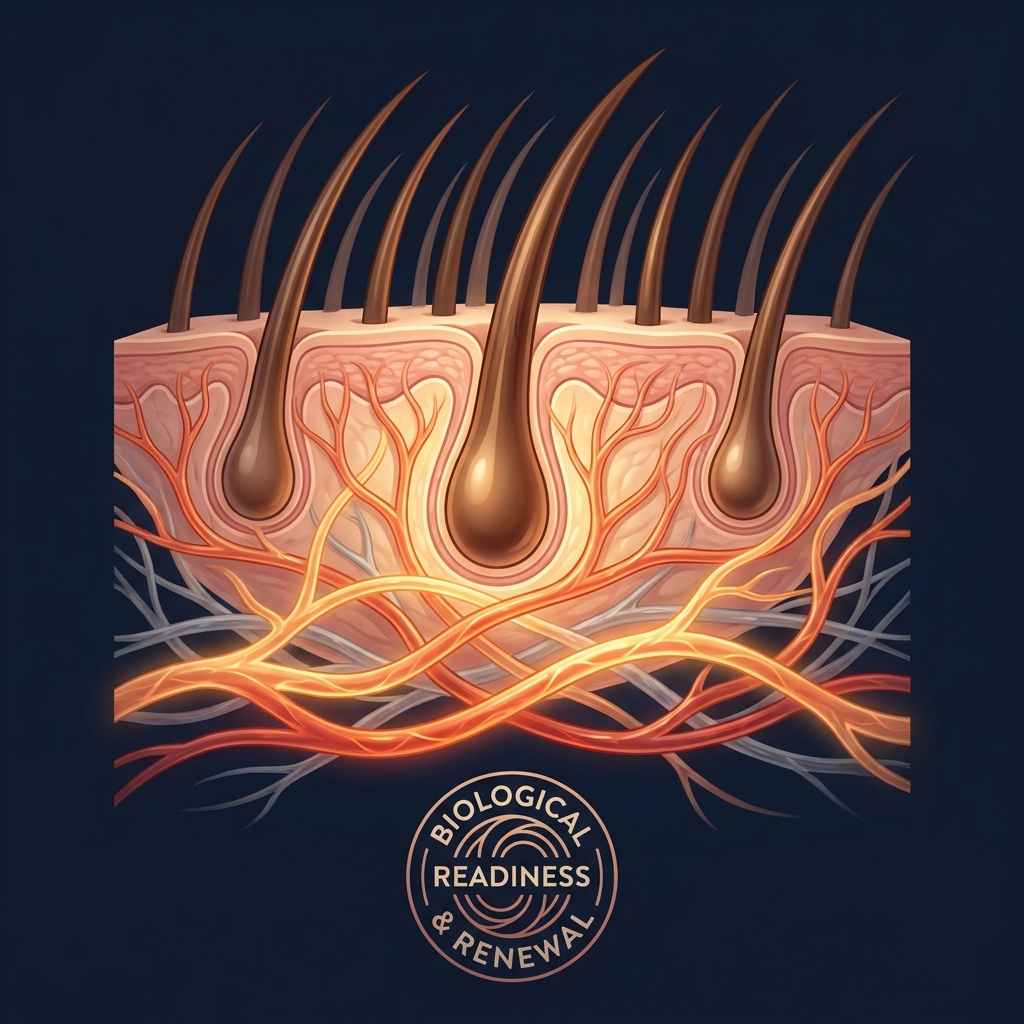
Vascular readiness represents the clinical framework for assessing whether burn scar tissue possesses sufficient blood supply to sustain transplanted follicular units through the critical post-operative engraftment window. Without adequate vascularity, grafts will fail regardless of surgical technique.
Scar maturation is the non-negotiable prerequisite. Patients must wait a minimum of 12 to 24 months post-burn injury before transplantation can be considered. Immature scars, characterized by pink or red coloration and raised texture, bleed excessively during surgery and actively eject grafts. The biological environment is simply too unstable.
The clinical signs of a mature, transplantable scar are specific: pale or white coloration, soft and supple texture, flat topography, and stable dimensions. These characteristics indicate that active remodeling has ceased and vascularity has stabilized to a predictable baseline.
McCauley’s classification of scalp burn scar alopecia provides a clinical tool for stratifying candidacy and planning surgical approach. This classification system accounts for scar location, depth, and extent, enabling surgeons to develop realistic expectations and appropriate surgical plans.
Burn scars demonstrate one favorable characteristic compared to other scar types. Research indicates that transplanting hairs into burn scars has shown higher success rates than into other scar etiologies, possibly because burn scar tissue tends to be shallower than other scar types. This relative advantage, however, does not eliminate the need for rigorous vascular assessment.
Optimal candidacy assessment involves a multi-disciplinary team approach. Burn surgeons, plastic surgeons, dermatologists, and hair restoration specialists each contribute essential perspectives. Single-specialty evaluation misses critical variables that affect outcomes.
The Epinephrine Contraindication: A Critical Technical Detail Most Clinics Miss
Standard hair transplant protocols include the addition of epinephrine (adrenaline) to local anesthetic solutions. This vasoconstrictor reduces bleeding and prolongs anesthetic effect, making surgery cleaner and more efficient. In healthy scalp tissue, this approach is appropriate and beneficial.
In burn scar recipient sites, epinephrine is contraindicated. Burn scar tissue already has severely compromised vascularity. Adding a vasoconstrictor further reduces blood flow to an already oxygen-depleted environment. The result is dramatically increased risk of graft necrosis.
The clinical consequence of ignoring this contraindication is straightforward: ischemic necrosis of transplanted grafts, poor engraftment, and potential worsening of the scar tissue itself. A procedure intended to restore hair and improve scar quality instead causes additional damage.
Expert surgeons address this by using plain local anesthetic without epinephrine in the recipient site. They accept slightly higher intraoperative bleeding in exchange for preserving the marginal vascular supply that grafts depend on for survival. This trade-off requires surgical experience and confidence.
This technical detail serves as a meaningful litmus test for surgical expertise. A clinic that uses standard epinephrine-containing anesthesia in burn scar recipient sites demonstrates a lack of burn-specific surgical protocol. For the discerning patient, this is a critical differentiator.
Pre-Conditioning the Recipient Site: Building Vascularity Before the First Graft
For many burn scar cases, recipient site vascularity is insufficient for direct transplantation. Pre-conditioning protocols improve tissue quality and blood supply before surgery, often making otherwise impossible cases feasible.
Non-Ablative Fractional Laser (NAFL) therapy stimulates collagen remodeling, improves tissue perfusion, and softens the scar matrix. Multiple sessions are typically administered prior to transplantation, creating a more hospitable environment for graft integration.
Microfat and nanofat injections using the ALMI technique introduce adipose-derived stromal cells and growth factors that promote angiogenesis. These injections improve the biological environment of the recipient site by enhancing vascular density and tissue pliability.
Clinical evidence supports this combined approach. A 2021 study of 13 burn scar alopecia patients treated with combined NAFL and microfat injections before FUE achieved a mean follicular unit survival rate of 85.04 percent and a density success rate of 84.54 percent, with all patients reporting high satisfaction with their outcomes.
PRP (Platelet-Rich Plasma) and mesotherapy serve as additional adjuncts, delivering growth factors that further stimulate graft survival in marginal vascular environments. These therapies complement rather than replace the primary pre-conditioning protocols. Patients interested in understanding how PRP hair loss therapy works as an adjunct to surgical restoration will find it plays a meaningful supporting role in complex cases.
Pre-conditioning is not optional in moderate-to-severe burn scar cases. Its absence is a significant predictor of poor outcomes.
The Test Graft Protocol: Why Expert Surgeons Never Skip This Step
The test graft protocol involves transplanting a limited session of 50 to 100 follicular units into the burn scar area, then waiting several months to objectively assess actual graft survival before committing to full transplantation.
The clinical rationale is rooted in the unpredictable biology of burn scar tissue. Even a well-vascularized scar may respond differently than expected. Depleting the donor supply on a failed full session is an irreversible mistake that cannot be corrected.
The test graft reveals critical information: actual survival rate in that specific patient’s scar tissue, the tissue’s tolerance for the surgical trauma of recipient site creation, and the optimal graft spacing and depth for subsequent sessions.
For burn patients, donor supply is often a finite and precious resource. Burns may have affected the scalp donor area itself, limiting available follicles. The test graft protects this supply by confirming viability before committing to larger procedures.
Skipping the test graft is a hallmark of under-experienced burn scar transplantation. It represents a meaningful risk factor for catastrophic donor depletion with poor recipient outcomes. Most burn scar scalp transplant cases require one to three surgical sessions over several years, with the test graft serving as the first stage of a deliberate, phased reconstruction plan.
Surgical Technique: FUE, Graft Density, and the Art of Adapting to Irregular Terrain
FUE (Follicular Unit Extraction) is the preferred technique for burn scar scalp transplants. Its individualized graft placement allows precise adaptation to the irregular surface topography of burn scars. Unlike FUT strip harvesting, FUE does not require the scalp laxity that may be absent in burn-affected tissue. Understanding the advantages and disadvantages of FUE hair restoration is essential context for burn scar patients evaluating their surgical options.
Graft density management is critical. Grafts must be placed at lower density and farther apart than in standard scalp transplants. Over-packing an already vascular-compromised recipient site causes ischemia and necrosis. Surgical restraint, not aggressive coverage, produces optimal outcomes.
Recipient site creation in scar tissue presents technical challenges. The fibrotic matrix requires modified incision depth and angle to avoid transecting grafts or creating channels that collapse before graft placement. These adaptations require surgical experience specific to scar tissue. The precision involved in hair transplant graft placement technique is amplified considerably when the recipient tissue is compromised burn scar.
Hair Stem-cell Transplantation (HST), developed by Dr. Coen Gho specifically for burn patients, offers advantages when donor supply is limited. Partial follicle extraction allows more grafts from a limited donor supply, a critical advantage when the donor scalp is itself burn-damaged.
When the scalp donor area is compromised, non-scalp donor sites provide alternatives. Beard, chest, and body hair have been used successfully in cases where scalp donor hair is unavailable, expanding the candidate pool for patients with extensive scalp involvement.
Realistic outcome expectations are essential. Even 40 to 60 percent coverage of a previously bald scar area creates significant cosmetic and psychological improvement. The goal is meaningful improvement, not perfection.
Candidacy Assessment: Who Is and Is Not a Surgical Candidate
Primary candidacy criteria include scar maturity (12 to 24 months post-injury minimum), adequate vascular supply on clinical assessment, stable scar dimensions, sufficient donor hair availability, and absence of active inflammatory or infectious processes.
Absolute contraindications include skin grafts adherent to the cranium (insufficient subcutaneous depth), active scar remodeling (immature scars), and systemic conditions that impair wound healing.
Relative contraindications requiring multi-disciplinary evaluation include extensive scalp burn involvement that compromises the donor zone, history of keloid formation, and patients on anticoagulant or immunosuppressive therapy.
The psychological candidacy dimension deserves attention. Hair loss from burns carries equal or greater impact on self-esteem and quality of life than visible scars. Psychological readiness and realistic expectations are part of the candidacy evaluation.
No globally accepted outcome measures exist for burn scar hair transplantation. This transparency point matters for patients managing expectations. Any clinic claiming standardized success guarantees should be viewed skeptically.
The Psychological Dimension: Restoring Identity, Not Just Hair
Clinical evidence establishes that hair loss from burn injuries carries profound psychological impact. The effect on self-esteem, identity, and social functioning often exceeds that of the visible scars themselves. Yet burn care teams routinely deprioritize this aspect of recovery.
For high-achieving men, hair loss from a burn injury represents more than a cosmetic concern. It disrupts professional presence, personal identity, and the confidence that underlies performance. The restoration of hair addresses these deeper concerns directly.
The multi-stage timeline requires honest acknowledgment. Burn scar hair restoration is a process measured in years, not months. Managing this expectation from the first consultation is part of the psychological support the surgical team provides.
Even partial coverage (40 to 60 percent of the affected area) produces significant and measurable psychological benefit. The goal is meaningful improvement that restores confidence and normalcy to daily life.
The Horizon: Emerging Science and the Future of Burn Scar Hair Restoration
The clinical implication is significant: pharmacological adjuncts that promote angiogenesis in scar tissue could dramatically expand the candidate pool for burn scar transplantation by improving recipient site vascularity before surgery. This emerging research complements the broader hair loss medication timeline that continues to evolve rapidly.
Exosome therapy and stem cell secretomes represent additional emerging adjuncts. Early-stage research suggests these may further enhance graft survival in compromised tissue environments.
The current gap in globally accepted outcome measures for burn scar hair transplantation represents an opportunity for the field to develop standardized protocols. Practices that monitor and integrate emerging clinical evidence are better positioned to offer burn scar patients the most current and effective protocols available.
Why the Surgical Team Determines Everything
Burn scar scalp transplantation is not a variation of standard hair transplantation. It is a distinct surgical discipline requiring mastery of burn wound biology, vascular assessment, pre-conditioning protocols, modified anesthesia technique, and multi-stage planning.
The specific competencies that separate expert burn scar transplant surgeons include knowledge of the epinephrine contraindication, use of test graft protocols, pre-conditioning with NAFL and microfat, ability to utilize non-scalp donor sites, and experience with HST when donor supply is limited.
Hair Doctor NYC’s team brings relevant depth to these complex cases. Dr. Roy B. Stoller’s 25 years of experience and over 6,000 successful procedures, Dr. Christopher Pawlinga’s 18 years dedicated exclusively to hair transplantation, and Dr. Louis Mariotti’s double board certification in facial plastic surgery represent a multi-specialist team structure directly relevant to burn scar complexity.
The Madison Avenue clinic provides state-of-the-art surgical facilities and a patient experience calibrated for the discerning individual who expects both clinical excellence and discretion. The team structure, spanning facial plastic surgery, dedicated hair transplantation, and aesthetic dermatology, mirrors the multi-disciplinary approach the clinical literature identifies as the standard for complex burn scar cases.
When the margin between success and failure is determined by variables as precise as anesthesia composition and graft spacing, the surgical team’s level of clinical nuance is not a luxury. It is the deciding factor.
Conclusion: The Vascular Readiness Protocol as the Standard of Care
Successful hair transplantation for burn scar on scalp is achievable. Success requires a surgical team that understands and rigorously applies the vascular readiness framework at every stage of the process.
The procedure restores hair and actively regenerates scar tissue. This dual benefit is supported by landmark peer-reviewed research that many clinics have yet to incorporate into their protocols.
From Okuda’s pioneering work in the 1930s to the 2026 regenerative medicine research, burn scar alopecia has always been at the frontier of hair restoration science. It remains there today.
The key clinical checkpoints bear repeating: scar maturity, vascular readiness assessment, pre-conditioning when indicated, test graft protocol, epinephrine-free recipient site anesthesia, appropriate graft density, and multi-stage planning.
Most patients require one to three surgical sessions over several years. Even partial coverage produces meaningful cosmetic and psychological improvement.
As regenerative science continues to advance the tools available for pre-conditioning and graft survival, the outcomes achievable for burn scar patients will continue to improve. The practices positioned to deliver those outcomes are those already operating at the highest level of clinical nuance.
Schedule a Burn Scar Consultation at Hair Doctor NYC
Burn survivors and referring physicians seeking expert evaluation are invited to schedule a consultation with the Hair Doctor NYC surgical team at their Madison Avenue, Midtown Manhattan clinic.
The evaluation will assess scar maturity, vascular readiness, donor supply, and candidacy for pre-conditioning. Patients receive a clear, honest picture of what is achievable before any surgical commitment is made.
The combination of Dr. Stoller’s 25 years of experience and over 6,000 procedures, Dr. Pawlinga’s exclusive 18-year focus on hair transplantation, and the multi-specialist team structure makes Hair Doctor NYC one of the few practices in New York equipped to manage the full complexity of burn scar scalp transplantation.
The consultation is a clinical conversation, not a sales process. Patients deserve complete transparency about candidacy, realistic outcomes, and the multi-stage nature of burn scar restoration.
Excellence meets elegance. This is the standard of care that burn scar patients, who have already endured enough, deserve at every step of their restoration journey.
Visit hairdoctornyc.com to request a consultation. The first step is simply starting the conversation with a team that has the expertise to guide it.