

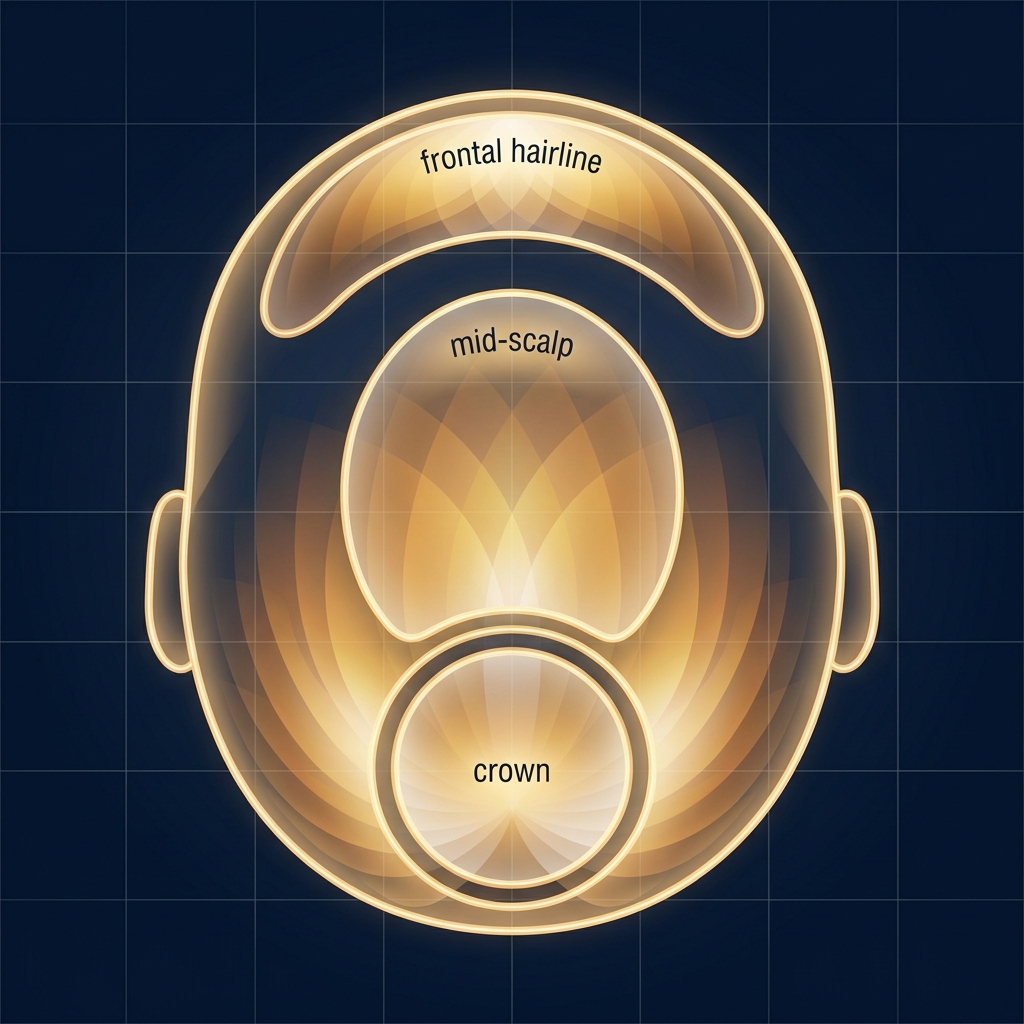
FUE Hair Transplant Results 12 Months Photo Timeline: The Zone-by-Zone Density Atlas
There is a gap between what most men expect from a hair transplant and what actually unfolds over the following year. They imagine a steady, linear climb from procedure day to full restoration. The reality is messier, more biologically nuanced, and frequently more anxiety-inducing than the polished before-and-after photos suggest. The first year of an FUE journey is not a single timeline. It is three timelines running in parallel, each governed by a different biological clock.
Most month-by-month guides treat the scalp as a uniform surface, applying one set of milestones to every region. This article does not. The frontal hairline, the temporal peaks, and the crown each follow distinct schedules dictated by blood supply, follicle density, and tissue characteristics. A man evaluating his crown at month six against a hairline photo from someone else is comparing two fundamentally different processes.
To anchor the discussion, this atlas relies on four quantified density benchmarks that recur throughout: roughly 10 to 15 percent of final density at month three, approximately 50 percent at month six, 75 percent or more at month nine, and 80 to 100 percent at month twelve. These are not marketing figures. They are clinically grounded reference points.
FUE now accounts for approximately 80 percent of all surgical hair transplant procedures globally according to the ISHRS 2025 Practice Census, and held 58.62 percent of market revenue share in 2025 per Mordor Intelligence. Graft count matters enormously here. A 1,500-graft procedure and a 5,000-graft restoration produce visibly different trajectories. This guide maps those differences zone by zone, month by month, for the discerning patient who demands precision over platitudes.
Why a Generic Month-by-Month Timeline Fails
The scalp is not a uniform canvas. Blood supply, follicle density, and tissue elasticity vary dramatically across its surface, and those variables directly govern how quickly transplanted follicles establish and grow.
Three primary zones each operate on their own biological clock. The frontal hairline benefits from robust vascular supply and typically finalizes between 12 and 15 months. The temporal peaks frame the face and follow the hairline closely. The crown or vertex is the outlier: reduced blood circulation in this region means results can take 18 to 20 months to fully manifest, according to Shapiro Medical Group.
This is why comparing a month-six crown to a month-six hairline is a flawed exercise. They are not supposed to look the same. Graft count compounds the variability. The average first-time FUE procedure in 2024 required 2,347 grafts per the ISHRS Practice Census, a useful midpoint. A 1,500-graft hairline refinement and a 5,000-graft full-scalp restoration are entirely different visual journeys. This atlas exists so that patients measure their progress against the correct reference point rather than an irrelevant one.
Understanding the Biological Foundation: What Happens to a Transplanted Follicle
FUE works by extracting individual follicular units from a donor zone, typically the back and sides of the scalp where follicles are genetically resistant to thinning, and implanting them into recipient sites. The technique traces its scientific roots to the foundational paper by Rassman and Bernstein in Dermatologic Surgery (2002), which established follicular unit extraction as a minimally invasive standard.
Once transplanted, a follicle does not simply continue growing. It is temporarily disrupted by the move and enters a resting phase before resuming normal cycling. Understanding the hair growth cycle clarifies the entire 12-month process. Follicles move through anagen (active growth), catagen (transition), and telogen (resting). Transplanted follicles are pushed into dormancy, then re-enter anagen and resume growth at roughly 0.8 to 1 cm per month.
In reputable, medically supervised clinics, graft survival rates typically range between 90 and 95 percent, with some studies reporting up to 97 percent. Donor source also matters: scalp hair achieves approximately 89 percent survival at one year per comparative data, which is precisely why scalp-to-scalp transplants remain the clinical standard. Understanding hair transplant donor hair characteristics is a key part of planning any procedure.
The Ugly Duckling Phase (Months 2 to 4): A Clinical and Emotional Reckoning
The ugly duckling phase is real, and it is the most psychologically demanding stretch of the entire journey. Shock loss affects approximately 30 to 70 percent of FUE patients. It is a normal biological response, not a sign of failure. Two distinct mechanisms drive it.
Telogen Effluvium: The Resting-Phase Trigger
Telogen effluvium occurs when surgical trauma pushes both transplanted and native follicles prematurely into the telogen resting phase. Shedding typically begins at 2 to 4 weeks post-procedure and peaks around weeks 6 to 8. Critically, this affects the native hairs surrounding the transplant zone, which can make the scalp appear temporarily thinner than it did before surgery. It is self-limiting. Follicles re-enter anagen and resume growth, generally by months three to four. This is the most common form of post-transplant shock loss.
Anagen Effluvium: The Growth-Phase Disruption
Anagen effluvium is less common but distinct. Hairs that were actively growing at the time of surgery are disrupted by the physical trauma of graft placement. It tends to occur earlier and can involve more abrupt shedding than telogen effluvium. Both mechanisms can occur simultaneously in the same patient, compounding the visual impact during months two through four. Understanding the mechanism transforms anxiety into informed patience: this is biology, not failure.
What to Expect Emotionally During Months 2 to 4
The emotional arc is predictable: post-procedure optimism, followed by shock loss anxiety, then dormant-phase frustration, and finally early growth relief. Patients often feel regret or doubt during this window. This is precisely when communication with a surgeon-led team delivers the most value. Patients who understand the dual-mechanism science of shock loss consistently report less anxiety. During months one through three, follicles are quietly establishing blood supply and preparing for active growth. Nothing visible is happening, but critical biological work is underway.
The Zone-by-Zone Density Atlas: Month-by-Month Breakdown
The framework here tracks three zones (hairline, temples, and crown) across all twelve months against the four density benchmarks. Multi-angle documentation, capturing front, top, side, and donor area, is the gold standard for accurate progress tracking.
Months 1 to 3: The Dormant Phase
Month 1: Initial healing dominates. Redness, scabbing, and minor swelling resolve within 5 to 7 days for most patients. Transplanted hairs begin shedding as expected.
Month 2: Peak shock loss. Maximum shedding of transplanted and native hairs occurs. The scalp may appear thinner than before surgery. This is the visual nadir.
Month 3: Early signals emerge. Fine, thin hairs appear in the hairline zone first, reaching roughly 10 to 15 percent of the final result. The crown and temples remain largely dormant. Patients typically show 0.5 to 1.5 inches of new growth in the most responsive zones.
The hairline leads. The temples show minimal change as follicles establish vascular connections. The crown typically shows no visible growth at all, which is entirely normal given its reduced circulation. A call to the surgeon is warranted only for persistent pain, signs of infection, or a complete absence of any growth signal by month four. For a detailed look at what to expect during recovery, the FUE hair transplant healing timeline provides zone-specific guidance.
Months 4 to 6: Early Growth
Month 4: Noticeable acceleration in the hairline. Hairs thicken and darken. Temples begin showing early vellus growth. The crown remains sparse.
Month 5: Hairline density becomes socially visible. Many patients report their first notable improvement when frontal styling becomes possible.
Month 6: The 50 percent milestone. Roughly half the final result is visible across zones, with strands appearing thicker, straighter, and darker.
- Hairline: approximately 50 to 60 percent density; shape clearly defined.
- Temples: approximately 40 to 50 percent; temporal peaks filling in.
- Crown: approximately 30 to 40 percent; visible but thin, lagging the hairline by 4 to 6 weeks.
By month six, FUE donor sites are typically fully healed and extraction points are no longer visible. Graft count shapes the picture: a 1,500-graft hairline procedure may look nearly complete in its target zone, while a 5,000-graft procedure shows broader but still-building coverage.
Months 7 to 9: Density Acceleration
Month 7: Rapid density increase across all zones. The hairline approaches near-final shape. Unsolicited compliments often begin during this period.
Month 8: Temples reach approximately 60 to 70 percent; the crown continues its slower climb at 50 to 60 percent.
Month 9: The 75 percent milestone. Roughly 75 percent or more of transplanted hairs are active. This is the most visually dramatic period.
- Hairline: 75 to 85 percent; natural, age-appropriate hairline fully established.
- Temples: 65 to 75 percent; facial framing clearly visible.
- Crown: 50 to 65 percent; meaningful coverage, but final density remains 3 to 9 months away.
Approximately 75 to 85 percent of transplanted follicles are active by month nine per Shapiro Medical Group. Uneven density within a single zone usually reflects placement patterns and resolves by month twelve. Persistent thinning in isolated patches warrants consultation.
Months 10 to 12: The Maturation Phase
Month 10: The hairline approaches final density. Texture and caliber of transplanted hairs match native hairs, rendering the result indistinguishable from natural hair.
Month 11: Temples reach 80 to 90 percent; the crown matures at 65 to 75 percent.
Month 12: The 80 to 100 percent milestone. Transplanted hair behaves exactly like natural hair and can be cut, colored, and styled.
- Hairline: 85 to 100 percent; considered finalized.
- Temples: 80 to 95 percent; considered finalized.
- Crown: 65 to 80 percent; not fully finalized and continuing to mature through months 15 to 20.
Patient satisfaction data is encouraging: 90 to 95 percent of patients report satisfaction, with an average score of 8.3 out of 10 at three-year follow-up. Month twelve is the standard evaluation benchmark, but it is not the endpoint for every zone, particularly the crown.
Beyond Month 12: The Crown’s Extended Timeline
The crown deserves dedicated attention precisely because most timelines overlook it. The physiological reason is straightforward: the vertex region has reduced blood circulation compared to the frontal scalp, which slows follicle establishment and growth cycling.
The realistic benchmark is 18 to 20 months to full manifestation. Patients who evaluate their crown at month twelve and feel disappointed are often assessing an incomplete result. This is why comprehensive documentation at multiple intervals (six, twelve, and eighteen months) is essential for crown procedures. A 1,500-graft crown procedure will show different density at month twelve than a 3,000-graft crown procedure, and both may be perfectly on track. Surgeon-led follow-up through month eighteen is the standard of care for crown restoration, not an exception.
Graft Count and Its Impact on the Visual Timeline
Three benchmark graft counts illustrate the range: 1,500 grafts for targeted hairline or temple restoration, 3,000 grafts for moderate full-scalp coverage, and 5,000 grafts for extensive multi-zone restoration. Since most patients have a lifetime harvestable supply of approximately 6,000 grafts, allocation is a strategic long-term decision.
1,500 Grafts: Targeted Zone Restoration
Typically applied to hairline refinement, temple restoration, or early crown thinning. Concentrated density in a smaller area means the target zone reaches near-final density faster, often by months nine to ten. By month six, the hairline is visibly transformed; by month twelve, results are essentially complete in the targeted area. Many of these patients later return for a second hair transplant procedure to address progressive loss in adjacent zones, which is expected and planned for.
3,000 Grafts: Moderate Full-Scalp Coverage
The most common profile, sitting near the ISHRS average of 2,347 grafts. Density builds across a broader area, so individual zones appear thinner at each milestone than with a targeted procedure. By month six, improvement is clearly visible across multiple zones without any single zone being fully dense. By month twelve, the hairline and temples approach final density while the crown continues maturing. The most dramatic improvement typically arrives between months seven and nine as multiple zones simultaneously reach 60 to 70 percent.
5,000 Grafts: Extensive Multi-Zone Restoration
Reserved for advanced androgenetic alopecia (Norwood IV to VI) requiring comprehensive coverage. These procedures involve the most extensive shock loss and the longest overall maturation. At month six, broad coverage is visible but thinner across all zones. At month twelve, the hairline and temples approach final density, the mid-scalp reaches 75 to 85 percent, and the crown may sit at 60 to 70 percent and still be maturing. The full result is often not appreciated until months 15 to 18. Given that androgenetic alopecia affects 70.9 percent of hair transplant patients, extensive procedures are frequently staged to preserve donor supply for future needs. Patients considering their options can review a comprehensive overview of androgenetic alopecia treatment options to understand the full clinical landscape.
Adjunct Therapies and Their Effect on the Timeline
For patients seeking optimal outcomes, adjunct therapies are not optional extras. They are clinically supported components of a comprehensive protocol.
PRP (Platelet-Rich Plasma): Accelerating Follicle Activation
A 2025 systematic review in Cureus (217 participants, three controlled trials) confirmed PRP consistently enhances follicular outcomes, including improved density, follicle survival, and earlier regrowth, as reported by Shapiro Medical Group. A 2024 prospective comparative study found 90 percent of the PRP plus FUE group achieved moderate-to-high-density graft survival versus 60 percent in the FUE-only group. A 2025 meta-analysis of 43 trials and 1,877 patients found PRP improved density by an average of +25.61 hairs per cm², per Charles Medical Group. PRP can shift the first visible growth milestone from month three or four to month two or three, easing the ugly duckling phase. Platelet-rich plasma therapy for hair loss is available as part of a comprehensive treatment protocol at Hair Doctor NYC.
Finasteride: Protecting the Investment
A 2025 prospective study confirmed significantly higher graft survival (94 percent versus 90 percent) in patients using finasteride post-transplant, attributed to DHT reduction protecting transplanted follicles. The mechanism matters: finasteride slows or halts progressive androgenetic alopecia in the native hairs surrounding the transplant zone. It does not dramatically accelerate growth, but it protects the result by preventing native loss that would otherwise undermine the transplant’s long-term appearance. This is a physician-prescribed medication and should be discussed during consultation.
Sapphire FUE: A Technical Upgrade With Timeline Implications
Research in BMC Surgery (2024) shows Sapphire FUE improves graft survival by 10 to 15 percent and reduces postoperative inflammation by approximately 30 percent versus standard FUE, according to Charles Medical Group. Sapphire blades create precise, V-shaped incisions that minimize tissue trauma. Reduced inflammation means faster initial healing, potentially milder shock loss, and earlier follicle activation. Technique selection is a surgeon-led decision based on anatomy, graft count, and zone-specific requirements.
Reading a Photo Timeline: A Practical Framework
Consistency is essential when documenting personal progress. The same lighting, angle, distance, and time of day (ideally morning, before applying styling products) should be used throughout. Four standard angles are recommended: frontal straight-on, top-down overhead, lateral 90-degree side view, and posterior for the donor area.
Comparing personal photos to social media results is unreliable without knowing the other patient’s zone, graft count, and month of documentation. The self-assessment framework is straightforward: month three (10 to 15 percent), month six (around 50 percent), month nine (75 percent or more), month twelve (80 to 100 percent). The crown should be evaluated against the 18-to-20-month benchmark, not the 12-month one. Any deviation accompanied by signs of infection, persistent pain, or complete growth failure warrants immediate surgeon consultation.
What Separates a Strong 12-Month Result From a Weak One
Not all 12-month results are equal, and the difference begins in the operating room. Real-world FUE graft survival ranges from 70 to 97 percent, citing a 2025 meta-analysis via Charles Medical Group. That 27-point spread is almost entirely attributable to technique and team quality.
The consequences of poor work are documented. Repair procedures rose to 6.9 percent of all hair transplants in 2024, and 59 percent of ISHRS members reported black-market clinics operating in their cities in 2025, according to the ISHRS 2025 Practice Census. Graft survival is influenced by every step from extraction through placement, which demands consistent expertise throughout the procedure. The average 2,347-graft procedure represents hours of meticulous work, and the quality of that work determines the 12-month photo. Patients can learn more about the dangers of unlicensed technicians performing hair restoration surgery before making their decision.
This is the standard against which outcomes should be measured. Hair Doctor NYC operates a surgeon-led, multi-specialist team: Dr. Roy B. Stoller (25-plus years, 6,000-plus procedures), Dr. Louis Mariotti, Dr. Christopher Pawlinga (18 years exclusively in hair transplantation), and Michael Ferranti, P.A. (25-plus years in aesthetic dermatology).
The Hair Doctor NYC Standard: What a Surgeon-Led Team Means for the 12-Month Result
Hair Doctor NYC’s approach reflects the clinical benchmark for every outcome described in this article. Unlike single-practitioner clinics, the practice brings complementary expertise to every procedure: surgical precision, facial aesthetic harmony, and dedicated hair restoration specialization.
Dr. Pawlinga’s 18 years of exclusive focus on hair transplantation translates directly to graft survival at the high end of the clinical range. Dr. Stoller’s background as a double board-certified facial plastic surgeon supplies the artistic and anatomical precision required for natural-looking hairlines and zone-specific density. The state-of-the-art Madison Avenue facility in Midtown Manhattan accommodates the full spectrum of surgical and adjunct treatments (FUE, PRP, and scalp micropigmentation) under one roof.
Achieving 80 to 100 percent density at month twelve requires far more than skilled extraction. It demands precise graft placement, appropriate zone-specific planning, and surgeon-led follow-up through the maturation phase. The practice’s tagline, “Excellence Meets Elegance,” reflects both the clinical standard and the patient experience discerning patients should expect.
Conclusion: The 12-Month Timeline Starts With the Right Decision at Month Zero
The zone-differentiated framework is the central insight of this atlas: the hairline, temples, and crown each follow distinct biological timelines, and understanding this prevents misinterpretation during the ugly duckling phase. The four density benchmarks (10 to 15 percent at month three, around 50 percent at month six, 75 percent or more at month nine, and 80 to 100 percent at month twelve, with the crown extending to 18 to 20 months) provide a reliable self-assessment framework.
Graft count is a strategic variable. Comparing a 1,500-graft procedure against a 5,000-graft restoration produces misleading conclusions. The emotional reality of the journey is genuine but temporary, and patients who grasp the dual mechanisms of shock loss navigate it with markedly less anxiety. Ultimately, the 12-month photo reflects the decision made before the procedure: surgeon selection, team quality, technique, and adjunct protocol.
The global hair transplant market is projected to reach $59.89 billion by 2035 per Towards Healthcare, reflecting growing recognition that surgical restoration, done correctly, delivers life-changing results. The standard of “done correctly” is set by surgeon-led teams with decades of dedicated expertise.
Ready to See What a 12-Month Result Could Look Like?
For patients weighing this decision, the logical next step is a clear-eyed clinical evaluation. A hair transplant consultation with Hair Doctor NYC offers a personalized zone-by-zone assessment and realistic density projections grounded in specific anatomy, hair characteristics, and goals.
This consultation is surgeon-led, conducted by specialists with 18 to 25-plus years of dedicated experience. Hair Doctor NYC serves patients at its state-of-the-art Madison Avenue clinic in Midtown Manhattan, a discreet, premium environment appropriate for patients who value privacy and precision in equal measure.
Schedule a consultation at hairdoctornyc.com. Excellence Meets Elegance: the standard every 12-month result deserves.