

Hair Restoration Near Me: Why Team Depth Beats Solo Practices
Introduction: The ‘Near Me’ Search Is Bigger Than Your ZIP Code
It usually happens late in the evening, after a meeting where the conference room lighting was less forgiving than expected. A successful professional in Manhattan, Westchester, or one of the outer boroughs picks up a phone and types four words: “hair restoration near me.” The assumption is that proximity will solve the problem, that the closest qualified clinic must be the right one.
The results suggest otherwise. Nearly every top listing is a single-practitioner storefront: one surgeon, one preferred technique, one opinion. That model is often marketed as a personalized boutique experience. Structurally, it is a narrow funnel.
This article argues that real “near me” value has little to do with the shortest commute. It comes from access to a multi-specialist team working under one roof, where diagnoses are cross-checked and each patient is matched to the procedure their case actually requires. Hair Doctor NYC, the Madison Avenue practice operating as Stoller Medical Group, serves as the case study. It brings together four credentialed practitioners whose work covers FUE, FUT, scalp micropigmentation (SMP), and facial hair restoration.
The stakes are higher than most searchers realize. Consumers make these decisions within a very short evaluation window, and each patient has a finite donor supply of roughly 6,000 grafts. Together, those two facts make a convenience-based choice potentially irreversible.
The Anatomy of a ‘Near Me’ Search: Why This Moment Carries So Much Weight
Local search is a dominant consumer behavior. Industry data shows that 46% of all Google searches carry local intent, and nearly half of consumers explicitly add “near me” to their queries. People who search this way are ready to act.
The follow-through is fast. According to local search research, 76% of people who search for something nearby on a smartphone visit a related business within 24 hours, and 28% of local searches convert into a purchase. This is bottom-of-funnel behavior: the searcher has already decided they want hair restoration and is now choosing where to go.
The decision window is also narrow. BrightLocal reports that 72% of consumers evaluate three or fewer businesses before deciding, and only 1% look at more than ten. For most searchers, the first few results become the entire consideration set.
In hair restoration, that compression has consequences. Because the evaluation happens so quickly, patients rarely look past surface-level signals such as a polished website, a star rating, or a map pin. They seldom ask who is actually on staff, how many physicians are involved, or which techniques each practitioner has mastered.
This creates the core tension: a search behavior designed for speed is being used to make one of the most consequential and hardest-to-reverse medical decisions a person will face.
The Single-Practitioner Storefront Problem
A typical “near me” result looks like this: a solo surgeon or a technician-led clinic offering one primary technique, presented as the default answer for every patient who walks through the door. The branding may be sleek, but the clinical range is narrow.
The limitation is structural. In a solo practice, one practitioner’s training, preferred technique, and caseload volume set the ceiling for every patient’s outcome. That ceiling applies regardless of what a given patient’s hair loss pattern, donor characteristics, or aesthetic goals actually require. A patient who would be better served by a different approach may never hear about it, because it is not offered.
Market growth has made this problem more common. The global hair transplant market reached $6.98 billion in 2026 and is projected to reach $10.64 billion by 2031, according to Mordor Intelligence. Rising demand has encouraged more single-operator clinics to compete for “near me” visibility rather than invest in clinical depth.
The safety data is sobering. According to the International Society of Hair Restoration Surgery (ISHRS), 59.4% of ISHRS members report black-market or unlicensed hair transplant clinics operating in their city. Repair cases stemming from botched procedures rose from 6% of all cases in 2021 to 10% in the latest census. Investigative reporting has also noted that many illegal clinics run sophisticated websites that rank highly through paid search ads. Many of these repair patients chose whichever result loaded first.
Proximity answers the question “how far is it?” It does not answer the question that matters more: is this the right specialist, using the right technique, for this specific case?
Why Team Depth Changes the Clinical Equation
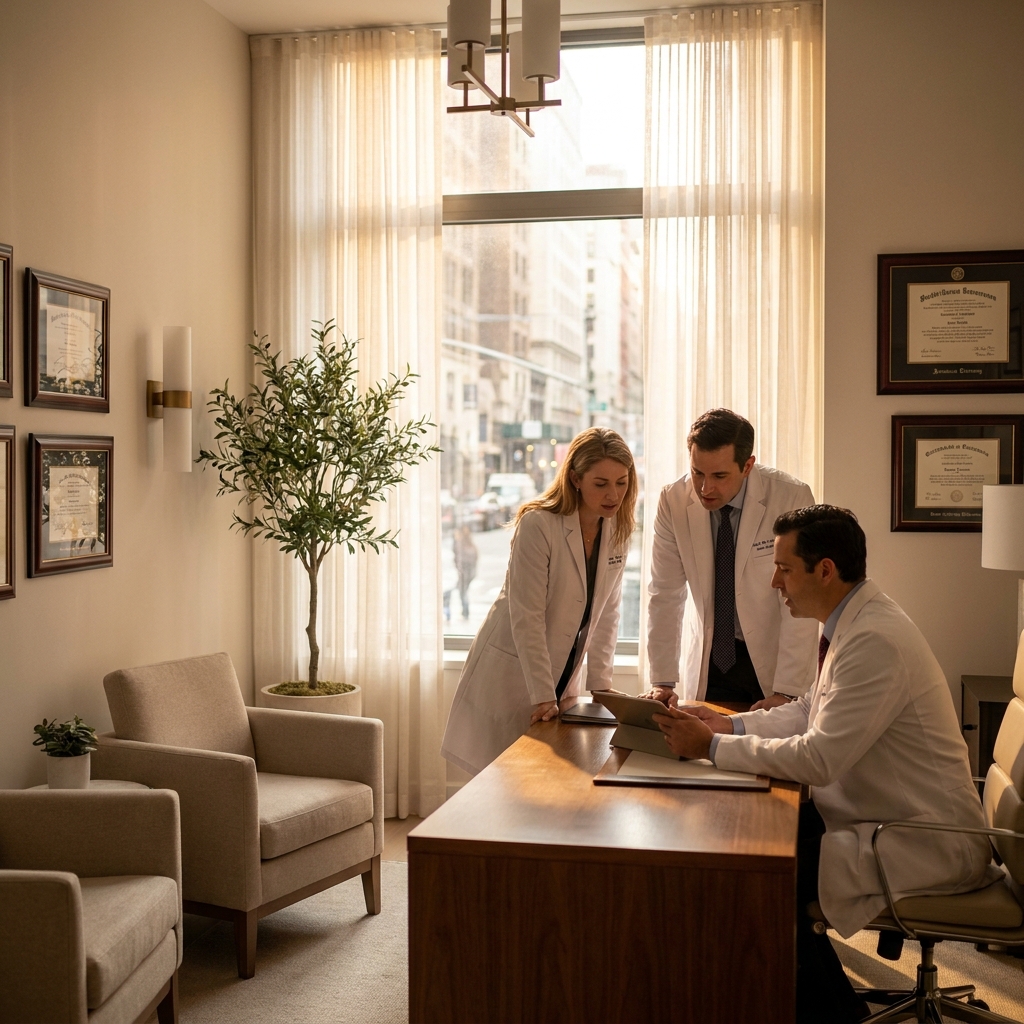
In a team-based practice, the main clinical advantage is the cross-checked diagnosis. When multiple credentialed specialists evaluate a case, the key decisions, including hairline design, technique selection, and graft allocation across the scalp, are reviewed from more than one clinical perspective before any incision is made.
A solo practice cannot offer this. Its single opinion is uncontested by definition. No second specialist is present to question an optimistic graft-yield estimate, flag a hairline that will look unnatural in fifteen years, or point out that a different technique would better protect the donor area.
Team depth also allows procedure-matched expertise. Not every patient is an ideal FUE candidate. Not every patient needs the higher graft yield of FUT. Some cases are best addressed without surgery. A team that spans several modalities can route each patient to the specialist trained for their exact presentation. A solo practice, by contrast, tends to fit the patient to the one tool it has.
Four Disciplines, Four Specialists: What Team Depth Actually Looks Like
At Hair Doctor NYC, team depth covers four distinct disciplines:
- FUE (Follicular Unit Extraction): A minimally invasive transplant technique that leaves no linear scar. It suits patients who wear short hairstyles and want a fast recovery, and most patients return to normal life within days. At its highest level, FUE benefits from a specialist with deep, exclusive focus on transplant technique.
- FUT (Follicular Unit Transplantation): Known as the strip method, FUT is reserved for patients who need maximum graft yield and the densest possible coverage, often in advanced hair loss. It requires a surgeon specifically trained in strip harvesting and precise closure.
- Scalp Micropigmentation (SMP): A non-surgical option that uses medical-grade pigment to replicate the appearance of follicles. It is well suited to patients who are not surgical candidates or who prefer to avoid surgery. SMP should be performed by a dedicated, licensed specialist rather than a surgeon who does pigment work on the side.
- Facial Hair Restoration: Beard, mustache, sideburn, and jawline transplants, including gender-affirming facial hair procedures. This work requires an understanding of facial harmony and proportion that differs from scalp restoration.
A single practitioner is rarely trained to an expert level in all four disciplines. A team is the only structural way to ensure procedure-matched expertise for every patient.
The Credentials Behind the Team
The Hair Doctor NYC roster shows what that depth looks like in practice:
- Dr. Roy B. Stoller is a double board-certified, globally recognized leader in facial plastic surgery and hair restoration. He brings more than 25 years of experience and has performed over 6,000 successful hair transplant procedures, which places him in a high-volume, physician-led tier.
- Dr. Louis Mariotti is a double board-certified facial plastic surgeon. He contributes surgical precision and facial-harmony expertise to the team’s diagnostic process, so that results suit the patient’s overall face and not just the scalp.
- Dr. Christopher Pawlinga has spent 18 years dedicated exclusively to hair transplantation. A generalist solo practice cannot match that level of specialization.
- Michael Ferranti, P.A., brings 25+ years in aesthetic dermatology and plastic surgery and is a licensed SMP specialist. He leads the non-surgical side of the practice.
These are four distinct specializations under one roof. At a solo storefront, the patient gets one opinion.
The Stakes: A Finite Donor Supply and No Room for a Second Attempt
Every patient has an approximate lifetime donor supply of 6,000 grafts. This is a hard biological ceiling. Donor follicles do not regenerate once harvested, and each graft used is one fewer available for future work.
That makes a poorly matched first procedure costly. Grafts extracted with the wrong technique, harvested too aggressively, or placed poorly can permanently deplete the donor reserve. A patient who later needs correction or additional coverage may find there is nothing left to work with.
Outcome data shows how much the choice of clinic matters. Graft survival rates at accredited, physician-led clinics range from 90% to 95%, while unlicensed or technician-run operations produce dramatically worse results. Low graft survival means donor supply is spent without delivering density.
The ISHRS has issued a direct warning: “increasing numbers of unlicensed personnel worldwide are performing substantial medical aspects of hair restoration surgery.” According to the society, these patients face serious risk of disfiguring results that cannot be repaired.
This brings the discussion back to the “near me” decision. Choosing a clinic because it is closest, or because it appeared first, without verifying team depth and credentials, risks an irreversible loss of a limited donor reserve.
Who Is Actually Searching: The Changing Face of the Hair Restoration Patient
The typical hair restoration patient is no longer who many people assume. According to the ISHRS 2025 Practice Census, 95% of first-time surgical patients in 2024 began treatment between ages 20 and 35. This reflects a clear shift toward earlier intervention.
The patient base is also becoming more diverse. Female surgical patients increased 16.5% from 2021 to 2024, and the average number of patients per ISHRS member grew 20% over the same period. Androgenetic alopecia, or hereditary pattern hair loss, affects an estimated 80 million Americans: 50 million men and 30 million women. According to MedlinePlus Genetics, it can begin as early as the teens. Only two FDA-approved drugs exist for the condition, finasteride and minoxidil. Surgical restoration by a qualified specialist remains the gold-standard permanent solution beyond medical management.
A younger, broader patient base makes team depth even more important. A 28-year-old with early recession needs a plan that anticipates decades of future loss. A patient with advanced loss may need the high yield of FUT. A patient seeking gender-affirming facial hair work needs expertise in facial aesthetics. Another may be best served by SMP. One practitioner working with one technique cannot serve all of these patients equally well.
Madison Avenue: A Location Built for the Entire Metro Area, Not Just One Neighborhood
Hair Doctor NYC’s Midtown Manhattan address on Madison Avenue works as a regional hub, not a neighborhood storefront. Its location makes it practically “near” most of the New York metropolitan area.
Access from all five boroughs:
- Manhattan: Several subway lines serving Midtown East, including the Lexington Avenue and Queens Boulevard lines, stop within a short walk.
- Brooklyn and Queens: Direct subway service runs into Midtown, often without a transfer.
- The Bronx: The Lexington Avenue express and local lines run straight down the East Side into Midtown.
- Staten Island: The Staten Island Ferry connects to Lower Manhattan subway lines that run directly uptown.
Access from the suburbs:
- Westchester and Connecticut: Metro-North arrives at Grand Central Terminal, a short walk from Madison Avenue.
- Long Island: The LIRR serves both Grand Central Madison and Penn Station.
- New Jersey: NJ Transit rail into Penn Station, PATH service, and trans-Hudson bus routes bring commuters into Midtown.
- By car: Major arteries including the FDR Drive, the tunnels, and the bridges feed directly into Midtown.
For many suburban residents, reaching Madison Avenue by train takes about as long as driving to a local strip-mall clinic. Many already commute into Midtown every weekday.
Because this location is realistically near the entire metro population, the deciding factor should not be which storefront is fewest miles away. It should be which destination has the deepest clinical team. When the alternative risks a permanent, irreversible result, a slightly longer commute to a team-based practice is a sensible trade.
How to Evaluate a ‘Near Me’ Result Before You Click
Most consumers compare three or fewer options, so each comparison needs to count. The following framework helps separate substance from marketing:
- Count the credentialed practitioners. Patients should check how many physicians and licensed specialists are actually on staff, not just the name on the door.
- Confirm the range of techniques. Patients should determine whether the practice offers FUE, FUT, SMP, and facial hair restoration, or only one of them. A single-technique practice cannot objectively recommend against its own specialty.
- Verify board certifications and years of specialization. Given ISHRS data on black-market clinics and rising repair cases, credential verification is a required step.
- Ask about diagnostic review. Patients should find out whether a second specialist reviews the diagnosis and treatment plan, or whether one person’s assessment makes up the entire decision.
- Weigh accessibility realistically. Patients should compare a destination clinic that is a reasonable commute from anywhere in the metro area against a nearby storefront with limited techniques and no internal cross-check.
A practice that holds up on all five points deserves to be one of those three options.
Conclusion: Redefining ‘Near Me’ Around Clinical Depth
Proximity answers a logistics question. Hair restoration also raises a clinical question, and because the donor supply is finite, the clinical question is the one that matters.
A multi-specialist team covering FUE, FUT, SMP, and facial hair restoration under one Madison Avenue roof offers cross-checked diagnoses and procedure-matched expertise. A solo practitioner cannot replicate that structurally, however talented they may be.
Hair Doctor NYC’s Midtown location is accessible from all five boroughs and the surrounding suburbs. Patients do not have to trade team depth for convenience; they can have both.
The practice worth being near is the one with the credentialed depth to get the diagnosis and technique right the first time.
Schedule a Consultation with Hair Doctor NYC’s Multi-Specialist Team
Hair Doctor NYC invites prospective patients to book a personalized consultation at its Madison Avenue practice. Each case is reviewed by a team whose expertise covers FUE, FUT, scalp micropigmentation, and facial hair restoration, so the recommendation reflects the patient’s needs rather than the limits of a single technique.
With a finite donor supply and a short evaluation window, the most prudent next step is a direct conversation with a credentialed team before committing to any procedure. The practice is a straightforward trip from Manhattan, Brooklyn, Queens, the Bronx, Staten Island, Westchester, Long Island, and New Jersey, so a consultation is practical wherever a patient lives or works.
For those who hold every other important decision to a high standard, the choice of hair restoration practice deserves the same scrutiny. Team depth, not just distance, should decide it.