

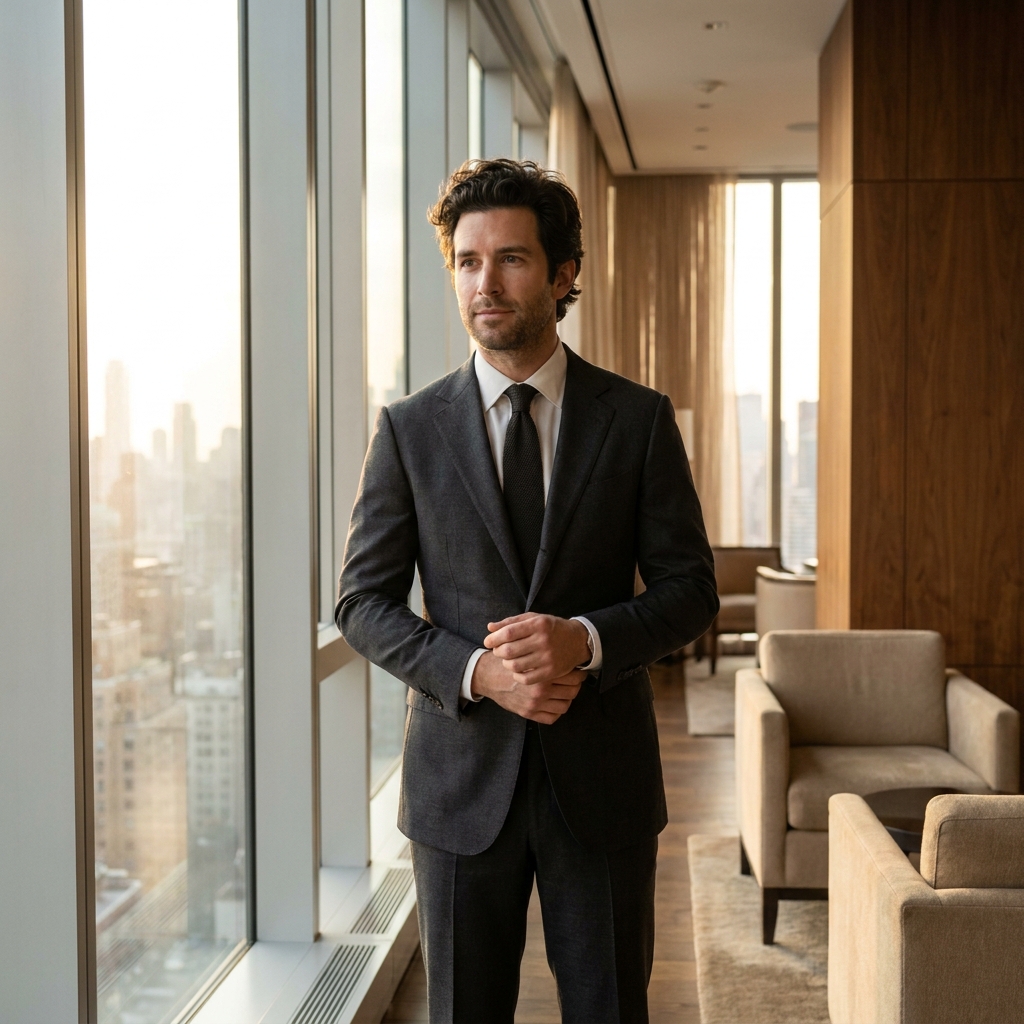
Hair Transplant Before and After Photos NYC: The Surgeon-Verified Results Atlas
Most before and after photo galleries in New York City are passive collections. They show a scalp before surgery, a fuller scalp after, and they ask the viewer to draw a favorable conclusion. What they almost never do is teach the prospective patient how to evaluate what they are actually seeing. A row of attractive images, absent context, tells a discerning man nothing about whether the result is exceptional or merely adequate, whether it is representative or cherry-picked, or whether it was even photographed honestly.
The stakes have never been higher. The global hair transplant market is valued at roughly $10.74 billion in 2026 and is projected to reach $59.89 billion by 2035, expanding at a 21.04% CAGR. An estimated 80 million Americans live with inherited hair loss. As the volume of clinics has surged, so has the variance in quality, and the gap between the best surgical work and the worst has widened considerably.
This article is not another gallery. It is an active educational framework designed to teach a sophisticated patient to read before and after photos the way a trained surgeon does. The promise is twofold: readers will gain the analytical tools to evaluate any gallery in Manhattan, and they will see how the documented results at Hair Doctor NYC hold up under that same rigorous scrutiny.
This is not a cosmetic impulse. A 2025 Frontiers in Psychiatry meta-analysis confirmed that androgenetic alopecia is significantly associated with anxiety, depression, and reduced quality of life. This is a serious medical decision, and it deserves serious evaluation.
Why Before and After Photos Are the Most Important, and Most Misunderstood, Evidence in Hair Restoration
For a man in the active consideration phase, before and after photos are the single most influential decision-making tool. They are studied more closely than credentials, more closely than pricing, and more closely than reviews. The emotional investment is extraordinary: according to the ISHRS 2025 Practice Census, 90% of patients chose hair transplantation to become or feel more attractive, and 63% cited wanting to appear younger to compete professionally.
That intensity creates a trust problem. An estimated 30 to 40% of online testimonials in the cosmetic surgery space are fabricated, incentivized, or selectively curated. Many clinics manipulate documentation through strategic lighting, calculated camera angles, and the oldest trick in the book: showing wet, flat, darkened hair in the “before” shot against styled, volumized, soft-lit hair in the “after.”
The regulatory environment has finally caught up. The FTC’s Rule on Consumer Reviews and Testimonials, effective October 21, 2024, prohibits fake and AI-generated testimonials, with civil penalties reaching $51,744 per violation. Authentic documentation is now both a legal and an ethical imperative.
The solution is not to distrust every gallery. It is to know precisely what to look for, and that is what this atlas provides.
The Surgeon’s Lens: Six Metadata Fields That Separate Credible Galleries from Marketing Materials
Before a surgeon draws any conclusion from a before and after photo, he reviews the data behind it. Without this metadata, an image is essentially unverifiable, no matter how impressive it appears.
1. Norwood Scale Classification
The Norwood-Hamilton scale classifies male pattern baldness across Stages I through VII, mapping the progression from a full hairline through frontal recession, crown thinning, and ultimately the extensive loss of the most advanced stages.
Norwood stage is essential context. A flawless result on a Norwood II patient is far less impressive than the identical visual outcome achieved on a Norwood VI patient, where donor supply is limited and the surgical challenge is enormous. Given that 70.9% of patients seeking treatment have androgenetic alopecia, Norwood classification is directly relevant to nearly every case.
Red flag: Galleries that omit the patient’s baseline Norwood stage are presenting results without context.
2. Graft Count and Graft Distribution
A graft, or follicular unit, contains one to four individual hairs, which makes graft count a more precise metric than “hair count.” Most patients require between 1,800 and 4,000 grafts per session, depending on the degree of loss and the density desired.
Distribution matters as much as the total. Three thousand grafts concentrated in the hairline will look dramatically different from 3,000 grafts spread across the hairline, mid-scalp, crown, and temples. Density in the frontal zone frames the face and reads very differently from density at the crown. A detailed breakdown of FUE hair transplant graft count by area helps clarify what realistic distribution looks like across zones.
Red flag: Impressive density shown without a disclosed graft count may represent an unusually high-volume session that is not representative of a standard procedure.
3. Technique: FUE vs. FUT and Its Visual Implications
FUE (Follicular Unit Extraction) removes individual follicular units one by one, leaves no linear scar, and is preferred by men who wear their hair short. It accounts for approximately 58.62% of global hair transplant revenue in 2025, per Mordor Intelligence. FUT (Follicular Unit Transplantation, the strip method) removes a strip of donor scalp for maximum graft yield and is well-suited to extensive restoration. Understanding the differences between FUT vs. FUE is essential when evaluating which technique a gallery is documenting.
Technique affects donor area appearance, the achievable density ceiling, and recovery. Credible galleries should therefore include donor area photos, not just recipient results.
Red flag: Galleries that show only the top of the scalp without any donor documentation are hiding half the story.
4. Post-Operative Timeline
Full results take 12 to 18 months to mature. Most patients see 60 to 70% of their final outcome by months six to eight. Between weeks two and six, shock loss occurs: transplanted hairs shed temporarily before re-entering the growth cycle. It looks alarming, and it is entirely normal.
An “after” photo taken at six months is a partial result. One taken at 18 months is a mature result. They look profoundly different. The gold standard is a multi-milestone progression showing the same patient at three, six, nine, 12, and 18 months.
Red flag: A single “after” photo with no stated post-operative date is unverifiable.
5. Standardized Photography Conditions
Lighting, angle, and styling can dramatically alter perceived density. Standardized conditions mean consistent overhead lighting rather than directional light, identical camera distance and angle, dry and unstyled hair in both shots, and multiple views including front, top, and sides.
The manipulation tactics to watch for are well known: directional lighting that casts shadow to fake density, wet hair flattened in the “before,” and volumized styling in the “after.” Video documentation is the true gold standard, because hair moving under natural light reveals texture and naturalness that static photos can conceal.
Red flag: Harsh overhead light in the “before” and soft, flattering light in the “after” is a common and easily overlooked manipulation.
6. Surgeon and Technique Verification
Credible galleries attribute results to a specific, named, board-certified surgeon, not to a clinic brand or an anonymous “team.” Double board-certified facial plastic surgeons bring both surgical precision and aesthetic judgment to hairline design. FUE graft survival rates of 90 to 95% are achievable in experienced hands, but execution varies significantly by practitioner.
The ISHRS 2025 census highlights a growing black market in hair restoration, which makes physician verification more important than ever.
Red flag: No surgeon attribution, or a model in which technicians rather than physicians perform the primary extraction and placement.
What Authentic Results Actually Look Like: Visual Markers of Surgical Excellence
Metadata is the technical layer. The visual layer is what a trained eye reads in the photographs themselves.
Natural Hairline Architecture
A natural hairline is not a straight line. It carries micro-irregularities, a soft transition zone, and age-appropriate recession at the temples. A hairline designed for a 28-year-old will look mismatched on a 50-year-old, so credible surgeons design for the patient’s current and future age. Single-hair grafts at the leading edge and multi-hair grafts behind them create a believable density gradient.
The payoff is measurable. A Johns Hopkins study found that men who underwent hair transplants were rated as appearing an average of 3.6 years younger, more attractive, more successful, and more approachable. Those outcomes depend entirely on natural design.
Marker of excellence: A hairline that looks as though it was never transplanted, with no plug-like clustering or unnatural uniformity.
Density, Coverage, and the Zone Hierarchy
Surgical planning follows a zone hierarchy. The hairline and mid-scalp are prioritized because they frame the face; crown coverage is secondary and frequently requires a second session. Appropriate density is not maximum density. Overcrowding compromises graft survival and looks artificial. A skilled surgeon also manages donor supply, preserving density for future procedures.
Marker of excellence: Even, natural density that matches the patient’s native hair in texture and direction.
Hair Direction, Angle, and Growth Pattern
Each graft must be placed at the correct angle and direction, typically 30 to 45 degrees from the scalp surface. Incorrect angles produce the unmistakable “doll hair” or “corn row” look. The crown, where hair grows in a spiral, demands precise rotational placement. The technical demands of hair transplant angulation technique are a key differentiator between surgeons.
Marker of excellence: Hair that flows naturally in every direction, lies flat when unstyled, and integrates seamlessly with native hair.
Donor Area Integrity
The donor area is as revealing as the recipient area. A well-executed FUE donor zone shows evenly distributed extraction sites, no visible scarring, no “moth-eaten” appearance, and maintained density. A well-executed FUT donor zone shows a fine linear scar easily concealed by surrounding hair. Overharvesting is a common error in lower-quality work, and it is visible whenever donor documentation is included.
Marker of excellence: A donor area that shows no visible evidence of extraction at normal hair length.
The Hair Doctor NYC Results Atlas: How the Gallery Meets the Surgeon’s Standard
The framework above is exacting by design. Hair Doctor NYC invites that scrutiny, because its documented results are built to withstand it. The practice’s physician-led team is the foundation of that quality: Dr. Roy B. Stoller (double board-certified, 25-plus years of experience, more than 6,000 successful procedures), Dr. Louis Mariotti (double board-certified facial plastic surgeon), Dr. Christopher Pawlinga (18 years dedicated exclusively to hair transplantation), and Michael Ferranti, P.A. (25-plus years in aesthetic dermatology). All primary surgical work is performed by board-certified physicians, not technicians.
FUE Before and After Cases: Metadata-Complete Documentation
Each FUE case documents the baseline Norwood stage, total graft count, distribution by zone, post-operative timeline, and standardized photography conditions. Representative case types span early hairline recession (Norwood II–III), mid-scalp thinning (Norwood IV), and advanced restoration (Norwood V–VI). FUE is the preferred technique for patients who wear their hair short or wish to avoid any visible scarring, and the practice’s track record supports the 90 to 95% graft survival benchmark. Donor area documentation accompanies each case.
FUT Before and After Cases: Maximum Density for Complex Cases
FUT suits advanced Norwood stages requiring maximum graft yield. Documentation meets the same metadata standards as FUE, with the addition of donor scar imaging at 12 and 18 months. Dr. Stoller’s experience across more than 6,000 procedures informs strip harvesting optimized for minimal scar width and maximum follicle viability. A physician-led consultation determines whether FUT is the appropriate approach.
Repair and Correction Cases: Restoring What Went Wrong Elsewhere
Repair work, meaning the correction of poor results from prior surgeries, represents a meaningful share of demand. These cases are uniquely complex: working around scar tissue, redistributing poorly placed grafts, and managing depleted donor reserves. Honest repair documentation shows the baseline state of the previous work, the surgical plan, and the outcome at 12 to 18 months. The multi-surgeon team model is particularly suited to these cases, and the practice includes them in its gallery rather than concealing them. Patients with low donor density present some of the most challenging repair scenarios, requiring careful planning to maximize available resources.
Facial Hair Restoration Cases: Beard, Mustache, and Eyebrow Results
Non-scalp procedures are surging, with beard transplants up 28% and eyebrow transplants up 35% year over year globally. Facial hair grows at different angles and densities than scalp hair, demanding precise single-hair placement. Credible facial hair transplant results documentation uses multiple angles, natural light, and a clear progression from sparse to full coverage. Hair Doctor NYC applies advanced FUE techniques for facial sculpting, offers gender-affirming facial hair procedures, and holds facial cases to the same metadata standards as scalp cases.
The 12 to 18 Month Timeline: What to Expect at Every Stage
Understanding the timeline prevents the misinterpretation of partial results.
Weeks 1–2: Immediate Post-Operative Period
Expect redness, small scabs at graft sites, and visible extraction points in the donor area. Photos from this window confirm graft density and distribution, not aesthetic results. Most Hair Doctor NYC patients return to normal activity within days.
Weeks 2–6: Shock Loss Phase
Transplanted hairs shed as follicles enter a resting phase. The appearance temporarily looks worse than before surgery, which is why patient education matters. Given the documented psychological distress associated with hair loss, shock loss can amplify anxiety without adequate preparation. It is a sign of normal follicle cycling, not graft failure. The practice’s physician-led follow-up includes explicit guidance through this phase.
Months 3–6: Early Growth and First Results
Fine, thin hairs emerge, sometimes with a slightly different initial texture. Three-month photos are early-stage and should be labeled as such. By months six to eight, 60 to 70% of the final result is typically visible, and meaningful transformation begins. A day-by-day FUE recovery guide helps patients understand what to expect at each milestone.
Months 9–18: Mature Results and Final Outcome
Full maturation, including final texture, caliber, and density, occurs between 12 and 18 months. Mature results show transplanted hair indistinguishable from native hair. Eighteen-month photos are the definitive benchmark, and Hair Doctor NYC’s gallery prioritizes mature results over early-stage images. Some patients with advanced loss may elect a planned second session to enhance the crown, a strategic step rather than a corrective one.
The Psychological Dimension: What Before and After Photos Do Not Show
Photos document physical transformation, but they cannot capture the psychological journey. The ISHRS data is clear: 90% of patients pursue treatment to feel more attractive, and 63% want to appear younger to compete professionally. The Johns Hopkins finding that men appear 3.6 years younger and more successful after surgery carries direct professional implications for an accomplished Manhattan audience.
The peer-reviewed literature reinforces the weight of this decision. A 2024 Skin Health and Disease study found that men with alopecia scored lower on wellbeing measures and higher on anxiety thresholds than matched populations. Hair Doctor NYC’s physician-led consultation addresses both the clinical and psychological dimensions: realistic expectations, timeline education, and support through shock loss. The practice’s discretion-first approach, set in a private Madison Avenue hair restoration clinic, is designed for patients who value confidentiality.
How to Evaluate Any NYC Hair Transplant Gallery: A Surgeon-Verified Checklist
The following checklist consolidates the framework into a practical tool the prospective patient can apply to any gallery.
The 10-Point Gallery Evaluation Checklist
- Is the patient’s baseline Norwood stage documented for each case?
- Is the total graft count and zone distribution disclosed?
- Is the surgical technique (FUE or FUT) specified?
- Is the post-operative date of the “after” photo clearly stated?
- Are multi-milestone timeline photos available (3, 6, 12, and 18 months)?
- Are both recipient and donor areas documented?
- Are photography conditions standardized (consistent lighting, angle, and dry unstyled hair)?
- Are results attributed to a named, board-certified surgeon?
- Does the gallery include complex cases (advanced Norwood and repair) alongside straightforward ones?
- Is video documentation available to supplement static photography?
This checklist reflects ISHRS standards for ethical documentation, and it is the standard Hair Doctor NYC applies to its own gallery.
Why Manhattan’s Most Discerning Patients Choose Hair Doctor NYC
The same criteria used to evaluate any gallery apply to this practice, and it welcomes the comparison.
A Physician-Led Team Model Built for Complex Cases
The multi-surgeon structure (Dr. Stoller, Dr. Mariotti, Dr. Pawlinga, and Michael Ferranti, P.A.) brings team depth that is rare in the NYC market. Patients benefit from multiple perspectives on hairline design, technique selection, and aesthetic outcome. Dr. Pawlinga’s 18 years devoted exclusively to hair transplantation represent a level of specialization that translates directly to procedural precision. Every primary surgical procedure is performed by a board-certified physician, a critical distinction given the documented black market problem in hair restoration.
Surgical Excellence and Artistic Precision on Madison Avenue
The state-of-the-art facility on Madison Avenue reflects the premium, discreet experience the target patient expects. Hair restoration is both a medical procedure and an aesthetic art form, requiring judgment about hairline design, age-appropriateness, and facial harmony. The surgeons’ grounding in facial plastic surgery provides a foundation in facial aesthetics that general practitioners often lack. The tagline “Excellence Meets Elegance” captures this dual commitment to outcomes that are both measurably excellent and aesthetically refined.
Comprehensive Solutions: From FUE and FUT to SMP and Facial Hair Restoration
The full range of modalities is available under one roof: FUE, FUT, Scalp Micropigmentation, and facial hair restoration spanning beard, mustache, eyebrow, and sideburn procedures. The optimal plan often combines surgical and non-surgical approaches, which requires access to all options. SMP, performed by Michael Ferranti, P.A., offers a non-surgical solution for patients who are not surgical candidates or who wish to complement a transplant. Personalized treatment planning, rather than a one-size-fits-all protocol, produces the individualized results documented in the gallery. Patients who want to explore all available options before committing will benefit from reviewing the hair loss treatment decision framework to understand how surgical and non-surgical approaches compare.
Conclusion: The Standard Has Changed, and So Should Expectations
Before and after photos are only as valuable as the metadata and analytical framework that accompany them. A passive gallery is not evidence; it is marketing. The criteria that matter are clear: Norwood stage, graft count and distribution, technique, post-operative timeline, standardized photography, and surgeon attribution.
This decision carries genuine medical and psychological weight, supported by a growing body of peer-reviewed research on quality of life and wellbeing. With the market expanding at a 21.04% CAGR and NYC commanding the highest standards, the variance between providers has never been greater, which makes informed evaluation more essential than ever. Hair Doctor NYC not only produces results that meet the surgeon’s standard; it teaches patients how to verify that standard themselves. The most informed patients make the best patients, and this practice is built for exactly that kind of discerning, analytically rigorous individual.
Schedule a Physician Consultation at Hair Doctor NYC
Prospective patients are invited to schedule a consultation at the Madison Avenue clinic. This is a physician-led conversation, not a sales appointment, designed to deliver an honest, individualized assessment of candidacy, technique options, and realistic outcomes. The consultation includes a review of the patient’s specific Norwood stage, donor area density, and treatment goals: the very criteria used to evaluate the gallery cases described in this article.
For patients who value privacy, precision, and a premium experience, scheduling can be arranged through hairdoctornyc.com.
Excellence Meets Elegance, beginning with the conversation.