

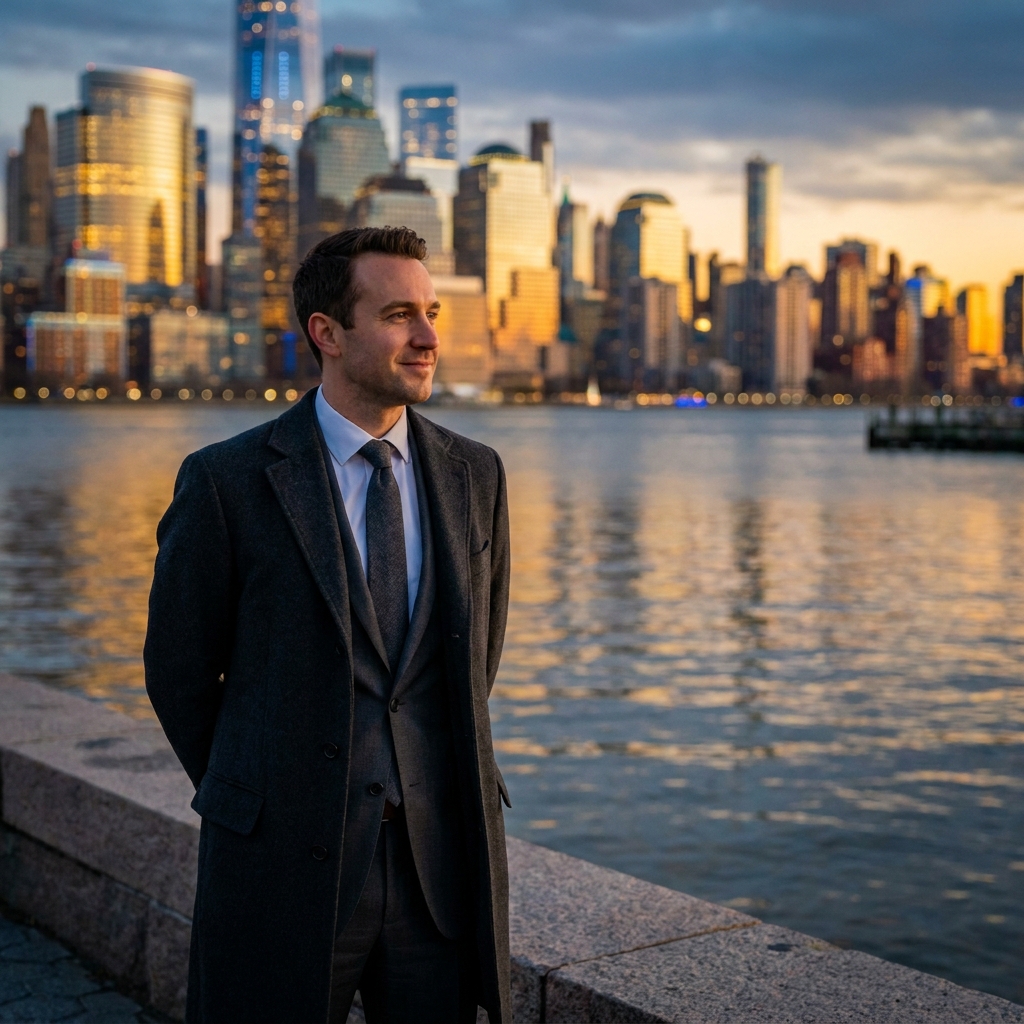
Hair Transplant NJ: Why the Hudson River Is Worth Crossing
Introduction: The Zip-Code Trap That Costs NJ Men Their Hair
Picture a successful New Jersey professional who has finally decided to address his thinning hairline. He opens his phone, types “hair transplant NJ,” and begins scrolling. Within minutes, he has bookmarked the clinic closest to his office, reassured by the short drive and familiar exit number. What he never questions is whether proximity should have been his filter at all.
This is the trap. For a procedure that is permanent, irreversible, and dependent entirely on the skill of the surgeon holding the instruments, choosing a clinic by geography is the equivalent of choosing a cardiac surgeon by commute time. The logic falls apart the moment it is examined.
The stakes are absolute. The maximum lifetime harvestable grafts for most patients is approximately 6,000. Every extraction and every placement is a decision that cannot be undone. There is no revision button, no do-over, no second donor supply waiting in reserve. The first procedure is, functionally, the only one that gets to be right.
Here is the reframe worth considering. A PATH train ride of eight to twenty minutes from Jersey City or Hoboken separates a New Jersey resident from a Madison Avenue surgical team with dual board certifications, more than twenty-five years of specialization, and over 6,000 procedures performed. This article examines the commute logistics, the credential benchmarks that actually predict outcomes, the graft survival data that separates good results from great ones, and the rising repair crisis that makes surgeon selection the single most important decision a patient will make.
Why NJ Men Are Searching, and What the Data Reveals
The scale of the problem is significant. Androgenetic alopecia affects approximately 50 million men in the United States, making it the most prevalent hair loss condition in the country, according to the American Academy of Dermatology and the National Library of Medicine. This is not a fringe concern. It is a majority experience among aging men.
New Jersey specifically registers as a high-concern market. A 2025 study from Innerbody Research identified New Jersey among the top states with the highest hair loss concern, alongside New York, California, and Pennsylvania. This confirms a large, engaged patient population actively searching for solutions.
The demographic picture may surprise many. According to the ISHRS 2025 Practice Census, 95% of first-time hair restoration surgery patients initiated treatment between the ages of 20 and 35. This is not an older man’s problem to defer. It is a career-stage decision made by men in the prime of their professional lives.
The motivation is telling. The same census found that 63% of patients cited “appearing younger to compete in the workplace” as a primary driver. For high-achieving professionals, hair restoration is not vanity. It is a strategic investment in presence, confidence, and competitive standing. The psychological impact of hair transplant on confidence is well-documented among men at this career stage.
Yet the search term “hair transplant NJ” reveals a proximity assumption rather than a quality-first framework. The task now is to separate those two ideas entirely.
The Proximity Heuristic: Why Convenience Is the Wrong Metric
The proximity heuristic is simple to define. When patients do not know how to evaluate surgical quality, they default to the one variable they can easily measure: distance.
The problem is that no other high-stakes surgical decision is made this way. A discerning man in New Jersey does not select his orthopedic surgeon, his cardiologist, or his oncologist based on which town happens to be closest. He seeks the best available specialist, then arranges his logistics around that choice. Hair restoration deserves identical reasoning.
Consider the concept of credential scarcity. Only approximately 274 surgeons worldwide hold Diplomate status from the American Board of Hair Restoration Surgery, and only 83 practice in the United States. Proximity to a clinic tells a patient nothing about whether the surgeon inside is among that elite group. Distance and quality are unrelated variables.
The irreversibility argument seals the case. Unlike a haircut that grows out or a medication that can be discontinued, a hair transplant cannot be undone. Graft placement, hairline design, and donor harvesting are permanent. When the only variable that truly matters is surgeon skill, choosing by zip code means ignoring the one thing that determines the result.
Before evaluating any clinic, in New Jersey or New York, a patient needs a credential framework. The following section provides one.
What Surgical Excellence Actually Looks Like: A Credential Framework
Dual board certification. A surgeon who holds double board certification in facial plastic surgery brings a foundational command of facial anatomy, proportion, and aesthetic harmony. This matters enormously. Hairline design is not merely a technical task of placing follicles; it is an exercise in facial aesthetics. A surgeon trained to understand how features relate to one another designs hairlines that look natural because they respect the architecture of the face.
ABHRS Diplomate status. The American Board of Hair Restoration Surgery is the only specialty-specific board certification for hair restoration in the United States. Candidates must demonstrate training, post-training surgical experience, aesthetic skill, and a comprehensive clinical understanding of hair loss. With so few Diplomates practicing nationally, this credential is a genuine differentiator, not a baseline expectation.
Procedure volume. The average first-time FUE patient requires 2,347 grafts per session, according to the ISHRS 2025 Practice Census. A surgeon who has performed more than 6,000 procedures has navigated millions of individual graft decisions. That depth of pattern recognition cannot be replicated in a newer or lower-volume practice.
Years of exclusive specialization. A surgeon who has spent 18 or more years dedicated exclusively to hair transplantation has a focus that a general dermatologist or cosmetic surgeon offering hair restoration among many services cannot match.
The framework is straightforward. Patients should evaluate board certifications (ideally dual), ABHRS Diplomate status, verifiable procedure volume, and years of dedicated specialization. These are the filters that predict outcomes. A structured hair restoration doctor vetting system can help patients apply these criteria consistently before committing to any provider.
Hair Doctor NYC: The Credential Case for Crossing the Hudson
Hair Doctor NYC, operating as Stoller Medical Group on Madison Avenue in Midtown Manhattan, is not offered here as a geographic alternative. It is the credential-first answer to the framework above.
Dr. Roy B. Stoller is double board-certified and a globally recognized leader in facial plastic surgery and hair restoration. With more than twenty-five years of experience and over 6,000 successful hair transplant procedures performed, he embodies the procedure-volume benchmark that separates mastery from competence.
Dr. Louis Mariotti is a double board-certified facial plastic surgeon specializing in surgical detail and facial harmony. His presence reinforces that hairline design at this practice is informed by deep expertise in facial aesthetics, not extraction technique alone.
Dr. Christopher Pawlinga has spent 18 years dedicated exclusively to hair transplantation. A career entirely focused on a single procedure represents the kind of specialization depth that is exceptionally rare in any market.
Michael Ferranti, P.A., is a licensed scalp micropigmentation specialist with more than twenty-five years in aesthetic dermatology and plastic surgery, ensuring that non-surgical options are delivered with the same credential depth as surgical ones.
The team argument is central to the case. Hair Doctor NYC is not a single-practitioner clinic. It is a multi-surgeon team where every member brings decade-level specialization. The benefits of a hair transplant team-based approach extend across every phase of care, from initial evaluation through final results. That depth is the differentiator, and it is accessible from New Jersey in under thirty minutes.
The Commute Is Not the Barrier You Think It Is
The commute objection deserves a direct answer. The PATH train from Jersey City reaches Midtown Manhattan in roughly eight to twenty minutes. From Hoboken, the trip runs fifteen to twenty minutes. NJ Transit buses from many northern New Jersey towns reach Midtown in under thirty minutes.
Placing that commute in context clarifies the decision. A hair transplant is a single-day procedure. The trip to the consultation is a one-time journey. The trip to the procedure itself is a one-time journey. The total additional travel investment over the entire lifetime of the decision is measured in hours, not days.
Recovery happens at home. Most patients return to normal activity within days of the procedure, and follow-up appointments are infrequent. The Madison Avenue location is not a recurring logistical burden.
The calculus should be reframed plainly. The question is not “Is it worth commuting to New York City?” The question is “Is it worth twenty extra minutes to access a surgical team with credentials that do not exist closer to home?” For a permanent, irreversible procedure, the answer is self-evident.
The premium Manhattan setting is itself a feature. A state-of-the-art clinic on Madison Avenue reflects the investment the practice has made in its facility, equipment, and patient experience, consistent with the level of care a discerning patient should expect.
Graft Survival: The Number That Separates Good Outcomes from Great Ones
Graft survival is the primary clinical outcome metric. It is the percentage of transplanted follicular units that successfully establish blood supply, survive the trauma of extraction and placement, and produce permanent growth.
The benchmark is precise. Graft survival rates at accredited, surgeon-led clinics range from 90% to 97%. This range is not arbitrary. It is a direct function of extraction precision, handling protocol during the procedure, and the accuracy of recipient site creation.
Adjunctive therapy compounds the difference. A 2024 prospective study found that 90% of patients receiving PRP combined with FUE achieved moderate-to-high-density graft survival, compared with 60% for FUE alone. That is a meaningful differential, and it underscores the value of a comprehensive, protocol-driven surgical approach.
Graft survival connects directly to donor management. With a lifetime ceiling of approximately 6,000 harvestable grafts, a surgeon who achieves 90% to 97% survival on the first procedure preserves the patient’s future options. A surgeon who achieves 60% to 70% may require a hair transplant second procedure to correct density, consuming a donor supply that can never be replaced.
The implication is worth stating explicitly. On a 2,500-graft procedure, the difference between a 90% and a 70% survival rate is 500 grafts. Those grafts are gone permanently. Choosing a surgeon based on proximity rather than technique and credential depth carries a measurable, irreversible cost.
The Repair Crisis: What Happens When the First Decision Goes Wrong
The data is alarming. According to the ISHRS 2025 Practice Census, 59% of members reported black-market hair transplant clinics operating in their cities, up from 51% in 2021. Repair cases from unqualified practitioners now account for 10% of all cases seen by qualified surgeons.
The trend is accelerating. Repair procedures rose to 6.9% of all hair transplants in 2024, up from 5.4% in 2021, a 28% relative increase. These are patients who chose a provider, underwent a procedure, and then needed a second surgery to correct the first.
Repair surgery is more complex than a primary procedure. Scar tissue, compromised donor supply, and existing graft placement all constrain the corrective surgeon’s options. The 6,000-graft lifetime limit becomes even more critical when a portion has already been used, or wasted, by an unqualified provider.
The ISHRS has issued a clear consumer alert: only properly trained and licensed physicians should perform preoperative evaluation, surgery planning, donor harvesting, hairline design, and recipient site creation. Unlicensed technicians performing these functions pose serious patient safety risks.
The fragmented, proximity-driven nature of the New Jersey market, where new clinics continue to open and technique marketing often substitutes for credential transparency, creates precisely the conditions the ISHRS warns about. A practice with more than 6,000 procedures, dual board-certified surgeons, and 18 to 25-plus years of specialization is not a repair-risk environment. It is the environment that corrects hair transplant revision cases from other providers.
FUE vs. FUT: Choosing the Right Technique for Your Goals
Technique selection is a clinical decision, not a marketing one. It requires a surgeon with the depth to perform both and the integrity to recommend the right one for each patient’s anatomy, hair loss stage, and goals.
FUE (Follicular Unit Extraction) is minimally invasive, leaves no linear scarring, and is ideal for patients who prefer shorter hairstyles or maintain active lifestyles. FUE now represents approximately 80% of all hair restoration surgeries globally and 85.4% of all male procedures, per the ISHRS 2025 Census. Recovery is quick.
FUT (Follicular Unit Transplantation), the strip method, is designed for maximum graft yield and dense coverage. It is often the preferred technique when a patient requires extensive restoration and donor supply optimization is the primary concern. A detailed FUE vs. FUT donor area comparison can help patients understand how each approach affects long-term options.
Scalp micropigmentation (SMP) offers a complementary non-surgical option. Using medical-grade pigments to create the visual appearance of hair follicles, it is a legitimate, skilled procedure for patients who are not surgical candidates or who wish to enhance density between procedures.
At Hair Doctor NYC, a patient receives a genuine clinical recommendation based on individual presentation, not a sales pitch for whichever technique the clinic has invested in marketing. Delivering that honesty requires a team with the credentials and volume to perform all options at the highest level.
What to Expect: The Hair Doctor NYC Patient Experience
For a New Jersey-based professional, the journey begins with an initial consultation at the Madison Avenue clinic. From there, the team develops a personalized treatment plan, followed by the procedure day and a home-based recovery.
The experience is designed for discerning patients who value privacy. The boutique, state-of-the-art environment on Madison Avenue is built for patients who expect a premium medical experience, not a high-volume processing operation.
The recovery timeline is predictable. Most patients return to normal activity within days. Initial hair growth typically becomes visible at three to six months post-procedure, with full results apparent at twelve months.
The team-based approach matters throughout. Unlike single-practitioner clinics, Hair Doctor NYC’s multi-surgeon structure means every aspect of a case, from hairline design to graft placement to non-surgical adjuncts, is informed by multiple layers of specialized expertise.
The practical reality for the New Jersey patient remains reassuring. The procedure is a single day. Recovery happens at home in New Jersey. Follow-up appointments are infrequent. The Madison Avenue location is not a logistical burden; it is a one-time investment in access to a surgical team that cannot be found closer to home.
How to Vet Any Hair Transplant Surgeon: A Checklist for the Discerning Patient
Regardless of which clinic a patient ultimately chooses, these are the questions every serious candidate should ask.
- Board certification. Is the surgeon board-certified, ideally dual board-certified? In what specialty? A facial plastic surgery background is directly relevant to hairline design and aesthetic outcomes.
- ABHRS Diplomate status. Does the surgeon hold ABHRS Diplomate certification? With only about 83 Diplomates practicing in the United States, this credential is a meaningful differentiator.
- Verifiable procedure volume. How many procedures has the surgeon personally performed? Ask for a specific number. More than 6,000 represents genuine mastery.
- Years of dedicated specialization. Is hair restoration the surgeon’s primary or exclusive focus? An 18-plus-year specialist has pattern recognition a generalist cannot replicate.
- Who performs the surgery. Will the board-certified surgeon personally perform extraction, hairline design, and recipient site creation, or will these be delegated to unlicensed technicians? The ISHRS is explicit that only licensed physicians should perform these functions. Understanding hair transplant surgical team experience is essential before committing to any provider.
- Repair case experience. Has the surgeon corrected failed procedures from other clinics? This signals both technical depth and the ethical standing to acknowledge when other providers have failed patients.
Conclusion: The Best Hair Transplant in NJ Might Not Be in NJ
The proximity heuristic is a reasonable way to choose a dry cleaner. It is not a reasonable framework for choosing a surgeon who will make permanent, irreversible decisions about a man’s appearance.
The credential case is clear. Dual board-certified surgeons, more than twenty-five years of specialization, over 6,000 procedures performed, and eighteen years of exclusive focus on hair transplantation: this is the team on Madison Avenue, accessible from most New Jersey towns in under thirty minutes.
With a lifetime donor supply of approximately 6,000 grafts, there is no second chance to make the first procedure right. The surgeon who performs it matters far more than the state in which he practices.
Ready to Make a Quality-First Decision? Schedule Your Consultation at Hair Doctor NYC
New Jersey residents ready to prioritize outcome over zip code are invited to schedule a personalized consultation at Hair Doctor NYC’s Madison Avenue clinic. The PATH train and NJ Transit make the trip straightforward, and the consultation is the single most important step in determining candidacy, graft requirements, and the right technique for each patient’s goals.
This is not a sales appointment. It is a clinical evaluation with a board-certified surgical team that has performed over 6,000 procedures and will provide an honest, expert assessment of what is achievable.
The depth of expertise available, Dr. Roy B. Stoller, Dr. Louis Mariotti, Dr. Christopher Pawlinga, and Michael Ferranti, P.A., is simply not available closer to home.
Visit hairdoctornyc.com to book a consultation.